



Junkers Ju 88
Country: Germany
Period of activity: 1939
Crew : 4 members
Dimensions: 20 m. breadth; 14,4 m. length;
4,85 m. height
W eigh: 9.860 kg. In emptiness; 14.000 kg. Maximum in takeoff
Autonomy: 2.730 km.
Engine: Two Junkers 211J-1/2, 12 cylinders, 1.340 CV
Speed: 470 km/h. maxim; 23' raise to 5.400 m.; 8.200 m. service's roof
Armament: Two machine guns of 13 mm. And 3 of 7,9 mm.; 2.500 kg. of bombs
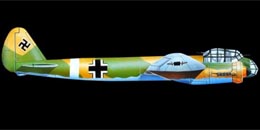
It entered in service at 1939, knowing along the contest different versions. Of the first ones, the most important it was Ju 88A, with variations that were going up to the Ju 88A-17, that was developing improvements in the engines and the operative capacity. Of the series Ju 88A were made 7.000 devices, while of the Ju 88D, with great radius of action, 1.450 were made. A specific variant for missions of recognition was Ju 88H, that was provided with engines BMW 801 in star capable of developing 1.700 CV. Other one was Ju 88S, a bombardier of great speed with engines as in star as in V BMW 801G, 1.700 CV, of which three sub variants went out of factory. Of Ju 88 S derived Ju 88T, for missions of recognition. Of the series H, S and T there was made a whole of 550 units. Of Ju 88A developed C, heavy bombardier, with an engine BMW 801A, that derived finally in the night fighter Ju 88G.
Ju 88 can be considered the equivalent German of the British "Mosquito" and one of the devices most versatile and qualified of the II World war. Used along the whole war, its production was about all 15.000 units. Projected as bombardier of high speed, its first flight was realized in December 1936, with engines Daimler-Benz DB 600A that were developing 1.000 CV of power. Later, two Junkers 211J-1/2, of 12 cylinders and 1.340 CV replaced the original engines.
