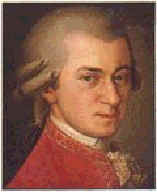
Wolfgang Amadeus Mozart
The
youngest child and only surviving son of the Austrian composer Leopold Mozart, Wolfgang
Amadeus received his early musical training from his father.
His musical talent was evident from infancy and he is now regarded as one of the greatest musical geniuses.
When
Wolfgang he was six years old, he and his gifted elder sister, Nannerl, were taken by
their father, on the first of a long series of concert tours, to all the royal courts of
Europe where they delighted audiences with virtuosotic performances on the harpsichord.
Of
all the stopping places on Mozart’s tours it was operatic Italy that gave him the
greatest pleasure and recognition.
The
following period proved disappointing to both father and son.
As
the young Mozart grew to manhood his popularity waned and he had difficulty finding
employment, but the sense of his own worth carried him past the danger point.
He
was eventually given a position as court and cathedral organist in the household of the
Archbishop of Salzburg.
Early
in 1781 he had a commissioned opera, "Idomeneo", staged in Munich for the
Elector of Bavaria.
Its
success induced him to go to Vienna where, for a while, he found moderate favour with the
nobility.
He
spent the last ten years of his life in precarious independence in Vienna, worsened by his
ill-advised marriage to the frivolous singer Costanze Weber.
Initial
success with German and then Italian opera and a number of subscription concerts were
followed by financial difficulties.
These
did not effect his music, but in the end they destroyed him physically; he became
seriously ill and died a pauper early in the morning on 5th December: he was buried in a
common, unmarked grave in Vienna.
Mozart's compositions were catalogued in the 19th century by Köchel, and they are generally now distinguished by K. numbering from this catalogue.
Others
are classified as Op, or Opus.
Some of his most famous works are:
Eine Kleine Nachtmusik (Pequeña música nocturna) (1er mov).
"Le nozze di Figaro"(The Marriage of Figaro): Overture
"Zauberflöte"(The Magic Flute): Die Königin der Nacht

 Baroque
Classical
Romantic
Modern
Baroque
Classical
Romantic
Modern