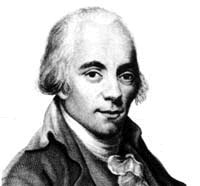
Muzio Clementi
Muzio Clementi was born in Roma, in 1752. His
father was a silversmith, and became aware of his son's musical talent at a young age.
When he was seven, Clementi was sent to musical instruction. He
was so good a pupil that two years later he gained a position as an organist.
In
England, Clementi received an excellent education in music and academics. In 1770, Clementi made his first performance on the piano.
His
audience was greatly taken with his playing, and this was the beginning of a incredible
successful career as a concert pianist.
Clementi
started a European tour in 1781, when he travelled to France, Deutschland, and
Österreich.
In
Vindabona, Clementi was asked by the Emperor Joseph II to enter a musical duel withMozart.
Clementi
performed a piece of his own composition, a piano sonata in B-flat major, Mozart performed
a dazzling series of variations.
Starting
in 1782, for the next twenty years Clementi stayed in England playing piano, conducting,
and teaching.
He
had two pupils in particular that achieved great fame themselves: J.B. Cramer and John
Field.
In
1810 Clementi ceased his concerts to devote all of his time to composition and piano
construction.
He
spent his final, uneventful years in Evesham, where he died on March 10, 1832,
and was buried at Westminster Abbey.
Some of his most famous works are:
"Gradus ad Parnassum": Study No. 2
"Gradus ad Parnassum": Study No. 9
Gradus ad Parnassum: Study No.16
 Home
Home