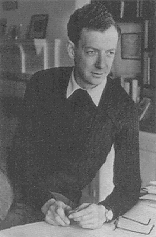
Benjamin Britten
Benjamin
Britten was born at Lowestoft, 22 November 1913, and died at Aldeburgh, 4 December 1976.
He
studied with Frank Bridge as a boy and in 1930 entered the RCM.
In
1934 he heard Wozzeck and planned to study with Schoenburg, but opposition at home stopped
him.
Stravinsky
and Mahler were important influences, but Britten's effortless technique gave his early
music a high personal definition, notably shown in orchestral works (Bridge Variations for
strings, 1937; Piano Concerto, 1938; Violin Concerto, 1939) and songs (Les illuminations,
setting Rimbaud for high voice and strings, 1939).
In
1939 he left England for the USA, with his lifelong companion Peter Pears; there he wrote
his first opera, to Auden's libretto (Paul Bunyan, 1941).
In
1942 he returned and, partly stimulated by Purcell, began to concentrate on settings of
English verse (anthem Rejoice in the Lamb and Serenade for tenor, horn and strings, both
1943).
His
String Quartet no.2 (1945), with its huge concluding chaconne, also came out of his
Purcellian interests, but the major work of this period was Peter Grimes (1945), which
signalled a new beginning in English opera.
His
next operas were all written for comparatively small resources (The Rape of
Lucretia,
1946; Albert Herring, 1947; a version of The Beggar's Opera 1948; The Little Sweep, 1949),
for the company that became established as the English Opera Group.
Britten
was appointed a Companion of Honour in 1952, to the Order of Merit in 1965, and was
awarded a life peerage in 1976.
Some of his most famous works are:
War Requiem
Cello Symphony
 Baroque
Classical
Romantic
Modern
Baroque
Classical
Romantic
Modern
