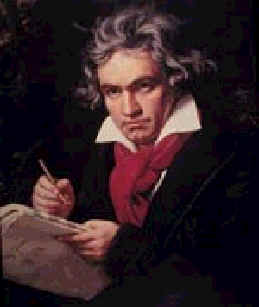
Ludwig van Beethoven
The
eldest son of a singer in the Kapelle of the Archbishop-Elector of Cologne and grandson of
the Archbishop's Kapellmeister.
Beethoven
settled in Vienna in 1792, where he studied with Joseph Haydn and others, quickly
establishing himself as a remarkable keyboard-player and original composer.
By 1815 he realised he was losing his hearing and had to give up concert work. Because of his deafness, he shunned away from mankind, and was, thus called rude and alienated.
His
deafness accentuated existing eccentricities in his character and gave him a reputation as
a Menschenhasser, a "misanthropist", but he was nevertheless patiently tolerated
by a number of rich patrons and his royal pupil the Archduke Rudolph. Once,he refused
Countess Thun, who was begging him to play a piece on the floor, while he was sitting on
the sofa.
The
length and complexity of Beethoven’s compositions as he explored new fields of music
made heavy demands on his listeners and his works often sounded strange to the ears of his
contempories.
His
significance in music history was immense and he had a great influence on later
generations of composers.
Some of his most famous works are:
Symphony No. 5 (The 'C minor'): Allegro con brio
"Moonlight Sonate" op.27 n.2: 1th mov.
Allegro ma non troppo un poco maestoso
 Baroque
Classical
Romantic
Modern
Baroque
Classical
Romantic
Modern