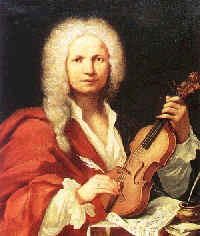
Antonio Vivaldi
Vivaldi, Antonio (1678-1741), Italian composer and violinist, the most influential of his age. Vivaldi was born March 4, 1678, in Venice, and was trained by his father, a violinist at Saint Mark's Cathedral.
Vivaldi was a master violinist and continually dazzled the patrons of the Ospedale with his wild bowing. A colorful account by the German traveler Johann Friedrich Armand von Uffenbach sums up Vivaldi's mastery very well. "Vivaldi played a solo accompaniment-- splendid-- to which he appended a cadenza which really frightened me, for such playing has never been nor can be: he brought his fingers up to only a straw's distance from the bridge, leaving no room for the bow-- and that on all four strings with imitations and incredible speed."
Ordained a priest in 1703, Vivaldi began teaching that year at the Ospedale della Pietà, a conservatory for orphaned girls.
He was associated with the Pietà, usually as music director, until 1740, training the students, composing concertos and oratorios for weekly concerts, and meanwhile establishing an international reputation.
His star opera soprano Anna Giraud, who played the lead in his operas starting with Farnace. She was 16 or 17 years old and Vivaldi was already 48 when they met. She and her sister Paolina lived at Vivaldi's house and became his traveling partners, accompanying him on his excursions all over Europe for many years. Vivaldi said the sisters provided much needed health care for the ailing composer, whose asthma severely hindered his priestly duties (without, apparently, affecting his abilities to travel, perform, teach, compose prolifically, or manage an opera house.) It is no surprise that historians were putting two and two together to make love.
From 1713 on, Vivaldi was also active as an opera composer and producer in Venice and traveled to Rome, Mantua, and elsewhere to oversee performances of his operas. In about 1740 he accepted a position at the court of Emperor Charles VI in Vienna.
He
died in Vienna on July 28, 1741.
Over 500 Vivaldi concerti exists today, as well as 40 cantatas, 22 operas, and more than 60 sacred works, and there were many more that have not survived (or been discovered.)
Some of his most famous works are:
The 'Four Seasons' (Winter-Allegro)
 Baroque
Classical
Romantic
Modern
Baroque
Classical
Romantic
Modern