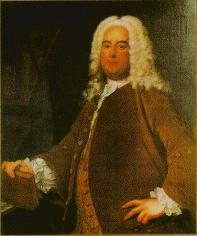
The son of a surgeon who was unwilling to allow him a musical education,
Handel studied law at the University of Halle before moving to Hamburg when his father
died in 1703.
He
served as second violinist in the Hamburg Opera Orchestra and subsequently as
harpsichordist and composer.
From
1706 until 1710 he was in Italy, where he soon mastered the Italian musical styles and
techniques and where he met Scarlatti in Rome.
Then
he was appointed kapellmeister to the court of the Elector of Hanover and, in the same
year, he visited London where his opera "Rinaldo" enjoyed great success.
He
liked England so much he settled there permantly two years later and in 1726 became a
naturalised English citizen.
When
his former patron, the Elector of Hanover, became King George I of England, he won favour
with the court and was given a life pension.
He
wrote and produced dozens of operas for various English companies in which he had a
financial stake.
The
decline of the Italian operatic style left Handel bankrupt and to extricate himself he
began to compose oratorias with English texts.
These
reflected the fullness and richness of the opera seria style, but released him from the
restrictions of the genre and appealed more to English Protestant sensibilities.
During
the last years of his life he was nearly blind, but he continued to conduct performances
of his works and revise some of his scores.
He died in London and was buried in Westminster Abbey in the presence of some 3000 mourners.
Some of his most famous works are:
The Royal Fireworks Suite (Excerpt)
 Baroque
Classical
RomanticModern
Baroque
Classical
RomanticModern