|
a live-in exhibition of the art of ChangHan Kim |
|
|
|
a live-in exhibition of the art of ChangHan Kim |
|
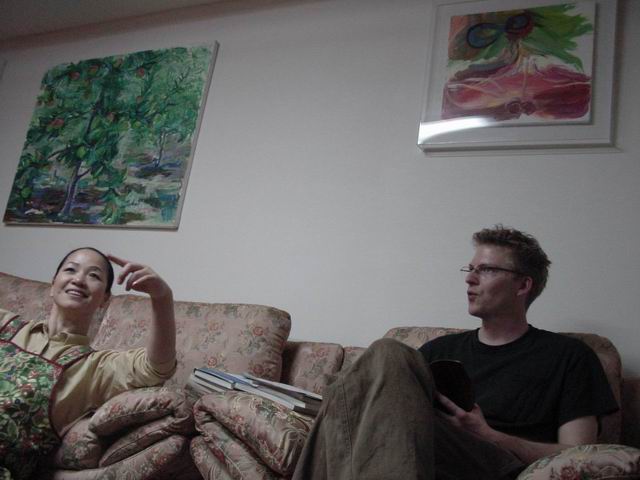
Travelling with ChangHan Kim to Seoul in early spring, I am invited to the home of MiRyeong Park and KyuSoo Kim. They have filled the walls of their new and ample AnYang apartment with ChangHan's artwork, acquired after his solo exhibition in Ulsan late last year. In their collection are many recent paintings which I have seen only in photographs. As we make the long drive north, I am eager to view them directly.
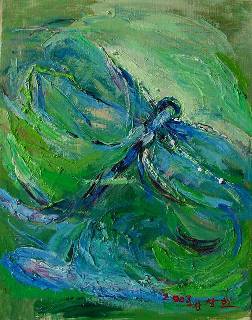
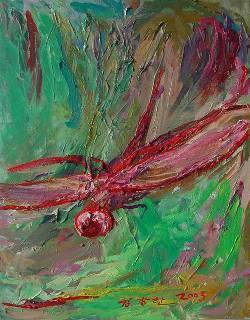
MiRyeong welcomes us in from a damp and windy afternoon, serving steaming bowls of pumpkin pudding. Hovering over the dining room table as we eat are two of ChangHan's dragonflies. It is a set of two small paintings -- one rendered in icy blue, the other in burning pink. Each piece is complete and striking on its own, yet hanging them together has created a much more powerful effect: the complementary curves of the figures in flight describe a circle -- a cycle -- simple, elegant, simultaneously reassuring and compelling.
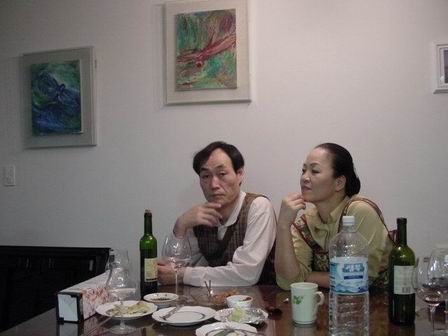
Beneath this yin and yang of dragonflies and between spoonfuls of scrumptious pudding, I introduce myself: an American living and teaching on Jeju Island, a friend of ChangHan's and a longtime admirer of his work. The conversation turns to the paintings, and soon MiRyeong is leading us into the hall to point out her favorites: a set of three landscapes painted by ChangHan on the grounds of his father's apple orchard near Youngju.
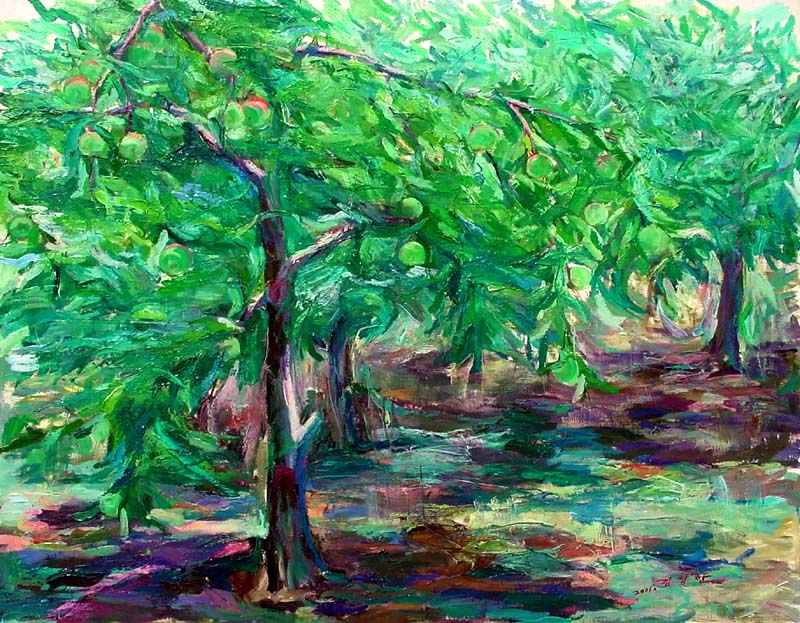
The first of the set is a sweep of green: early apples in a row of sprawling trees; broad, ambitious brushstrokes on a large canvas; subtle browns below, with white and palest blue filtering in from above. The next painting down the hallway is a smaller piece: detail of a ripening bough, the fruit blushing and pendulous. As we enjoy the images, our hostess explains that she spent her girlhood in a similar orchard, and finds in these works the power to awaken enchanting nostalgia and a hopeful attitude toward the future.
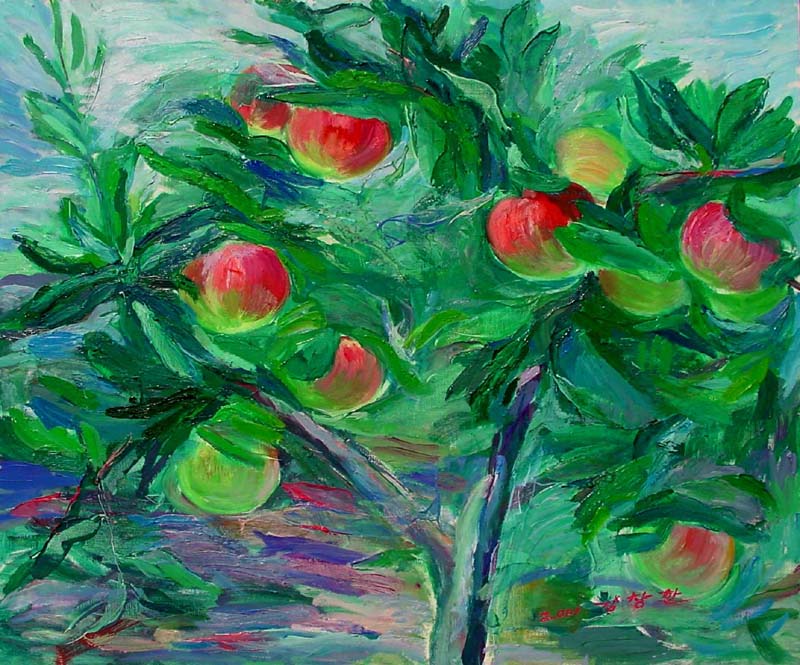
The third painting of MiRyeong's favorite set hangs above the sofa in the living room. Like the first, it is large and lavish. Here we see the crop just before harvest time. Branches bow with the weight of reddening apples. Deep blues and a drowsy maroon shadow the ground, executed in thick swells and ridges of oil which weigh heavily below the sparing brushwork of the trees' foliage, where patches of untouched canvas, gesso-white, lend a light-as-air feel to the canopy of the grove.
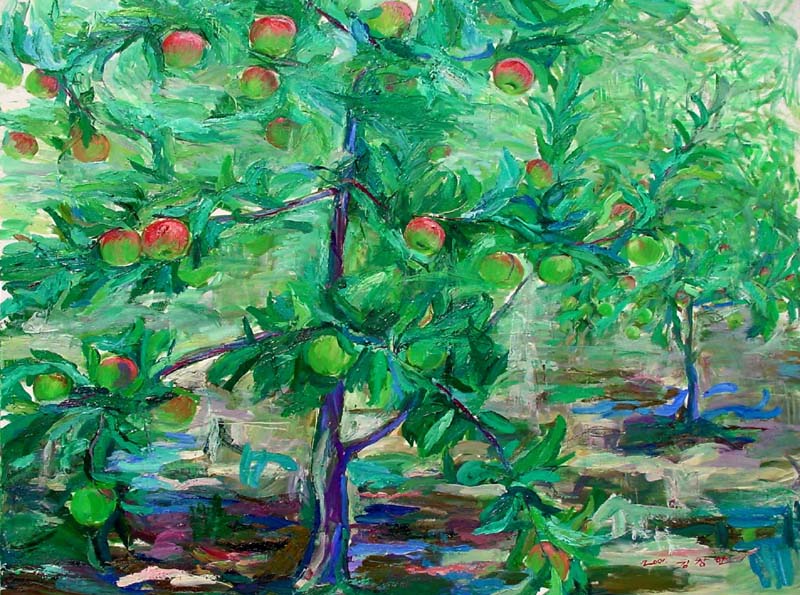
Following this series from the entryway into the living room of the home gives me a pleasant sense of health and growth. Painted in 2001, these works were a return to familiar ground for ChangHan in more ways than one. He had painted the orchards also in the mid 90's, creating a body of work much more realistic and somber than this more recent series. These later works are far brighter by comparison and more liberal -- a step away from grim realism toward a more light-hearted, impressionistic treatment: from Corot toward Van Gogh. For me, as for MiRyeong, the later works are comforting and invigorating.
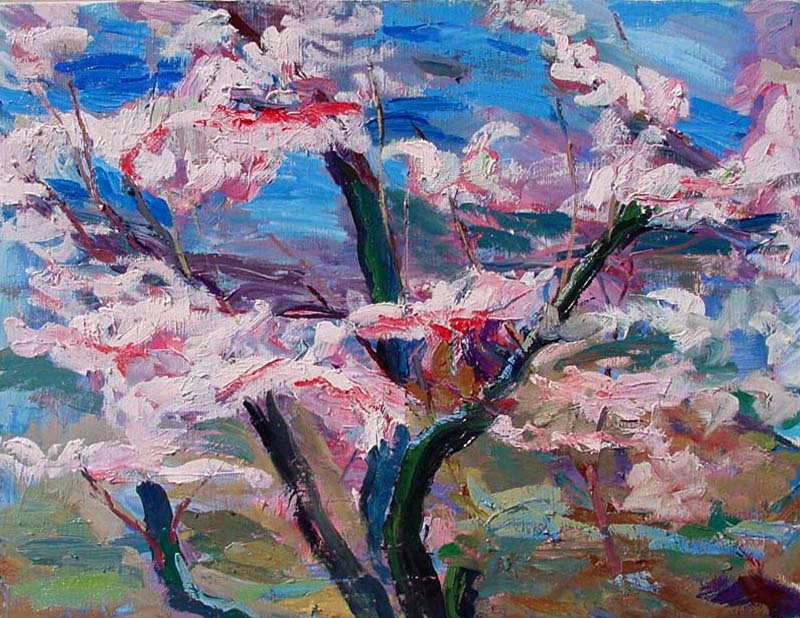
Of the thirteen Kim paintings in this collection, KyuSoo favors a study of cherry blossoms which is positioned opposite the living room sofa. A blaze of red burning through wintery white creates the brilliant pink of this smaller piece from 2003. The purpled grey of aged trunks works against the tenderness of spring's first blossoms, forging a harmony which KyuSoo finds exuberent and inspiring. Alongside this study is a larger piece from 2003, a wash of lake and sky in which two dragonflies rendezvous under a fluid moon. MiRyeong and KyuSoo enjoy the muted blues and browns of this piece as a welcome calm in their busy lives.
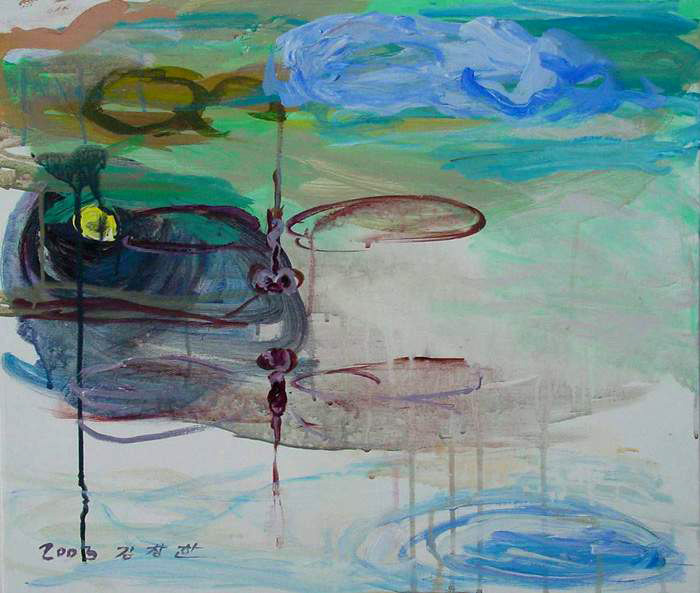
Another 2003 nightscape hangs in the hall at the door to the master bedroom, and for me it is the most lyrical and haunting of the collection. Violet night swept with grey and alive with deep greens and reds, cloaking a ridgeline of distant mountains, is the setting for the meeting of these two dragonflies. Their spiralling chase sends my eye eddying along the raw, unprimed canvas, where strong lines of reed and weed draw me back to the center.
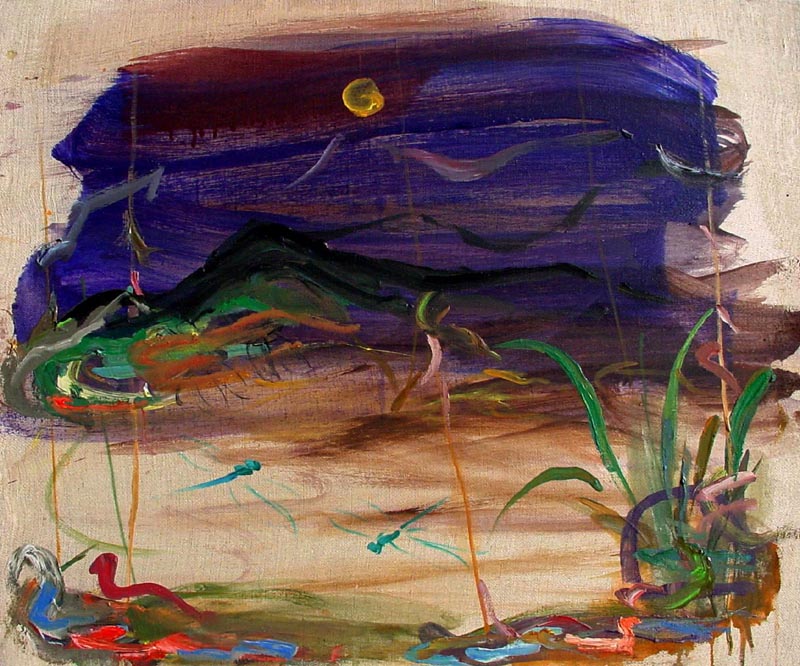
Dynamic and resonant with primal patterns, this painting is a product of what ChangHan sometimes refers to as his dreaming mind. The scene recalls the region near Ulsan where he lives, yet returns those familiar surroundings to a primitive, perhaps prehistoric period. The dragonflies shine an eerie turquoise under a dusky, golden moon. Ephemeral, unknowable, they are utterly free in unadulterated nature, a state of grace achingly alien to modernity.
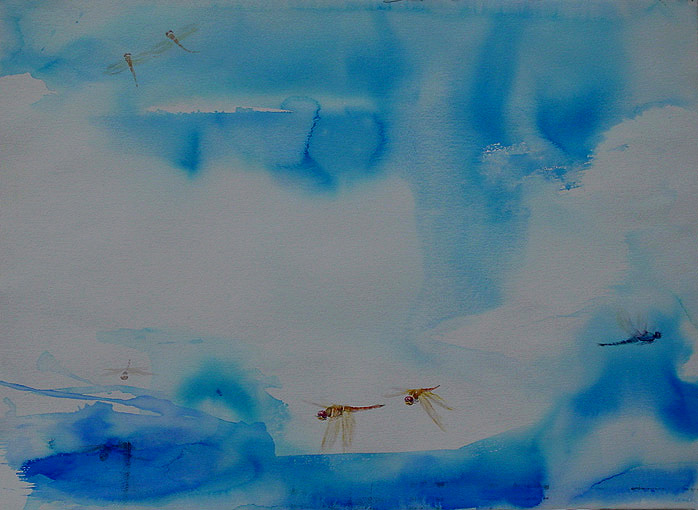
Within the master bedroom is a large watercolor from the year 2000. Here we see several dragonflies flitting individually and in pairs through currents of textured blue and frosted white. The watercolor dragonflies are magically articulate and detailed. Vibrant color courses through their segmented bodies and plays like light upon their skin. It is a piece that would be whimsical but for the illustrative precision which sharpens it to a snapshot of a dream.
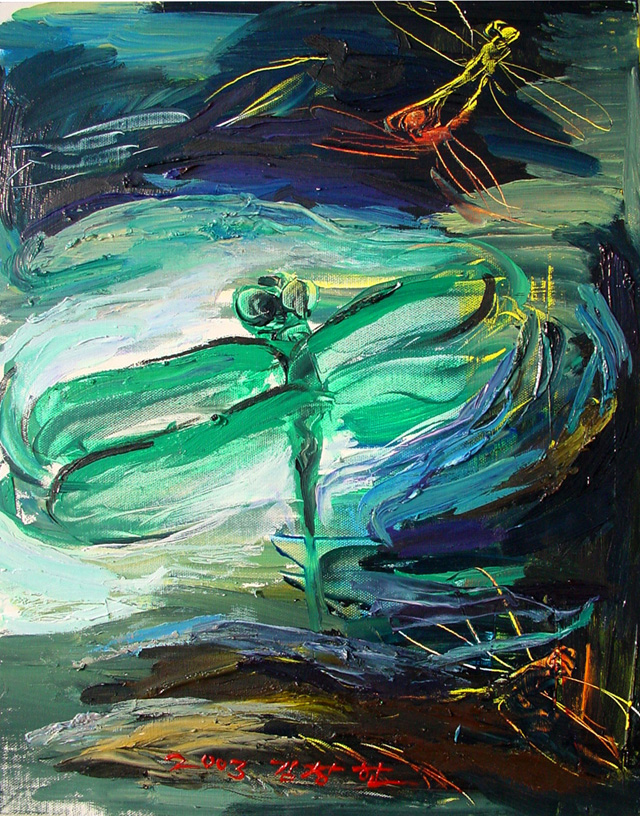
Also in the master suite is a darker study in oils. Into a thick night, ChangHan has knifed the fine-lined figures of yellow and orange dragonflies coupled in coitus. This Chagall-like skyscape is presided over by a regal, glowingly green creature, her double sets of wings clearly defined as she climbs through the foreground. To me, she is queen of the dragonflies. She brightens the room as she brightens my mood.
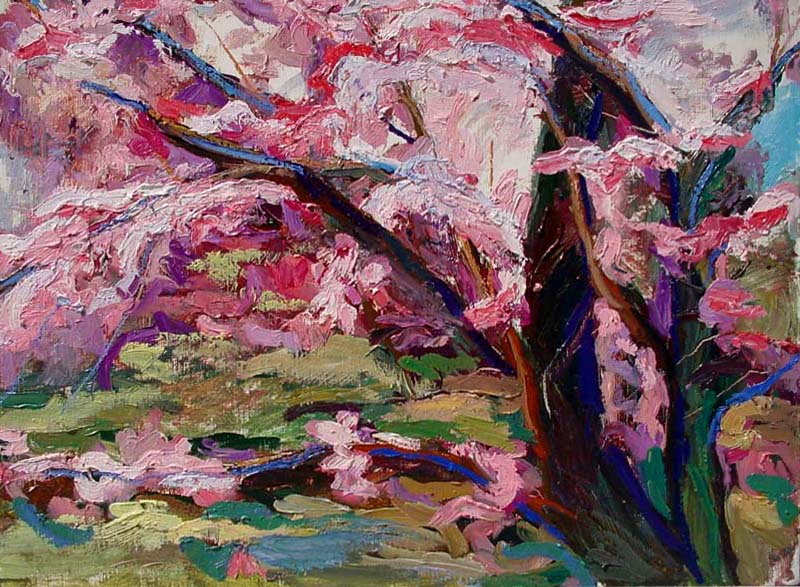
I pass a restful night in a guest bedroom attended by the portrait of a lone cherry tree. From the 2003 series, this painting possesses the enthusiasm and liberty of that in the living room, yet I feel it maintains a hint of reserve, a stately dignity. Its presence lends a certain refinement to the room.
In the morning, I return to the living room to sip peach tea beneath what is easily the most abstracted painting of the collection. Bold, thick lines sugest two dragonflies, but in such close focus that the muted red tones of their heads dominate the canvas. Gossamer wing shapes are visible in the oranges and greens describing their flight. Perhaps they are joined, yet granted a veil of pivacy by the abstraction of their forms.
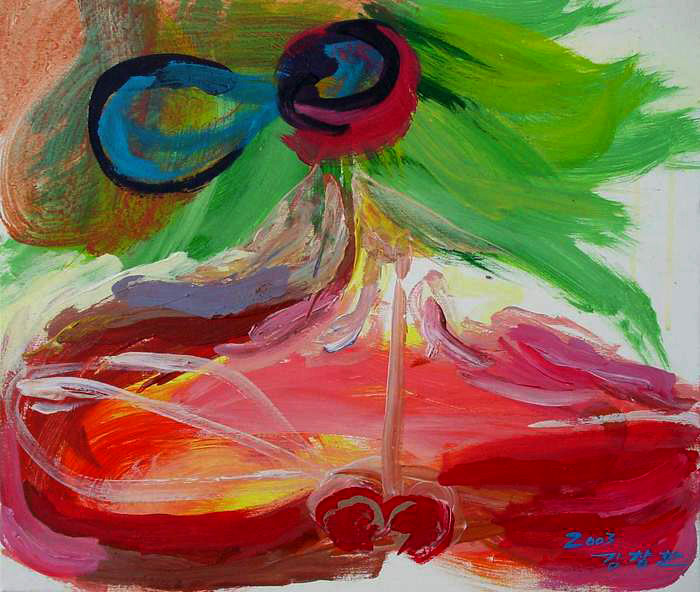
On the balcony, a similar swirl of lines has been drawn by a fingertip in the dewy condensation on the outer window. It seems to say, 'ChangHan was here.' Certainly, there is a sense of his signiture in the dragonfly, like the 'tag' glyph left by graffiti artists to mark their passing in a public space. In the years which he has devoted to this figure, ChangHan has become the dragonfly, his identity merging with the natural sovereignty he sees in the captivating creature.
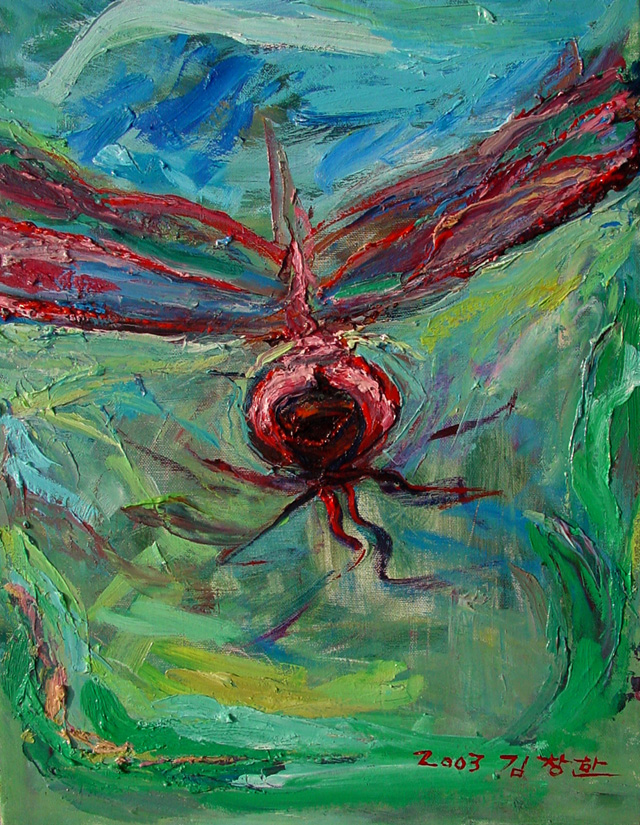
In the apartment's back bedroom, I find the final painting of my home-gallery tour. In this aggressive work, a blood-red dragonfly dives outward from the center of the canvas, pulling forward a wake of purple and green vectors. Questing limbs stretch from the arched undercarriage of the creature, as if he is aware of the viewer and eager to make contact. It is easy for me to imagine this winged mystery escaping the oils to alight on my shoulder, or reaching out to drag me into the world of the painting.
It has been compelling and heartwarming to see this collection communicating with a living space. ChangHan's work breathes nature into this otherwise urban environment. The vibrant color of the paintings accentuates the apartment's decor, and their intimations of seasonal cycles, maturation and sensuality, nostalgia and optimism, create a dignified and thought-provoking atmosphere. As we depart, I feel great gratitude for the hospitality I have been shown by the fortunate owners of these works. I am honored that they have shared with me both their home and their art.
Daniel Julian
February, 2004