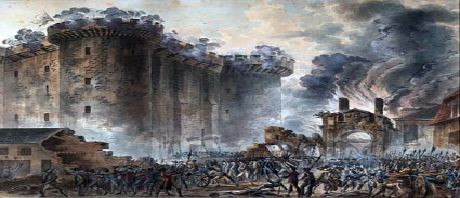

Half past three on July 14, 1789. A huge, bloodthirsty mob marched to the Bastille, searching for gun powder and prisoners that had been taken by the unpopular and detested King, Louis XVI. Even elements of the newly formed National Guard were present at the assault. The flying rumors of attacks from the government and the biting truth of starvation were just too much for the angry crowds. The Bastille had been prepared for over a week, anticipating about a hundred angry subjects. But nothing could have prepared the defenders for what they met that now famous day. Along the thick rock walls of the gargantuan fortress and between the towers were twelve more guns that were capable of launching 24-ounce case shots at any who dared to attack. However, the enraged Paris Commune was too defiant and too livid to submit to the starvation and seeming injustice of their government.
The Bastille was governed by a man named de Launay. On July 7th,thirty-two
Swiss soldiers led by Lieutenant Deflue, came to aid de
Launay, helping him
to prepare for a small mob. Rumors were flying
everywhere. De Launay
was expecting a mob attack, but certainly not a siege! The entire workforce
of the Bastille had stealthily and furiously been repairing the Bastille
and reinforcing it, all to prepare for a minor attack from a hundred or
so angry citizens. At three o'clock that afternoon, however, a huge group
of French guards and angry citizens tried to break into the fortress. There
were over three hundred people ready to give their lives to put an end
to their overtaxing and overbearing government. However the Bastille was
threatened by more than the numerous crowds: three hundred guards had left
their posts earlier that day, out of fear and from the rumors. The besiegers
easily broke into the Arsenal and into the first courtyard, cut the drawbridge
down, and then quickly got through the wooden door behind it. They boldly
demanded that the bridges be lowered, but they were refused. The Marquis
de Launay said he would surrender if his troops were allowed to leave peacefully,
but he was simply rebuked. They wanted de Launay on a noose or with his
head in a basket.
The vicious crowds shouted for him to lower the bridges. De Launay sent a note to a mob leader named Hulin, claiming that he had 20,000 pounds of gunpowder and if the besiegers did not accept his offer, he would annihilate the entire fortress, the garrison, and everyone in it! Yet they still refused. The bridges were finally lowered on de Launay's command, and he and his soldiers were captured by the crowds an dragged through the filthy streets of Paris.
The mob paraded through the streets, showing off their captives, and crudely
cutting off many heads. The National Guard tried to stop the crowds
from looting, but it was useless. They continued marching on, making their
way to the Hotel de Ville. Upon learning that the Bastille had been taken,
King Louis XVI, who was residing at Versailles, was reported to have asked
an informer: "Is this a revolt?" and La Rochefoucauld-Liancourt said, "No,
Sire, it is a revolution."1 Little did Louis know that the mob's next plan
was to march to Versailles, take him away with them.