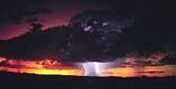
Lightning
Lightning
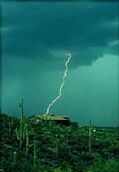
Lightning Facts
Florida is the
lightning capital of the United States.
Lightning bolts travel at
speeds of up to 60,000 miles per second.
A single lightning bolt
travels through twisted paths in the air that can be as wide as one of your fingers or
from six to ten miles.
A flash of lightning is
brighter than 10,000,000 100-watt light bulbs.
A flash of lightning can
pulse as much power as there is in all the power plants in the United States in that split
second.
A flash of lightning
could power a light bulb for a month.
Trees sometimes can
survive direct hits from lightning because the electricity passes over their wet surface
and go into the ground.
10% of all people struck
by lightning were in Florida at the time.
In March of 1991, a
single six hour storm stretching over Iowa, Illinois, Wisconsin, and Missouri caused more
than 15,000 lightning strikes. During the storm the skies were blazed
with almost constant lightning.
Lightning can be made in
a laboratory by an instrument called a Van de Graaff static electricity generator which
could generate million of volts of artificial lightning from a metal sphere mounted at the
top of an insulated column.
About 71.4286% of all
people struck by lightning still survive.
Temperatures in the path
of a lightning bolt can reach as high as 50,000 degrees Fahrenheit.
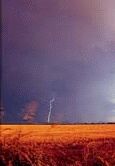
HOW LIGHTNING FORMS
Ice crystals and raindrops move violently
in storm clouds.
Because of the motion, electric charges
build up at the bottom of a cloud. An opposite electric charge builds up in the ground
just under the cloud.
Small streamers of sparks called stepped
leaders begin to shoot downward in 50-yard leaps, starting in the cloud.
As the leaders approach the ground, they
meet upward leaders from the ground. The upward leaders most likely come from high places
like treetops and tall buildings.
When the two streamers meet, their paths
form a channel and a lightning bolt is born. Even though this kind of lightning seems to
shoot down from the clouds, what we actually see is the return stroke of electricity
flashing upward from the ground.
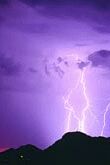
KINDS OF LIGHTNING
Intracloud lightning - One of the main
kinds of lightning and it is the most common one. It occurs when lightning arcs between
oppositely charged centers within the same cloud.
Cloud-to-ground lightning -
Also one of the main kinds of lightning. It is the most dangerous form of lightning and
the kind we know most about.
Intercloud lightning - Another
one of the main kinds of lightning. It occurs when lightning leaps across a gap of clear
air between two different clouds.
Heat lightning - It occurs when it's hot.
Summer lightning - It occurs in
the summer.
Sheet lightning - It seems to
come in flat waves.
Ribbon lightning - It looks
like streamers flashing through the sky.
Silent lightning - It appears
without a sound because it is so far away.
Colored lightning - It seems to
flash red or blue.
Ball lightning - It is a bright
round spark that seems to float in the air.
Elves - In the summer of 1995
this form of lightning was discovered by scientists. Elves are very bright, short flashes
of lightning high above the clouds at the very edge of space. They last for less than a
thousandth of a second. Their color is unknown but is thought to be green.
Jets - Another recently
discovered high-altitude lightning. Jets are fast-moving fountains or sprays of blue light
that burst upward from the top of storm clouds to an altitude of about twenty miles above
the clouds. Pilots have reported seeing columns of blue or green light above thunderheads
for years, but have only recently been videotaped.
Sprites - A
recently discovered kind of lightning. One of the first true-color pictures of a red
sprite was photographed at an altitude of sixty miles over a thunderstorm in the Midwest
in July of 1994.
Fulgurites - Lightning sometimes strikes
the ground and tunnels downward into the ground. The intense heat of the electricity
causes the sand particles to come togehter of the shape of the bolt's path. The resulting
tubular crust is called a fulgurite, after the Latin word for lightning. Some fulgurites
are longer than ten feet.