White IbisTop
The White Ibis breeds in the coastal region of Virginia, south and
west to Louisiana, including inland S. Carolina through Florida. It also breeds along the
entire coast of Mexico, Belize, Nicaragua, Cuba, Jamaica, Panama, and Costa Rica. Their
non-breeding range extends only slightly deeper into inland Louisiana, Georgia, and S.
Carolina. Top
Physical Characteristics
Resembling the Great Blue Heron in body shape, the White Ibis is a
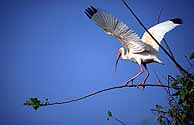
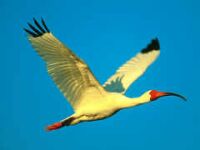
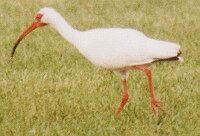
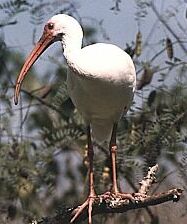
medium-sized wading bird. Its feathers are entirely white, except for its dark wing tips.
The face of the ibis is bare and pink, blending into its long, curved bill, which is brown
at the tip. It has long pink legs, which end with webbed toes. The adults eyes are light
blue. Top
Food Habits
Using its long decurved bill and long neck, the White Ibis probes the
surface of its wetland habitat for aquatic crustaceans (such as crayfish and crabs) and
insects. It washes the mud from its prey in the surrounding water, then swallows it with a
quick, upward thrust of the neck and head. White Ibises tend to feed in large groups. They
fly with this group to and from their feeding location. Top
Reproduction
Pair formation in ibises tends to depend on the amount of rain,
light, and available food rather than occurring at a set time every year. Nest building,
however, tends to fall between May and early June. Colonies begin with the roost sites of
males, who form a sort of daytime bachelor party. The females then come and build the
nests nearby. Nests are built in live or dead woody plants, usually in branch crotches. On
average, 2-3 eggs are laid. Both the male and female incubate, and the eggs hatch about 21
days after incubation begins. The nestlings are born with their eyes closed and cannot
stand, preferring to sleep for the first week of life. They are easily overheated, so both
parents make sure to keep them guarded from the sun with their wings. After about 40-50
days of care from the parents, the fledgling ibises first leave the colony. They do not
leave permanently until they are at least 79% the adult mass, which takes about two years
to achieve. Top
Behavior
The White Ibis walks slowly while foraging, occasionally leaping over
others in their flock as it moves across its feeding grounds. White Ibises are highly
sociable, nesting, feeding, roosting, and flying in flocks. In spite of this, ibises
defend their small nesting territory and mate agressively. They do this by jabbing and
biting at rivals, as well as holding their opponent's wing or head in their bill. Top
Habitat
Barriers, marshes, spoil islands on the coast, and islands in inland
lakes are the preferred nesting sites for the White Ibis. These sites are in interior and
coastal wetlands, in environments ranging from southeastern mixed forest to outer coastal
plain forest, savanna, prairie parkland, and prairie bushland. Feeding habitats include
sedge marshes, cypress swamps, salt marshes, and mangrove swamps. Top
Importance for Humans
Positive:
White Ibis was hunted as game throughout its range. Its appealing taste is thought to
originate from its crustacean diet. Top
Negative:
In Louisiana, White Ibises are considered a threat to commercial crayfish farmers and are
sometimes shot as vermin. Top
Threats
The main threat to the White Ibis population is the destruction of
colony sites and wetland foraging environments by humans. The management of these areas
causes a problem, because ibises tend to change sites frequently. As a whole, however, the
population is not experiencing large decreases in number and no special status has been
issued for this species. Top
|
|
|