Florida Black BearTop
STATUS:
Although the population of Florida black bears is drastically declining, the U.S. Fish and
Wildlife Service has not listed them under the Endangered Species Act as threatened or
endangered. However, they are listed as threatened by the state of Florida. An estimated
12,000 bears once roamed the area that is now Florida. Approximately 1,000 to 1,500
Florida black bears survive today. A healthy bear population needs at least 400,000 acres
to survive. To protect an area of this size in highly developed Florida often requires
preserving connections between core habitats. The black bear is considered an umbrella
species by biologists because it is such a wide-ranging species. By protecting bears and
their habitat, we also protect many other plant and animal species, including the
endangered Florida scrub jay and the eastern indigo snake. Top
DESCRIPTION:
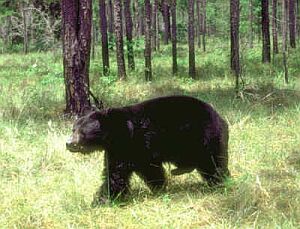
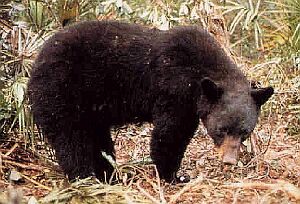
These black bears often have a white band of fur across their chest. The distinct shape of
their skull differs from those of other black bears. Top
SIZE:
The average weight of a Florida black bear is 350 pounds for males and 150 pounds for
females. However, they can range in weight from 150 to 600 pounds. They are 4.5 to 6.5
feet long, making them larger than any other subspecies of black bears. Top
POPULATION:
It is estimated that there are between 1,500 and 2,500 Florida black bears. Top
LIFESPAN:
Male bears usually live from 15-25 years, while females can live up to 30 years. Most
Florida black bears live for several decades. Top
RANGE:
Most of Florida’s black bears occur in five major populations located in the
Ocala/Wekiva River Basin, Big Cypress National Preserve, Apalachicola National Forest,
Osceola National Forest and Eglin Air Force Base. Top
HABITAT:
Florida black bears can be found in a variety of habitats throughout Florida,
including mixed hardwood pine, cabbage palm hammock, upland oak scrub, and forested
wetlands, such as cypress and riverine swamps. Top
FOOD:
The Florida bear is an omnivore and enjoys a wide variety of foods, including berries,
acorns and fruits. They also eat insects, such as carpenter ants and termites, as well as
armadillos and carrion. Top
BEHAVIOR:
Florida black bears do not truly hibernate. Instead, from late December to March, they
have a period called "wintering." During this time, pregnant females give birth
in the den and go without food. Males and non-pregnant females sometimes leave the den for
short periods of time. Top
OFFSPRING:
Every two years during January or February, females give birth to 2 to 4 cubs. Their dens
may be high in a tree, in a hollowed out stumps or in a forest floor protected by
vegetation. The cubs are dependent on the their mother’s protection for nearly two
years, during which time she teaches them lessons of survival. Top
THREATS:
The biggest long term threat facing the Florida black bear is loss of habitat as a result
of development and urbanization. Vehicle-caused mortality (or "road kills") is
the number one direct cause of death for this species. Habitat fragmentation is another
danger as highways built through bear habitat can bisect and isolate large areas of
habitat that bears depend on for food, water and shelter. Habitat fragmentation also makes
it difficult for bears to find mates and limits their chances to move into more suitable
habitat. and ground squirrels. Top
PROTECTION:
Although Florida black bears currently receive no protection under the Endangered Species
Act, they do receive some protection by the state of Florida. Top