Organic Farming under Rainforest Trees
ervaUna
Development in the Atlantic Forest Region of Bahia, Brazil

|
|
|||
|
Organic Farming under Rainforest Trees |
|||
|
|
Diversified
Organic Agroforestry—an Innovation to Rural Development in the Atlantic Forest Region of Bahia, Brazil |
||
|
|
|||
| The project | Status Quo • Prospects • Products • Map |
| In Southern Bahia, cocoa is grown beneath a canopy of rainforest trees. This agroforestry system sustains biodiversity and is well adapted to the tropical climate with the tree canopy protecting the crops, the soil and the water supply. Today a fungal disease, abject poverty and rural flight jeopardize the continuation of the environment-friendly cocoa plantations.
|
|
| The
ervaUna
project aims to strengthen the smallholders’ economy, making them
self-sufficient by developing appropriate methods of organic farming,
improving their agroforestry system and diversifying their crops with
tropical fruits and vegetables. The smallholders’ agrocooperative Associação dos
Pequenos Produtores da Queimada Grande e Jacão of the Una district will
realize the project, involving 30 families with 800 hectares of land. |
|
|
ervaUna* is a
Brazilian-Swiss
development project,
comprising smallholder families of the Associação dos Pequenos
Produtores da Queimada Grande e Jacão at Una, the Swiss NGO
“Vereinigung pro mata atlântica”, the non-governmental foundation
FUNPAB, and the technical assistance team with the local managers and
coordinators Fábio and Linde Nobre and the Swiss biologists Barbara
Suter and Richard Bolli. * erva (portug.) = herb, medicinal plant; Una = Name of the district and town where the project is being carried out |
|
|
Status Quo—Rural poverty In Southern Bahia, agriculture today is mainly based on the cultivation of cocoa. In the 1990s, fluctuating world market prices and a disastrous fungal disease brought about the cocoa crisis. As the smallholders of the area lack any agrotechnical knowledge other than cocoa cultivation, prospects of diversification are out of the reach of today’s impoverished families. They have no other choice than getting their firewood from the endangered Atlantic Rainforest, in which they continue logging. Owing to deficient infrastructure, only half of the population is able to make use of the healthcare programs, and access to herbal remedies is restricted because the traditional knowledge of medicinal plants has virtually disappeared.
|
|
|
Prospects—Stronger economy, better
alimentation, balanced ecosystem Smallholder families will adopt the methods of organic farming and diversify their cocoa plantations with tropical fruits vegetables, which improves their alimentation and contributes to strengthen their self-sufficiency and economy. In addition, smallholders regenerate native rainforest trees, thus sustaining their agroforestry and the ecosystem. Foreseeably, an improvement of the smallholders’ economy and health will enable them to cease exploiting the rainforest and protect the Mata Atlântica. |
|
|
Products—Organic fertilizer, tropical
fruits, and vegetables The smallholders’ products will comprise compost, seeds and seedlings of legumes (enriching the soil), organically grown cocoa and other tropical fruits as well as organic vegetables for the local markets.
|
|
|
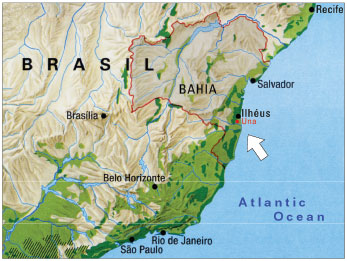
Map The project site in the Atlantic Rainforest area, Mata Atlântica
|
|
|
|
|