We can evaluate the Management for Engineer lesson according to the following topics:
First let us discuss the meaning and content of the outlined topics and then evaluate and criticize the Management for Engineers lesson under each topic one by one.
1.
Project-based learning
Project based learning can be defined as a way of studying and learning with a concrete result. The result can be a dissertation, a report, an assay, an exhibition, a development plan, a theater performance and so on. In project learning the teacher and the student agree about the common objective the ways of action and the control before they start the project. Students work alone or in minor groups or teams leaving a common responsibility to solve the problem. They learn the substantial knowledge and also how to obtain the information.
One of the main advantages in project-based learning is the advancement of responsibility in one�s own studies and through this content motivation. The direct control of the teacher decreases and the self-evaluation of the student or group will increase.
The didactic characteristics of the project-based learning can be classified under the following topics: The real life situations, the independent initiative and the self-development of the student and finally the comparative learning of the team members
Typical feature for project learning is the fact that the problem, the task is derived from the real life situation. The student examines the situation acts in it and gets experiences, which are systematical and generalized. As a learning result one gets new ways and modes of action, which can be used for solving problems.
The independent initiative of the students is one of the didactic characteristics of project-based learning. This means that the student themselves learn to identify the general problem of the facts.
In a traditional group work it is common that a part of the group ignores the responsibility while the cooperative learning point out the common responsibility of performing the task. However the project-based learning achieves its goal when this situation is eliminated and the leadership of the group members are increased and members become active cooperative individuals.
Now lets first put the existing situation in the Management for Engineers lesson in terms of project-based learning aspect and then evaluate and criticize it according to the definitions and the characteristics of the project-based learning teaching tool described above.
Management for engineering Lesson has a term project which base on a concrete result in the form of presentations and a formal written report. The projects are real life projects and initially no concrete data exist for starting the projects. Instructor has declared the topics of the projects and students, consisting of five people (minor groups) have chosen the projects randomly according to their names and availability. The projects were given to the students according to the first come first serve principle due to the limited availability of the subject of the projects. Then students started to deal with the projects and they met with the instructor when they have a problem or have a question. No regular meeting hours were assigned.
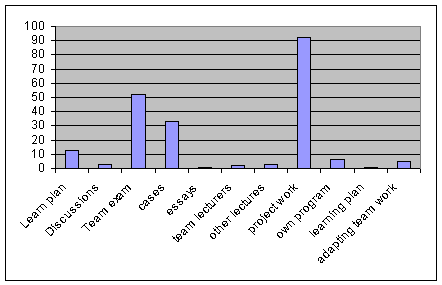
The course offers a project based learning method with projects derived from the real life cases. The projects are performed with teams of five students. According to an evaluation made by the students in Turku School of Economics and Business Administration, project based learning got the highest score in the result of the question that which method they considered had the best effect on achieving the different skills. (See the figure below)
Since the course has satisfied the two most important feature of the project-based learning it gets positive points from there. When considering the described situation of existing case it can be seen that the offered projects also satisfies the condition of independent initiative of the students which gains the course another positive point. However the projects weren�t described in detail at the stage of introduction and no regular guidance of the instructor was scheduled during the semester. These were the only negative points on the application of the project based learning method. The following table summarizes the evaluation of the application of project-based method in this course.
|
Criteria |
Satisfaction |
|
Projects with team work |
� |
|
Real life projects |
� |
|
Independent initiative of the students |
� |
|
Good introduction of the projects at the beginning |
� |
|
Regular guidance of instructor |
� |
|
Percent
Satisfied |
%60 |
In conclusion we can say that the course satisfies the %60 percent of the criteria.
2.
Action-based learning
The focus of action-based learning is on current, real-life issues as well as specific subject matter concerns. This simplified problem solving process can be applied to everyday situations in the school as well as important content concerns within the standard curriculum. Students learn how to work together toward a common goal as they acquire the skills to make connections and synthesize knowledge effectively. They become active problem solvers and decision-makers rather than passive memorizers. Action-based problem solving connects all students to real-world challenges. It provides both directed guidance and opportunity toward making a difference in the real world through enacting positive change.
The action-based learning method prepares students by teaching the skills of convergent and divergent thinking, emphasizing team-building strategies, developing decision-making and communication skills, and encouraging students to use and apply knowledge meaningfully in real-life situations.
The existing situation for the Management for Engineers course was stated earlier. Now let us evaluate and criticize the situation according to the descriptions made above. The course enforces students to form teams and get familiar with working together. This increases the students� communication skills and ability of collaboration. Beside, they develop a team building strategy, which will be useful for them in their future lives.
With the real life project students have a chance to become active problem solvers rather than passive memorizers. The course does not enforce students to memorize any unnecessary knowledge that they will never use. Rather they have an opportunity to acquire the skill to make connections and to synthesize knowledge effectively. Also divergent and convergent thinking skills are gained to the students by this way.
The following table summarizes the discussion.
|
Criteria |
Satisfaction |
|
Collaborative working |
� |
|
Increase communication skills |
� |
|
Develop team building strategy |
� |
|
Active problem solvers and decision makers |
� |
|
Convergent and divergent thinking |
� |
|
Become real world challengers |
� |
|
Acquire skills to make connections and to synthesize knowledge effectively |
� |
|
Percent satisfied |
%100 |
3.
Problem-based
learning
Lets start with definition of Problem � Based learning method. PBL is the learning method in which students take an active role in learning by focusing on a problem and learning not just a solution, but how to come up with the classical solution. The opposite of this learning is the subject � based learning. The SBL is the classical learning method implemented in most universities. In SBL educator emphasizes the accumulation of knowledge and rules of the discipline. Actually this method teaches students well � structured problem solving, not how to solve the problem. On the other hand, PBL helps students learn and comprehend new material better than SBL.
At the beginning of the course tutor start lecture with giving a problem to the students. Examining the problem students identify the type of knowledge they should know to solve the problem. At this moment student become enthusiastic about the subject, which results in higher participation and interest to the course. Lecturer teaches students the subject. Students try to implement what they learned on the given problem. During the problem solving process students don�t focus only on the subject that is taught in the course, but also this learning method helps them to synthesize a broad range of subjects and topics. So, in PBL students take a horizontal collection of information that is pertinent to the given problem. In addition PBL incorporate teamwork, critical thinking and real � world application in engineering curricula.
Coming to the IE � 404 course, this learning method can successfully implemented in that course. We can say that PBL is partially applied in that course. During the term we had a real life project, several cases that were controlled by the people who are in that business. For example in the term project we didn�t use only subject related to the course, but a broad range of subjects and topics like cost accounting, work study were applied in problem solving process.
The PBL should be applied in our university. Especially it is important for engineering disciplines. Most of the real � life problems are ill � structured which cannot be solved by the same problem solving steps that are taught to solve well � structured problems. So, this solution sequence taught is seldom transferable. This learning method was successfully applied in many universities and colleges.
The initial experiences with PBL were in 1988, in Faculty of Policy Sciences.(University of Nijmegen, the Netherlands). The aim of the PBL was for students to acquire knowledge and at the same time that they were able to master the application of this knowledge. The experiences were as equally positive and as they were negative. Many students worked with dedication and enthusiasm within the PBL-curriculum. They mention having a lot during their first year and the collaborative work in small groups, supervised by a tutor, was highly appreciated in many evaluative studies. These evaluations also gave evidence that students learned to study regularly and became experts in the finding and editing of information. The analysis of examinations proved that students understood the content sufficiently. With respect to the students� ability to navigate with facts, concepts and theories, dissatisfaction prevailed; students were uncritical, refused to relate pieces of knowledge and they were reluctant to use their acquired knowledge to illuminate problems in real life situations.
Besides the benefits PBL has its costs. This learning method is more expensive compared with straightforward lecture format. Much of investment should be made in prep time. It cost to figure out new process, to select problems, choose materials and anticipate conflict in a new environment. For PBL one lecturer is not enough. Teams should have someone to whom they can consult continuously. These may be research assistants. Especially for engineering disciplines universities should provide laboratories and workshops were student can practice what they learn. Technicians and shop assistants should be hired. This has additional maintaining and personnel costs. Not every department can cover such huge costs. These courses are quite effective but as practical issue department cannot teach every course in such way.
In addition to financial problems psychological problems also exist. These are challenges for educators. PBL require educator to make significant changes. Not every educator will be willing to give up the lecture control and the role of expert. Educators must be willing to put ego aside and say, � There are some other places to get information�. It will time for educators of our university to get used to new learning system.
Every person has his own perspective to a learning situation. Students are likely to assure their own ideas about solving problems. Personal guidance is also important. Without it students can pick up only about 60 percent of the learning objectives. But financial constraints can increase the number of students per instructor for a course, prohibiting much personal guidance. This is very common problem in our university.
Nevertheless, many engineering students are enthusiastic about the PBL method, and this enthusiasm translates into increased student confidence and motivation.
4.
Learning by doing
Lets describe this teaching tool with an example. By most of the students it is believed that professors would be much happier if they did not have to stand in front of a room year after year teaching the same things over and over again. All they do, for the most part, is lecture from the same pile of notes every year. Why can't they simply Xerox their notes, assign the required readings, and expend their remaining undergraduate-designated energy answering specific questions or even better, designing alternative supplementary forms of instruction such as internship programs and research studies? The lecturers must try to make the course more interactive and learning by doing based by assigning real life projects suitable to the course content. By this way students may acquire the necessary skills and understand the technical content of the courses that they learned much better when they see them in action or when they deal with them.
The Management for Engineers course supports the learning by doing. As stated before a real life project was assigned to the students to give them the change of learning by doing. As described in the example the instructor doesn�t try to teach the same material year and year after. Instead he tries to make the students to learn by themselves via dealing with the real cases that necessitate some management approach. Therefore the content of the course differ in year-to-year, which makes the course more instructive.
5.
Team Working
One of the applications of the team working necessitates the followings: in the team working cases the students forms teams and one or two teacher tutors every team. A regular meeting schedule is arranged in which the team members presents their progress, submit cases and exercises that they are obligated to do. Beside this the instructors support the teamwork in the main lecture hours. Team members are supposed to share the responsibility and participate the work carried out with the same effort.
The objective of the team working is to get the students to learn communicative skills, working skills in groups or teams, obtain and handle information, to solve problems and behave in different situations in real life cases. The students also become acquainted with ethical questions in different real life decisions.
In the Management for Engineers course, the students are expected to work in groups of five. As stated before the team working application of the course helps the students to improve their communicating skills and the ability of collaborative working.
In conclusion it can be said that all these teaching tools have their specific objectives and benefits to the students. The application of these tools will prepare the students to the real life and make them more beneficial to the development of the society. Therefore these tools are highly recommended to be implemented in METU. However there are some limitations on the application of some of these techniques in Turkey and in METU, arising from the economical conditions. Expensive laboratory requirements, finding real life project to be submitted to the students are some of these limitations.
Top
B) Before evaluating the METU�s position with respect to historical evolution of universities as an organization, their system approach and contemporary structural changes which resulted from effects like information technology, globalization, organization theories, lets consider these factors in more detail and then reflect the METU�s position on these factors.
The word �university� originates from �universitas� which means �autonomous institution�. The first building blocks of universities came into picture with the cathedral schools beginning in the 12th century. At these times, the university structure consisted of loosely organized collections of teachers and students, where the teachers, namely the masters, were responsible for giving degrees and admitting the students to their professions. In Paris, the fame of some masters, like Aberald and Saint-Victor, who were a member of the cathedral schools, attracted the attention to many students and soon the cathedral became unable to hold all those students. Consequently, competitor schools started to appear in Paris, which eventually faced the opposition of Notre-Dame cathedral, traditionally the unique awarder of license to teach. As a result, these schools have been closed for two years. However, the masters could get rid of this situation even with higher control and dictated the fact that the religious institutions cannot hold a monopoly of control over education. This can be considered to be a milestone event in the evolution of autonomous universities. Later other universities have been established one after the other in the Southern and Western borders of the Western, Latin Christian European countries.
In terms of administration structure, there were two models. In the first one, there was the domination of masters over the students. This structure, which sounds very natural today, originated from the Parisian structure and has been applied in most European countries. While Paris University attained a reputation in theology, the Bologne University in Italy became the center for law. Bologne University attracted older and especially wealthier students who were not inclined to accept the masters� control. Therefore Bologne had a different administrative structure in which the students dominated their masters opposed to the structure of Paris University.
Throughout its development, the university faced another change after World War II. The economy after World War II enjoyed a rapid growth phase which resulted in more available funding for research on specific topics. The research institutions and universities became bigger and therefore difficult to manage. The solution to this problem has also emerged at these times; the division of labor and structural hierarchies. The universities have been divided in disciplines, departments or faculties and the universities of today have risen.
Two powerful forces � one intellectual, one political � lie behind this transformation in the purpose and self �image of the university. The first is the triumph of the natural sciences. Science has been burning so bright in the 20th century that it has become difficult, to argue that the university needed merely to cultivate the intellect. The intellectual achievements of science have been so large, so clear to all, that it has dethroned the liberal education in the arts and humanities, which dominated Newman�s university.
The second big force for change in the university has been the rise of democracy, and the demand for mass education that is one of its corollaries. For most of their long history, universities were the preserve of a small elite.
Today, universities can be characterized by their hierarchical management systems and the high level of bureaucracy that is inherent with this system. Moreover, universities no longer fancy the economic growth that has supplied the required funding for their operations. In addition to decreased income, the administrative costs increase rapidly resulting in budget gaps. For example, MIT is one of the institutions which have been experiencing budget deficiencies for years and this has been the driving force for them to reengineer their administrative processes.
The post �war expansion of university science was based on the assumption that to invest in knowledge was to invest in growth. What is new is the way the debate is currently framed. The globalization of the world economy, together with declining demand for manual labor and the simplistic belief that this must put nations increasingly in competition with one another, has lately given investment in knowledge a political resonance it lacked before. Moreover, governments start to raise funds for variety researches to be done in university. For example, the government of Malaysia spent $40 billion to establish a �multimedia� university. As this sort of thinking takes hold among politicians, the university moves ever further from its origin as a sanctuary from the worldly society around it.
Now that we have acknowledged with the historical evolution of universities around the world, we can observe the METU�s historical evolution as an organization.
Founded in 1956, METU is a state University that has the objective of training Turkish and foreign students in scientific, technical and professional fields of study, and of utilizing these studies in the field of pure and applied research for contributing to the economic and social necessities of Turkey and other developing countries. Since its inception the language of instruction has been English.
Giving ideas reality and fulfilling dreams is often a slow process, but the growth of METU from an envisioned concept in 1956 to a campus with more than 304.228 square meters of floor space, has been a dynamic and phenomenal exception.
The idea of a regional technical university originated in 1954 when an evaluation of housing and planning conditions in Turkey showed the need for competent technicians trained in these professions who would dedicate themselves to speed the development of the countries of the Middle East. After much discussion and advice from various groups, the School of Architecture and City Planning, with 40 students and 4 teachers, was opened in 1956.
From 1957, when the Turkish Grand National Assembly gave the new university legal standing with a provisional law, until 1962, the METU campus consisted of temporary buildings on grounds in the city. The Turkish Grand National Assembly approved the Charter of Middle East Technical University in 1959.
Construction began on the new campus area in 1962. In a year and a half all the basic facilities of the University were completed. The building programs, originally planned to meet the needs of 12.000 students, have continued to progress rapidly. Classes were opened on the new campus in October 1963.
Besides the construction of buildings, METU has concerned itself with the reforestation and landscaping of its campus. It has been estimated that 10 million trees have been planted (many by the students themselves) since 1962.
METU's modern campus, equipped with the most advanced scientific and technical facilities, now serves almost 20.000 students from all parts of the world. In the past decades, METU's dream has been realized and its impact has been felt throughout the region.
Till now we just go over the historical evolution of METU. When we consider the organization structure of the METU we can observe that there is not much significant changes. To adapt itself in competitive environment and provide high quality service METU has to restructure it organization system. Instead of criticizing the existing organization structure of METU we propose a new one.The hierarchical organizational structure of the METU should be transformed into a matrix organization. At the bottom line there is the academic personnel and one level above there are teams to make tactical and strategic level decisions. These teams can be limited with the following: strategic planning team, academic personnel team, and research and funding team. It should be emphasized that this suggestion not only decentralizes but also centralizes the decision-making process as the decisions related with academic personnel or research faculties. The proposed system is better in the sense that the use of scarce resources can be made more effective and efficiently by considering them together.
In the last few years we have seen significant changes occurring in universities and colleges all over the world. Some have gone through a reengineering process; others have grown by adding new programs and services, which are highly innovative while experimenting with new teaching methods. Each university should use a systematic approach to protect and benefit itself with least cost from these innovations. Because of these rapid changes in information technology and harsh competitive environment universities often updates their programs. Each university examines its administrative layers, organizational structure, curricular offerings, and operational practices in order to become more attractive to students and more responsive to change, more cost-effective, and to have greater impacts for the good of our global society. The academic deans and president�s cabinet are engaged in a series of planning sessions in preparation for discussion throughout the University community. This broad discussion is intended to ensure that there are widespread opportunities for faculty, staff, students and constituents to provide input into developing the plan, and to offer and consider ideas and suggestions.
The University leadership constructs a set of guidelines for the ways in which the University will manage the process and change. In quantitative sense, the guidelines are 95% final. That is, University leadership is unanimously committed to the guidelines, but reserves the option of changing them if better ideas emerge from campus discussion. These guidelines can be listed as followings:
i) Enhancing intellectual capacity
ii) Maintaining and enhancing educational quality
iii) Generating new resource opportunities
iv) Maximizing local, regional, national and global impacts of the University
� Increasing the amount and quality of the knowledge generated
� Keeping up with the recent enhancements in literature and technology
� Equipping the new generation with the most recent and relevant knowledge in order to make them serve the society in the best way
� Giving support to private sector in order to make them able to convert knowledge into useful products to serve society
Before start to consider METU�s system approach lets us state its mission. The Middle East Technical University is devoted to the pursuit and application of knowledge for the social, cultural, economic, scientific and technological development of our society and mankind through achievements in teaching, research and community service that are of highest international standards. In order to fulfill its mission METU generate the following guiding principles:
1. The University strives to be a university of the first rank in an international context. To this end, the University seeks to be a dynamic institution aiming at excellence that will attract both the best teaching and research staff and the highest quality students.
2. The University hopes to create an environment where inquiry and scholarship can flourish, where heterodoxy is not suppressed and where creativity can find expression. Its goal is excellence in all facets of university life; teaching, research, administration and the interface with the community.
3. The University accepts unreservedly that a fundamental part of a university's scholarship mission should be a strong research component and orientation to add to and improve understanding of existing knowledge; to this end the University opposes any form of censorship, which prejudices fundamental research and scholarship.
4. The University encourages each faculty, department and the administration to plan forward and establish specific strategies for the years ahead so that the Middle East Technical University of the future will not merely be the projection of its past but will be in tune with and reflect the changing environment in which it functions. To this end, the University, recognizing that there are physical and other constraints on its growth, endeavors, without being restrictive, to control and contain its rate of overall growth with appropriate adjustments to the balance between faculties and departments so as to ensure the highest standards.
5. The University is dedicated to the fundamental concept of academic freedom, which is essential to ensure high standards of teaching and research; is necessary to counter fear of heterodox thought and ideas in the continuous search for truth; accepts as vital the right to determine, on academic grounds, who may teach, who may be taught, what may be taught and how it should be taught; thrives best in a society which encourages frank questioning and inquiry as well as legitimate protest; a society where those who exercise these rights are protected by the rule of law.
6. The University seeks to ensure that no student is deprived of the right to receive higher education due to financial difficulties.
7. The University, recognizing that explicit consultation and accountability mechanisms are essential for just and efficient governance, encourages a high degree of staff and student involvement in its affairs.
8. The University is dedicated to instill in students an appreciation for human and ethical values; vision and training that will prepare them for lifetime learning and leadership.
9. The University wishes to function in intimate contact with and to contribute to its environment. The issues that concern Turkey, Middle East, Mediterranean and the international community are of concern to the University as part of that environment.
10. The University encourages in all its members and in society those attitudes of understanding, tolerance, and respect for others, which are essential for the attainment of peace and justice.
We believe that if the university follow these guidelines thoroughly as it have done up to now, it will be one of the most respectable universities among the other universities in the world.
� Information technology
� Globalization
Before starting to consider the effects of above stated factors on METU, lets us go over other universities in the world and see how they respond to these factors. Let us consider a representative university�s respond to each factors one by one.
Undoubtedly, one of the most noticeable forces significantly impacting the practice of education in university is the new information technology. The pervasiveness of IT in education has been increased as we entered the new millennium. The potential of this technology for enhancing the learning process is mind- boggling.
The impact of IT on education can be investigated at two levels: the first one within the university and the second one linking the outside world to the university. Access to the campus network and Internet has brought in the possibility of computer-integrated instruction. Computer-integrated instruction and education includes the transmission of course material, submission of assignments, simulating experiments, performing bibliographical searches and communication through e-mail with the instructors and with other students. It should be emphasized that IT is not proposed to replace instructors because face-to-face communication still dominates communication by other means. Instead, the role of instructors as the person disseminating his knowledge to the students can be replaced with a leading role in which the students are taught what to learn and how to learn it. This will save time for the instructors, which can be used for research and carrying out discussion sessions with the students, which will enhance the actual process of learning.
Furthermore, the increasing easy access to information through the Internet that we are already witnessing makes us see that the new information technology has the potential for democratizing education more than any other invention of the past. The use of the internet as a communication and search tool that allows for the exchange of ideas, sharing of knowledge and access to incredible amounts of information all over the world in no time; the increasing use of �distance learning;� a significant larger number of partnerships between industry and universities; etc. However, we can already witness some significant limitations to the access of these benefits by the majority of universities in the world. Despite a significant decrease in the cost of this technology, it is the highly industrialized countries that can afford the technology. Universities can play a leading role in finding ways of developing Information technology that is available and affordable to the majority of people in the world. Also, it is the universities that help these people learn how to use this technology.
The best universities in the world regardless of their country of origin have always been world class in that their quality has attracted students, faculty, staff, national governments and companies from all over the world seeking their services. What is new is that tougher domestic market conditions and the globalization of most industries are pushing what used to be local universities to redesign themselves to be world competitive. Strategic alliances, collaborative agreements, joint research projects, faculty and student exchanges between institutions of higher education across borders have been increasing at an accelerated pace in the last decade. One might expect this trend to continue because of the globalization of industries, financial systems and economies. Also, this trend will continue to be facilitated and accelerated by information technologies like satellite-TV and the Internet.
When we consider the respond of METU to the increase in IT and globalization we see that its similar to the representative university stated above. IT and globalization helps the university to improve its interior services structure and collaboratively corporate with exterior organization more effectively. The university now provided an online registration opportunity, which was previously done by filling the forms manually. This was too time consuming and costly. Also, the use of the internet as a communication and search tool allows for the exchange of ideas, sharing of knowledge and access to incredible amounts of information all over the world; the increasing use of �distance learning;� a significant larger number of partnerships between industry and universities. METU has created agreement with the international universities and now the exchange programs with other universities is possible. METU faculty's wide experience outside Turkey demonstrates again METU's long-standing international commitment. Many of METU's faculties have had experience in educational or research institutions in other countries as students, as faculty, as researchers. All these changes help to reduce time and funding required carrying out non-value adding activities and transferring these resources to the value adding activities.
Top
First lets give some introductive knowledge about the recent development of European accreditation system before discussing the METU�s position with respect to higher education system in Europe.
There is an increasing demand for transparency and for international mobility of students and engineers. A definition of minimum criteria on the European level would therefore be most valuable. Standardization should be the tool for transparency and comparability. This approach is fully in line with the Bologna declaration. By accreditation SEFI understands a declaration by a competent body that a certain programme satisfies such minimum criteria.
There is obviously a growing interest in Europe for accreditation of engineering education programmes and an increasing awareness of the importance of this for the mobility of engineers and to guarantee the quality of European engineering education. The Bologna declaration has put the accreditation issue on the European agenda and it will form an important part of follow � up minister meetings of the Bologna declaration. The issue of declaration is of vital importance for European Engineering education and thus for SEFI.
As the follow � up minister meeting of the Bologna Declaration sets out, Ministers asserted that building the European Higher Education Area is a condition for enhancing the attractiveness and competitiveness of higher education institutions in Europe. Ministers supported the idea that higher education should be considered as a public good and will remain a public responsibility. Students are the full members of the higher education community.
The
six objectives of Bologna Process are:
Ministers committed themselves to continue their cooperation based on the objectives set out in the Bologna Declaration, building on similarities and benefiting from the differences between cultures, languages and national systems, and drawing on all possibilities of intergovernmental cooperation and the ongoing dialogue with European education institutions and student organizations as well as the community programmes.
New members were welcomed to join the Bologna process. Applications from Croatia, Cyprus and Turkey were accepted.
As stated above, to become independent of ABET European countries create their own accreditation system. Some departments of METU are already accredited with American based ABET. Through out the EU integration, Turkey must also integrate its high education schools to be on the same level with the universities in the Europe. Therefore those departments of METU and the other universities, which are not currently accredited with ABET or European accreditation system must be developed soon and become able to satisfy the necessary criteria. At this point let us concentrate on the Industrial Engineering department of METU.
The IE is one of the departments of METU which is accredited with ABET. However this is being the case, we must compare the weakness and insufficiencies of its program with the similar programs in European universities. Most of the European Universities doesn�t cover the branch under the name of Industrial Engineering but rather it is named as system engineering, management engineering or similar. Beside, some of the lectures given in the METU IE program have their corresponding topic as a separate department. Consider the Berlin Technical University Industrial Engineering corresponding program.
Berlin Technical University�s IE program differs from the METU�s in the following points: BTU gives more importance to the mechanical and electronic discipline in the early years and the managerial science lessons gains more weight in the last years. However in METU statistics and production based courses are given more importance. The main engineering lessons such as calculus, physics, and introduction to computer programming are similar. We can think that the differences in course curriculum arise due to the program differentiation. The corresponding program in the Berlin Technical University has integration with the mechanical engineering and do not focus only on system engineering. The technical content of the courses are more or less the same.
In conclusion, Turkey must make its universities to become accredited with the European standards as a step in the Turkey-EU integration. For this reasons the universities must develop themselves and make their curriculum suitable to the European�s. Also Turkey must develop its own accreditation system similar to ABET. The first steps are made and Turkey is joining Bologna process.
When we come to the METU�s IE discipline we see that there is not much significant difference with respect to its corresponding universities in Europe. METU has developed its IE discipline both in terms of generating qualitative knowledge to the society and installation of current information technology. However, the way of selecting IE elective courses is different.
The elective courses are given to students according to their ability on that particular area in European Universities. That is, any student selects elective courses on which he wants to specialize and have adequate skills. Obviously, IE department in METU should revise its way of distributing its elective courses or at least the inside of these courses should be enlightened before registration so that the students would have idea about these courses.
Top