Burlington High School Teaching Internship
This past Fall 2004 and now during Spring 2005, I have been involved in teaching predominantly sophomores and juniors at Burlington High School. I have instructed both 10th Grade Literature, Writing, and Speech in addition to 11th Grade Seminar in American Literature.
Both of these classes have strongly emphasized student participation and constructivist teaching practices including the use of literature circles. Within the classroom I have seen students actively learning about literature at a fast clip whenever they are allowed to engage with one another; peer-to-peer frameworked projects propel students towards understanding texts without the instructor dictating what the meaning of each individual text should be. Students need to arrive at textual understanding through their own efforts first; then, the instructor can fill in some blanks where greater thematic connections need to be made. I strongly believe that students need to engage with texts and attach their own meanings and interpretations to them without instructors forcing a single-minded "literary view."
As students begin to approach a text such as "A Lesson Before Dying" by Ernest Gaines, it is easy to recognize that their analysis will be markedly different from that of an adult reader. After completing the novel an adult reader may get a sense of the novel portraying the societal need of messianic figures for bringing us closer to higher ideals. In the book "A Lesson Before Dying", the falsely accused man, Jefferson, must sit in jail awaiting his death sentence while being visited by a teacher from his ex-plantation Cajun community located in segregated Louisiana in the late 1940's. The book's setting consists of the town's jail, church, and barroom coupled with various scenes of racism on many levels. Jefferson becomes the messianic figure who brings transcendency to the black and white characters in the novel by forcing them to recognize their own personal shortcomings within their respective communities.
The 10th graders at Burlington High School did not immediately reach this "adult" understanding of the novel through their literature circle readings and activities. Their conclusions tended to focus more on the individual instances of racism within the novel and on the ensuing effects of this upon the main characters within the novel. As students discovered these connections, it was exciting for them to process these ideas in class.
When assisting students with discovery of text, it is important to use multiple intelligences in order to access a good degree of textual comprehension. When I work with students within literature circles, I make sure to create group roles that provide for many levels of textual understanding. Each role is created to allow for maximal student discovery.
The following roles are examples of "the duties" of students working within literature circles. Students switch roles throughout the covering of a text during the academic quarter. It is important for students to switch roles within groups as they work through the novel, but it is equally important for students to stay within a particular group in order to experience synergy and role responsibility.
Themes Analyzer
When acting in the role of themes analyzer, students learn to recognize "the big ideas" within the homework readings. Students can't just list words like "racism" or "greed", nor can they make statements like "This chapter is about racism." Instead, students have to connect these ideas and make value statements such as "In Chapter 3 the narrator, Grant Wiggins, faces racism even within the African American community as he encounters different levels of respect between lighter and darker-colored peoples such as the mulatto bricklayers hanging out in the tavern." Students acting as themes analyzers might also make statements such as "Chapters 1-3 show how Jefferson is looked down upon by all members of his community and he feels just like a hog" (hog is a direct quote from the book).
Other roles that are included within our literature circle methodology include a connector, a summarizer, an illustrator, and a word stylist.
The illustrator is an engaging role in the sense that students can now create particular images that help to bring to life any important part of the novel. A student can draw an image, record a television commercial that uses evocative images onto a VCR tape, or make clay figurines that somehow visually represent what is taking place within particular chapters of the novel.
Another very effective role within the student literature circles is the connector role. The connector role essentially allows students to "make a connection" with any real world events or ideas, that tie-in with the chapters read for their homework. This activity often allows students to feel comfortable with sharing their experiences in school or in their home lives -- as long as this is processed in a safe and respectful manner, it is a wonderful tool for having students make connections between "real life" and ideas in literature.
Students really do enjoy discovering that they can learn to function as active readers of literature and create meaning with their understanding of text. As one of my classes returned to working in their literature circles, I recall a particular student slowly sliding my comment portfolio back to me and then moving their connector role sheet forward. The student had written about the fact that just as Grant, the narrator of the novel, continued to visit Jefferson the inmate on death row, so too, did her parents visit her uncle in jail in an attempt to lift his spirits. This practice seemed important to the student and it established a sense in the student that "this book really described what a prison visit looks and feels like." The student had made a connection between literature and the real world.
Literature circles are also challenging! An instructor can never "phone it in" for there needs to be consequences if students come to class without any of their work prepared. At Burlington High School students are sent to "Mr. Spark's room", which is a punnishment room of sorts for students who "misbehave". Students who are sent to this room must work in silence on their work and report to homework club at the end of the day in order to complete their work. In this fashion students learn that just showing up for literature circle is not enough -- it is important to show up and to make a contribution with both the reading and role work done. Literature circles teach responsibility. Students of high school age quickly develop a sensibility for understanding that "you get out of it what you put into it" -- as far as literature circles go.
MEDIA PRESENTATIONS(Please excuse the large play-mode butttons. Be sure to put one audio passage off at a time -- otherwise the other will play over it!)
Listen here as 11th Grade BHS Seminar Students discuss the novel "The Old Man and the Sea" by Ernest Hemingway
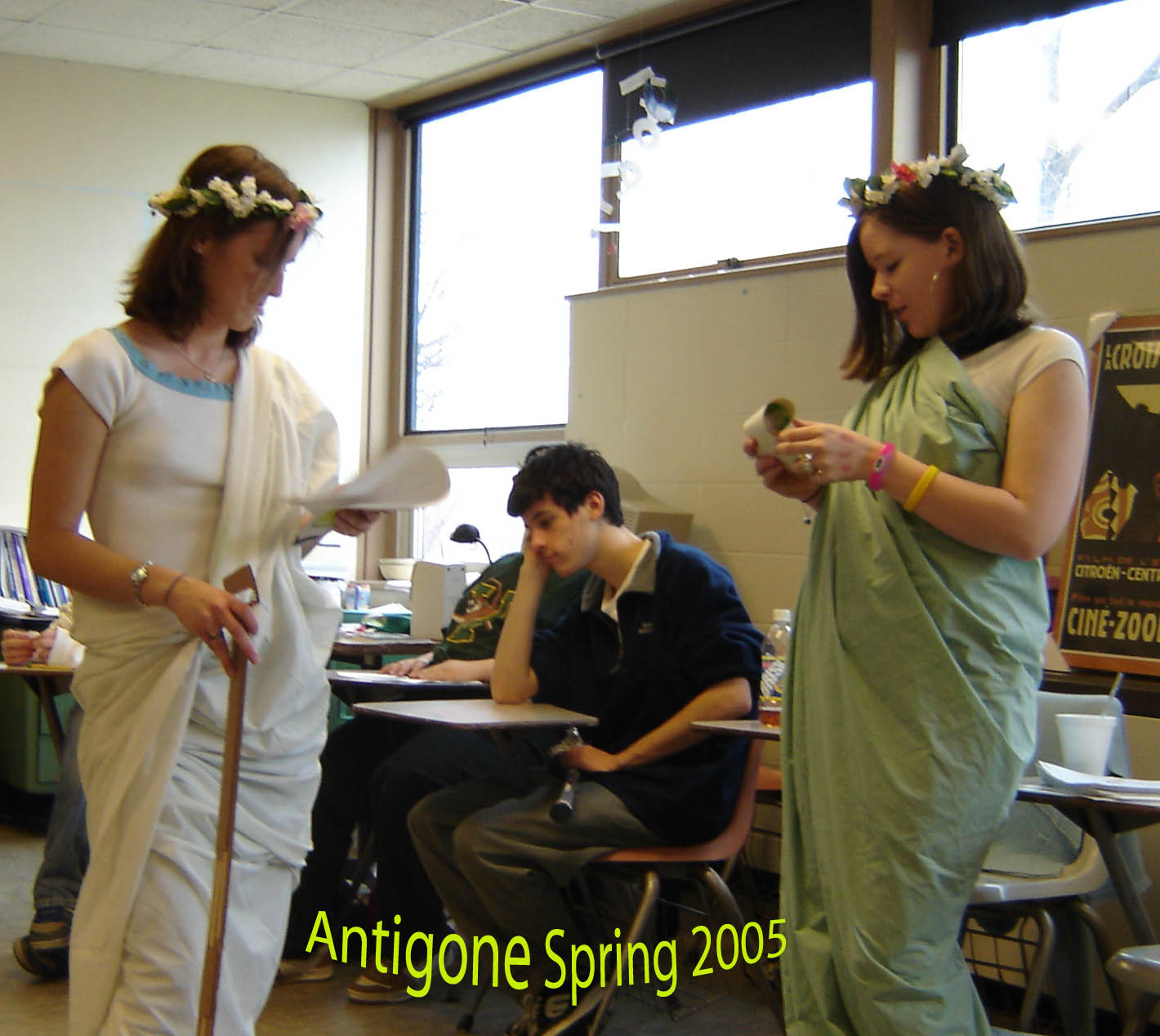
Ismene and Antigone appear in 2005 via 10th Grade BHS students.

Perhaps the most significant factor within the world of instruction is that both as instructors learn from teaching through time, so do students learn through listening and relating with teachers and peers through extended periods of time. Much as a flower grows into bloom, so do students gradually move towards mastery as they pass through the simple element of time. Within my assignment creation and academic planning, I always take this into consideration. Towards the end of any course I always create a culminating assignment / assessment that ends with the students doing teachbacks to the class. The wonderful thing about teachbacks is that they can be used in any class and at any level. The reasons that I use teachbacks for students is for their powerful message of empowerment. Virtually every student can teach something to their class by the end of the semester and if the instructor has created an appropriate classroom environment, then each and every student should be comfortable with talking to their peers. I mostly use student-group teachbacks for culminating assessments for the following reasons:
Teachbacks are by their very nature examples of differentiated instruction. Students can report knowledge back to the class at whatever level they are comfortable at, and as they work within their groups the socialization process is engaged. This allows for students to be able to make use of their peer relationships they have fostered over the course of the semester. Each group can then display its own dynamics in front of the classroom.
Teachbacks give students a sense of putting together materials under some time constrictions. This teaches them the process of putting together plans, creating materials, rehearsing their designated role, and then speaking in front of the class. Notice how this activity always plays directly into expanding and refining the work done by the Public Speaking instructor at some juncture within the high school career of the student.
Teachbacks allow for students to interact with the class as a whole and to witness the entire communicational paradigm that takes place within the classroom as it occurs with a competent instructor at the helm. The point here is that students can see that they can approach becoming �competent instructors� themselves and that they can gain more of a realistic view of teachers as humans whose mastery was arrived at through practice and study.
Teachbacks allow students to pick a thesis statement and to argue for it with supportive visual, auditory, presentational, and textual proofs. This particular skill is invaluable as it is the backbone of the American academic tradition.
Teachbacks offer students the opportunity to multitask and to move towards mastery when having to put together a large number of related materials.
Finally, it seems that when students are putting together works that are relevant and formed from their own musings on materials that have been covered throughout the semester, students can connect with true enduring understandings that come from deep within themselves. This provides for education that is transformative and not top down in scope. Instead of education having been a disciplinary experience, teacher understanding can now help students to scaffold concepts towards their own final works of relevance with the group teachback coming back acting as a summative assessment.
Nikki and Lillian created a fantastic presentation based in literature study when they wrote about and presented Hemingway�s �Old Man and the Sea� as being primarily a simple tale of Santiago�s spiritual awakening in the tradition of Castaneda or even of Christ in the Bible. Their thinking was so fresh and clear that I wondered if it was time for me to sit down and have them instruct the rest of the unit. Please view their PowerPoint slides here.
"Spiritual Awakening within The Old Man and the Sea" by Nikki and Lillian (Spring 2005)