Hunger, Agriculture, and the End of Cheap Oil
The Universal Declaration of Human Rights (UDHR), adopted by the U.N. General Assembly in 1948, states that every human being has the right to access to sufficient food necessary for well-being (UDHR, Article 25; and reaffirmed by the FAO's 1996 Rome Declaration, Part I, Annex II). This is clearly a fundamental human right, because if people cannot find the means to eat, all of the other rights they have as humans are effectively worthless. And yet, in spite of international recognition of this fact, hunger remains a major worldwide problem. Each year over 8 million people die of hunger, while about 800 million suffer from chronic malnutrition (FAO, 1996). This figure threatens to increase dramatically once the world petroleum supply begins to shrink. For disaster to be averted, we must acknowledge the dangers inherent in the present trend towards the global agriculture, and alternatives to it must be explored.
Although the hunger scenario looks dark today, it looked considerably darker forty years ago. In 1960, the world's population had just reached 3 billion, and it was projected to hit 4 billion by the mid-seventies. Very few people imagined that agricultural production could keep up. But thanks to what is now known as the "Green Revolution", agricultural production managed to outpace population growth. In the Green Revolution, agro-scientists bred grains which were resistant to pesticides and responsive to fertilizers. This allowed for a much increased productivity, in some cases up to ten times that of traditional modes of production. Due to these developments, growth in agricultural production greatly exceeded population growth for almost three decades, and the number of people suffering from hunger dropped considerably. In 1977, for example, 41,000 people were dying per day of hunger, while today that number has dropped to 24,000.
But 24,000 deaths per day isn't exactly cause for celebration. Even more so when we realize that those deaths are unnecessary. There is, at present, enough food produced around the world to feed everyone. The problem is that the food is unevenly distributed. A healthy diet consists of about 2,700 calories per day, while 2,300 calories is the number estimated to be the minimum acceptable figure. Current world food production allows for about 2,700 calories per person per day, just the right amount for everyone, but what actually happens is that people in the industrialized nations eat over 3000 calories (3,700 for the U.S.A.), while many hundreds of millions of people in the third world end up malnourished (see Daily Calories Per Capita Map at the World Resources Institute).
Optimists like to point out that growth in agricultural production continues to exceed population growth, and some believe that this, by itself, will eventually solve the hunger problem. This is not necessarily so, however, because the unequal distribution of food is due largely to more deeply ingrained inequalities in the distribution of wealth; in practice, food is distributed to those who can afford it. In any case, there are limits to the gains that can be had from the Green Revolution, and it appears that they have almost been reached (Food Production: Have Yields Stopped Rising, World Resources Institute).
Global agriculture may soon begin to lose ground against population increases for a number of reasons. First, the main technological methods of increasing crop production -- the heavy use of fertilizers combined with irrigation systems -- have already been exploited. Future gains are subject to the law of diminishing returns. Second, many agricultural lands which were once productive under the Green Revolution are now suffering from various symptoms of mismanagement -- overuse, salinization, chemical saturation, and topsoil loss -- all of which result in decreased crop yields. Other agricultural lands are being lost altogether to the rapid expansion of cities, roads, and deserts. Since 1940, an area equal to the cropland of two Canadas has been taken out of production (Cropland Losses Threaten World Food Supplies, Worldwatch Institute, 1996).
However the most ominous threat to global agriculture lies in its heavy dependence on petroleum. To produce crops, industrial agriculture uses tractors and other farm machinery which mainly rely on petroleum. In addition, there is the need for vast amounts of fertilizers and pesticides. A majority of these are petrochemical products, and fertilizers also require large amounts of cheap energy (supplied by petroleum) in order to convert nitrogen into usable nitrates (see Revelle & Revelle, The Global Environment, Chapter 9; and Walter Youngquist, The Post-Petroleum Paradigm -- and Population). Finally, there are the energy requirements needed to transport produce from farm to market, and with the agricultural industry now operating on a global scale, these energy requirements often eclipse all others. For the moment, we are fortunate enough to have access to a very cheap, transportable form of energy called petroleum. But how long will that last?
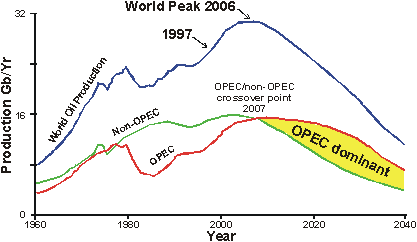
Historical and projected levels of oil production: the world's oil supply will soon reach peak production (from Duncan & Youngquist, The World Petroleum Life-Cycle)
Not as long as most people think. Recent studies estimate that world oil production will peak in 2005 (Colin J. Campbell and Jean H. Laherr�re, The End of Cheap Oil)or 2006 (Richard C. Duncan and Walter Youngquist,The World Petroleum Life-Cycle). The oil wells won't suddenly run dry, but prices will begin to rise sharply even before the peak is reached -- perhaps even by 2001 -- as steadily increasing demand begins to outstrip a dwindling supply. This will start a feedback loop: it takes energy (supplied by petroleum) to extract oil from the earth, so prices will rise not only in relation to the demand/supply ratio, but also in relation to the increased costs of recovery. In other words, increasing the price of oil will automatically further increase the price of oil. And not just oil, but most alternative energy sources as well. For example, the growing and harvesting of biomass requires fuel for tractors, processing, etc. In the age of 'hydrocarbon man', as some anthropologists call this era, oil is the base upon which most human wealth is built. Ultimately, cheap oil subsidizes the cost of almost every primary resouce: minerals, lumber, energy, etc., and the prices of all other commodities will rise as the price of oil goes up. (see Walter Youngquist, The Post-Petroleum Paradigm -- and Population; or Jim Minter, Joy Ride to Global Collapse)
Food will be no exception. In fact, a heavy dependence on cheap oil makes global agriculture especially vulnerable to the coming shortages. The bottom line is that once the oil supply is tightened, food prices will rise, production will fall, and more people will starve. A lot of people. In his book The decline of the age of oil (1995, Pluto Press Australia Limited), Brian Fleay writes:
A very large proportion of the world's population depends for food from high agricultural yields achieved by the use of fossil fuels. The world may only be able to support a population of 3 billion without this input. Petroleum is a key fuel.... The principal grain exporters are the U.S.A., Canada, Europe, Australia, and Argentina -- all highly dependent on petroleum-based industrial agriculture.
Many people have faith that technological solutions will eventually come to the rescue. If, for example, some sort of fabulous breakthrough in nuclear fusion technology were to occur in the next few years, perhaps enough facilities could be built in the following decades to produce energy that would replace that which is now supplied by oil. Unfortunately, such a scenario is extremely unlikely. Fusion is not expected to be commercially viable for at least another 40 years, and most scientists in the industry believe it will take far longer (see David Price, Energy and Human Evolution). Alternatively, giant biotech corporations like Monsanto would like us to believe that the genetically modified organisms (GMO's) which they are developing will eventually solve the world's hunger problems, but they fail to mention the risks. Many people believe that GMO's have not been sufficiently tested for long enough periods of time to understand their long term effects on humans and the environment. Additionally, there is the question of vulnerability to disease, and a reduced yet continuing energy dependence. To embark on a global reliance on this sort of technology at this time would be extremely risky.
Above and beyond the question of feasibility, there is a dangerous agenda lurking behind these technological 'solutions'. They serve to centralize power and concentrate wealth in the hands of the few, when a real solution, as was mentioned briefly in an earlier paragraph, must involve a more equitable distribution of wealth (and, by extension, food). In the unlikely event that nuclear fusion were to come on line in the near future, the benefactors would be those living in industrially developed countries, not the poor countries where the majority of starvation occurs. As for genetic engineering, Monsanto Corporation talks about feeding the hungry, but at the same time, they have developed "terminator" seeds (seeds which produce plants that cannot reproduce) in order to prevent farmers from being able to collect their own seed. The goal, of course, is to increase the farmers' reliance on Monsanto so that profits can be continuously funneled upwards to the corporation. Similarly, critics point out that the 'miraculous' products wrought by genetic engineering are focused on profits, not on alleviating hunger. Who, for instance, is going to pay a premium to buy Calgene's FlavrSavr tomatoes (developed to be more cold tolerant by the addition of a fish-gene to a tomato's DNA)? Don't expect too many customers among the poor of Africa and India.
A realistic solution to the problem of hunger must involve redressing the huge imbalances in wealth distribution that exist around the world. A first step would be to resist the expansion of global agricultural markets and, instead, to encourage regional food security through the development of small-scale, localized, organic agriculture. In the third world, large monoculture farms are usually oriented towards growing expensive, specialized products for export rather than towards growing more basic foods to feed the local population (read: Sustainable Agriculture, Landlessness and Food Security by Francisco Pascual for an account of the situation in the Philippines). The majority of profits from large-scale operations don't go to the country where production takes place, but end up being absorbed by middlemen and retailers. On the other hand, smaller sustainable farms which grow food for local markets might be less profitable, but at least the profits remain within the community. Such farms are not heavily dependent on oil, and they improve regional food security (local independence rather than global dependence). In addition, they restore productivity into the hands of more people, thereby spreading wealth, not concentrating it.
Another obvious method of wealth redistribution is taxation. Agricultural restructuring in poor countries to improve food security through the local cultivation of staple foods could be financed by taxing 'luxury' crops such as tobacco, coffee, chocolate, etc. All of these crops utilize valuable farmland which could otherwise be used to produce food for hungry people. Such a tax would be a sort of 'world duty', imposed and administered perhaps by the Food and Agriculture Organisation (FAO) of the United Nations.
A truly progressive program should also promote vegetarianism. Meat could be included on the list of taxable luxuries, since about 5 vegetarians can be fed from the same amount of land that is required to feed one meat-eater (see Holly Stewart, Limits to Growth: Facing Food Scarcity). This is so because of the inefficiencies involved in growing grain, feeding it to animals, and then eating the animals; large amounts of energy are lost in the multi-step process. Imagine it this way: A farmer plants a field with enough grain to feed 50 people for a month. He harvests the grain, but instead of selling his crop at a relatively low price to 50 people, he feeds it all to one cow. When the cow is fattened up, he slaughters it and sells the meat at a high price to 10 (rich) people, each of whom receive enough beef to feed themselves for a month. In real terms, we can see that 40 people are starving not for a lack of food, but to allow 10 people the 'luxury' of eating meat and to allow the farmer to pull in extra profit. There are numerous health and environmental reasons why meat production is disadvantageous to humankind, animalkind, and the planet in general, but what is being emphasized here is the simple fact that one person's meat consumption contributes in a very real way to someone else's hunger.
Universal access to sufficient food is a fundamental human right, and seeing that that right is respected should be an obvious priority for governments as well as individuals. The target should be food security founded upon localized, sustainable agriculture, and the method of attaining that goal should include taxation of agricultural luxuries. In the balance are the hundreds of millions of people who remain malnourished, as a petroleum-induced agricultural crisis looms on the horizon.