Social Justice
Rev. Eric Posa
There are two ways of being a prophet. One is to tell the enslaved that they can be free.... The second is to tell those who think they are free that they are in fact enslaved.
- Richard Rohr
Pray for the dead, and fight like hell for the living.
- Mother Jones
Interfaith Candlelight Peace Vigil
March 16, 2003
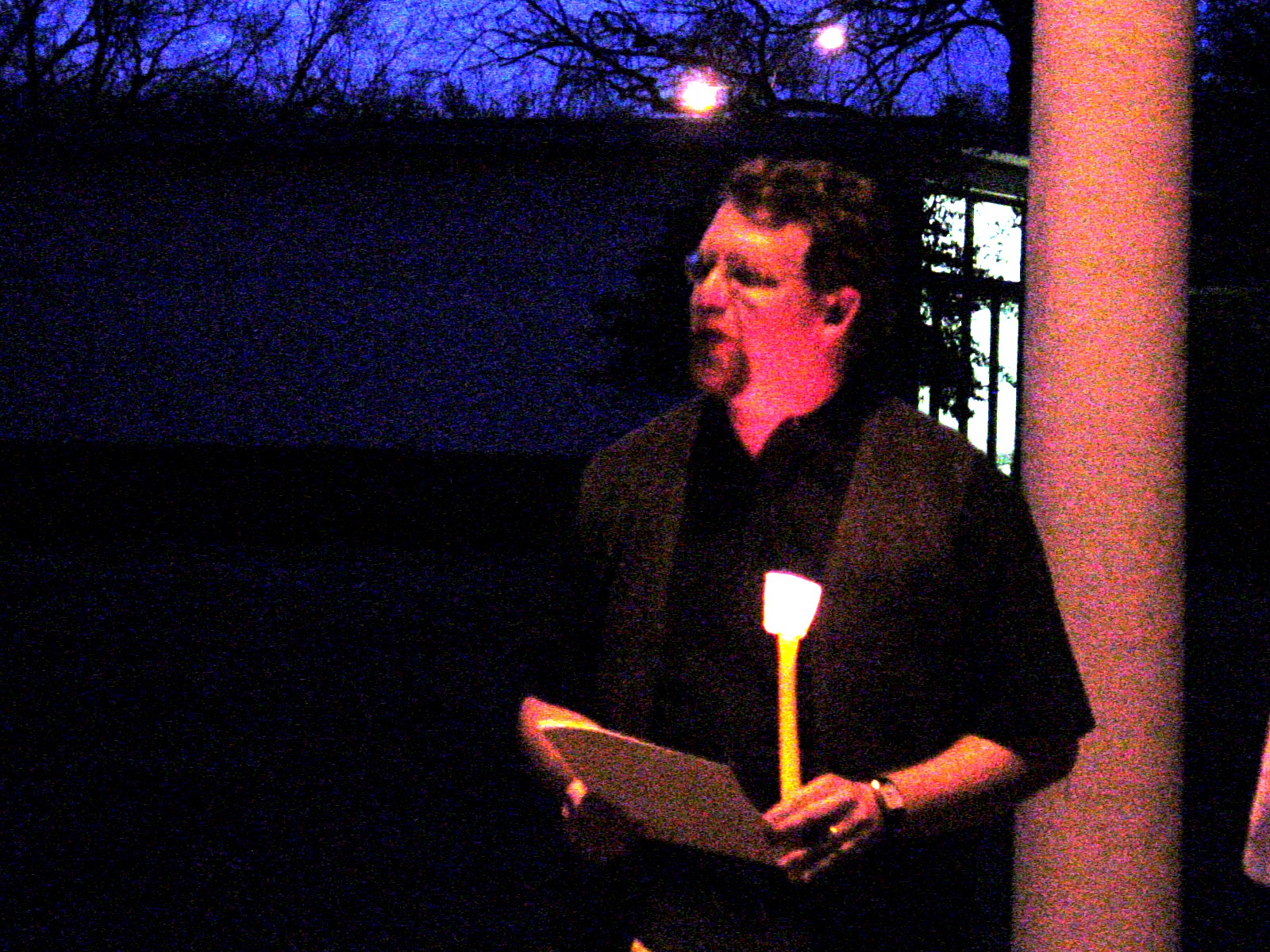 Photo by Rev. David Reed
Despite the strident nature of my social justice work as a younger man, my approach today is much more relational. While I am willing to stand up and speak forcefully on issues in public when necessary, experience has shown me that much more is accomplished by sitting down at the table with someone than by shouting across the table at them. Indeed, I've found this approach fits my personality as a relational, warm person better than the more confrontational approaches of my early activism. My work in the community now involves getting to know key leaders in the community, building relationships, and working together on common causes, even when there are other issues where we differ widely. This style of activism is usually more effective, and as a minister of a church, it serves the church well, because by association, our church becomes known as one that takes an active role in the well-being of the community, and gets results doing so, without polarizing our potential supporters.
My current interim ministry has brought with it a welcome return to this work. I value serving a church that has a great deal of involvement in the community, and I have stepped forward in several ways to engage this work as well. Issues in which I've been involved include organizing peace vigils, protesting executions of prisoners, and supporting living wage capaigns. Two issues in particular, on which I've focused throughout my adult life, have also captured my attention here in San Antonio:
One is advocacy as an ally with the bisexual, gay, lesbian, and transgender (BGLT) community. My support for the equality of BGLT-identified persons has led me from working to have sexual orientation included in my university's non-discrimination policy during my undergrad years, to volunteering at the local AIDS Services agency, to leading two congregations in their work to become Welcoming Congregations. Here in San Antonio, I have become active in the newly-organized PRO San Antonio (PRO: Progressive Religious Organization), a BGLT advocacy group including leaders of several local faith communities; we're working on projects from a Christmas collection drive for the local AIDS Foundation, to coordinating the annual interfaith Pride worship service in June.
The other is grassroots community organizing work. I believe strongly in particpatory democracy, and recognize that for the participation of citizens to be authentic and effective, especially citizens marginalized by poverty, race, or social status, it requires coalition building among disenfranchised groups around causes of common good. This work for me began during my more radical activist days, before seminary, when I worked with residents of a predominantly African-American, working poor neighborhood in my hometown to oppose building a nearby plant to manufacture radioactive material. This campaign taught me valuable lessons about the intricacies and challenges of such work. (Our campaign was not successful in stopping the plant--but the company building it went bankrupt before it opened, so no radioactive material was ever manufactured there.) In San Antonio, I've become involved with COPS and The Metro Alliance, two of the nation's most successful community organizing groups, to meet with organizers, participate in accountability assemblies with political candidates, and advise leaders on strategy for future campaigns. This work equips me to live out the principle of promoting the right of conscience an the use of the democratic process in ways that help produce real results in the communities I serve.
home page