Preaching & Religious Education
Rev. Eric Posa
Preach as you would speak to someone you love: not spectral,
jargon language or public utterances.
- Federick Buechner
The great end in religious instruction is not to stamp our minds
upon the young, but to stir up their own....
- William Ellery Channing
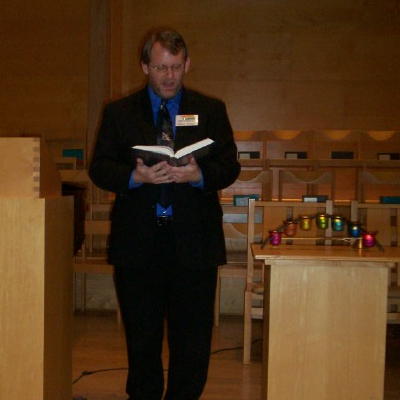 First UU Church of San Antonio
leading Unison Reading after Sermon
December 3, 2006
Yet the sermon cannot be reduced to mere text. Preaching is an embodied act, one in which words, thoughts and ideas are given life through their delivery by the preacher using his or her voice tones, inflections, gestures and expressions. In my own preaching, I often find my delivery of the sermon is most effective when I step away from the pulpit and can walk around, engaging my whole body at times in the delivery of the message. It�s not uncommon to see me moving about the �chancel� (or the front of the sanctuary) with the goal to engage the sermon as fully as possible and to present it as personally as possible.
My sermon themes vary widely. I believe in drawing upon many traditions and many disciplines to inform my sermons. Some focus on themes from particular religious traditions: in recent years I�ve preached on the Four Noble Truths of Buddhism, the Taoist concept of acting through inaction, and a liberal religious understanding of the Christian resurrection myth. I�ve also preached on more personal themes of forgiveness, thankfulness, and anticipation; these sermons may draw on religious writers, poetry and fiction, psychological perspectives, or simple daily wisdom.
Theological themes regularly inform and are expressed in my preaching on any given Sunday. However, I find my focus in most sermons is more inspirational than intellectual. My general style is to draw themes out of stories: these stories strive not only to illustrate such themes but also to help people connect on a more visceral level. Sometimes these are personal stories from my own life; sometimes descriptions of the lived experiences of other people contemporary and historical; other times fictional tales, fables, parables, myths and allegories. My goal in preaching a sermon is for people to leave with some food for thought, but more so with an inspiration to commit to another aspect of life.
I have found that for in-depth exploration of intellectual themes, the classroom or small group setting is a far better context than Sunday morning worship. Adult Religious Education (RE) classes provide opportunities for the give-and-take exchange of ideas that fosters deepening of insights. Small group ministry, whether affinity groups or a more co-ordinated small group program, can also meet this need for intellectual stimulation while pairing such exploration with the fellowship and intimacy of an on-going group meeting. I greatly enjoy teaching in a small group setting, and will pursue regular opportunities to "proclaim" in these interactive settings in any church I serve.
I also strongly support children's RE, and will look for ways in any congregation I serve to be present with children and parents throughout their experience of church life. In San Antonio, for example, I attend the monthly RE worship on the first Sunday of each month, and often participate in some way. That said, I find that I most effectively can support children's RE by entrusting the DRE to do her or his work well. I collaborate regularly with the DRE, offer support and advice when needed, and stay out of his or her way the rest of the time.
home page