Theology
Rev. Eric Posa
No existent theology can be a final formulation of spiritual truth.
- Harry Emerson Fosdick
It is our function as ministers to be multi-lingual with respect to variant religious philosophies - to manifest our own theological preferences while simultaneously undergirding others navigating their own routes toward divine wisdom.
- Tom Owen-Towle
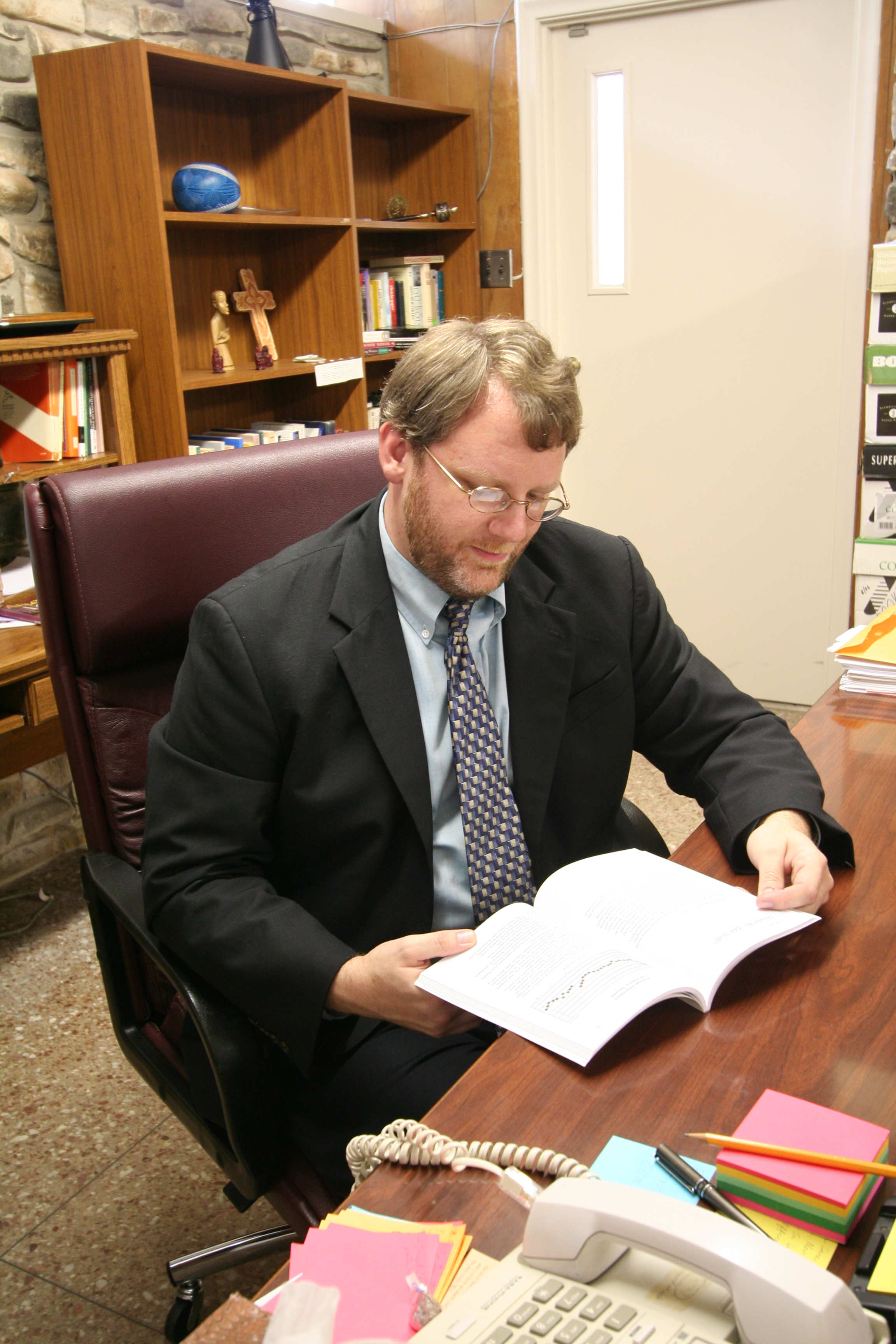
San Antonio, Texas - Minister's Study
November 5, 2006
Philosophies such as pragmatism and process philosophy/theology also inspired me to explore the meanings to be found in interrelatedness, a view of reality affirmed by both schools of thought. As I began graduate studies in philosophy I focused my studies in environmental ethics. Thinking critically about the relationship between the human and natural worlds further focused my emphasis on understanding all elements of existence as interdependent. More recently, encountering the Jewish existential philosopher Martin Buber has helped me to see how human relationships can be understood more deeply when they are seen as expressions of this larger interrelatedness.
Over time, I've become more interested in theology than in philosophy. Philosophy, or (more generally) reason, are tools for exploration of ideas. Theology has been described by Rebecca Parker (president of Starr King, a UU seminary) with the metaphor of a house. Philosophy and reason may be our greatest tools, but one cannot build a house with only tools; you also need building materials, and a foundation. The foundation, I'd argue, is faith. By faith, I do not mean belief. The word "faith" derives from the Latin for trust � trust in a value which transcends my own simple self, whether natural or supernatural, person or impersonal � and trust in something on which I can rely to make sense of my world. We may place our trust in God/gods/goddesses, nature, or the human community. To have faith in one of these is to trust not only its importance in my life, but in doing so to begin understanding something of my place in the world and my sense of hope toward it. Theology has been defined as "faith seeking understanding;" I see theology as applying the tools of philosophy (as well as those of art, science, etc.) to the materials of our experience, upon a faithful, trustworthy foundation, to construct a house of understanding.
In more recent years I�ve come to value the importance of stories and metaphor, not only to convey larger truths, but as a fundamental way in which we human beings make meaning in our lives. To understand something for us means to be able to tell its story. Thus I�ve come to appreciate the narratives of sacred scriptures from many traditions and their abilities to make sense of our world. Whether it is the Buddhist story of Siddhartha Gautama reaching enlightenment after 49 days of meditation, or the Christian story of Jesus of Nazareth rising from his tomb on the third day following his crucifixion, deep meanings about fundamental aspects of life are conveyed through these stories, regardless of their historical accuracy. Thus I value sacred stories not for literal truth, but for metaphorical truth.
home page