Pastoral Care
Rev. Eric Posa
Where no counsel is, the people fall. - Proverbs 11:14
Maybe that is why ministers were invented. We may not minister all the time better than your neighbor who brings you chicken soup when you are sick, but we are reminders that such work ought to be done in the world.
- Diana Heath
Roozbeh Arianpour - public memorial
March 24, 2005
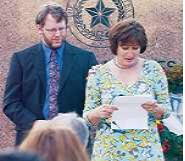 Photo By D.J. Peters
I�ve come to see that pastoral care is, can be, and ideally will be provided through multiple forms. Of course, the one-on-one pastoral conversation is an obvious venue for providing care and comfort to troubled parishioners. In such conversations, I strive not to solve problems, but to hear the emotions underlying the problems, to reflect back my concern, and when possible to ask questions and offer insights that may open up new ways for a person to consider his or her problem in new ways, that may then lead to a good solution.
Much of my pastoral care, however, takes place during coffee hours and church social functions. There I am able to provide the presence and openness to several people in a short time that helps them know they are supported. The pulpit is another venue for providing pastoral care; through sermons that touch on personal issues, I strive to provide inspiration that can help carry congregants through their week reinforced and refreshed. And even in prophetic social justice work, a pastoral element can come forth. By advocating for issues in the public realm�for example, by speaking before a city council to support non-discrimination policies or same-sex partner benefits for BGLT persons�ministers also displays care and concern for the needs of the people in whose behalf we speak.
Pastoral care is one of the aspects of ministry where the importance of shared ministry comes most clearly into focus. The needs of church members for care from the beloved community of their congregation vary widely. Some people have deep spiritual or emotional concerns, which are best addressed in one-on-one conversation with the minister. As a minister, it is important for me to realize that some people's counseling needs require follow-up care beyond a minister's training. I will gather information early in my next ministry regarding mental health care resources in the community, to which I can refer such members when needed.
Sharing the caregiving ministry of the church also means the minister and lay caregivers remain in close contact, sharing information on those in our church needing care, and referring each other to members we can aid. Other care needs such as rides to church or medical appointments, temporary help with meals while recovering from surgery or illness, or casual conversation partners to alleviate loneliness, best can be filled by lay caregivers; an active member care team is invaluable in any church. Part of my pastoral role as minister is to keep these team members informed of needs I encounter, and stay abreast of the work they do with members.
As my seminary career drew to a close, I realized that one area of my pastoral skills was lacking�I had little experience with death and grief. To address this developmental need, I found an unusual way to complete my unit of Clinical Pastoral Education (CPE - an experiential ministry training program, usually in a chaplaincy setting, and required of all ministers in fellowship with the UUA). I met this requirement not at a hospital (the most common choice), but with a hospice agency. Meeting with hospice patients in nursing homes, and in the hospice unit the agency maintained, immersed me in the dying and grieving processes, for families as well as patients. This chaplaincy internship was difficult, but also invaluable in equipping me with the experience to walk with people toward death. I�ve also found that my experience with grieving people has served me well to officiate funerals and memorial services. Recently, this comfort and ability was reinforced, and greatly beneficial, when I first arrived at my current interim ministry with First UU Church of San Antonio, and led two memorial services in my first five days of ministry. Thanks to my previous chaplaincy experiences, I was able to conduct these services well.
The pastoral experience, especially my experience with trauma ministry, was reinforced during my for-unit CPE residency. following my first unit of CPE. (One unit of CPE involves approx. 3 months of full-time chaplaincy work.) This was a year-long, full-time position as a chaplain at Harris Methodist H-E-B Hospital, in the suburbs of Fort Worth. I had frequent opportunities in the Emergency Room, Intensive Care Unit, and other hospital areas to be present with families as they came to terms with the loss of a loved one, sometimes suddenly, sometimes after years of preparation. I also honed my skills with communicating with persons undergoing various kinds of medical challenges, which has served me well in my hospital visits with church members.
Another deeply valuable aspect of my hospital service was my work in the psychiatric and chemical dependency treatment facility next door to the main hospital. Regularly attending group sessions in both the inpatient and outpatient programs, and frequently meeting one-on-one with patients, vastly increased my awareness and sensitivity to mental health issues, especially depression and addiction, but also bipolar disorder, various personality disorders, and other conditions. My familiarity with these conditions, and knowledge of how best to spport those living through them, has been greatly enhanced.
home page