 |
What
is Karst?
The term karst was first used
to describe a plateau in the Dinaric Alps of Yugoslavia. Karst
is formed by the dissolution of carbonate bedrock, such as
limestone, marble and dolomite. This dissolution occurres
over many thousands of years. This process is called "the
carbon dioxide cascade." It begins with raindrops passing
through the atmosphere picking up carbon dioxide. Upon reaching
the ground, it sinks into the ground. As the rainwater travels
deeper into the earth, it begins to absorb more carbon dioxide.
This begins to create a weak acid called carbonic acid. Soon
the water finds cracks and crevices in the earth . After thousands
of years, this waterflow begins to dissolve the carbonate
bedrock. This dissolution process creates karst formations.
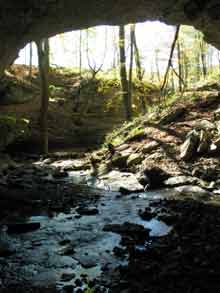
Natural features of the topography of such areas are dominated
by sinkholes, vertical shafts, disappearing streams, large
springs. Eventually, these drainage systems develop into what
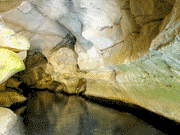
are known as caves.
These great drainage systems or aquifers are capable of providing
large supplies of water. More than 25 percent of the world's
population either lives on or obtains its water from karst
aquifers. In the United States, 20 percent of the land surface
is karst and 40 percent of the groundwater used for drinking
comes from karst aquifers. Unfortunately, these aquifers are
sensitive to external pollutants and have been significantly
impacted by mankind’s influence. This cycle repeats
itself as the negative impact upon these aquifers also negatively
affects mankind. It is the purpose of the BKC to preserve
these karst features.
|
|