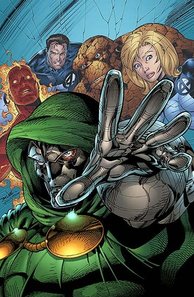
Doctor Doom, one of the most archetypal
supervillains and his arch-enemies The
Fantastic Four (in background). Art by Jim
Lee.
A supervillain is a variant of the villaincharacter
type, commonly found in comic
books, action
movies and science
fiction in various mediums. Supervillains often have
colorful names, costumes and/or other eccentricities and
concoct complex and ambitious schemes to accumulate power and
suppress adversaries. Female supervillains are sometimes known
as supervillainesses.
Supervillains are often used as foils
to superheroes
and other fictional heroes. Their
extraordinary brainpower and/or superhuman abilities make them
viable antagonists
for even the most gifted heroes.
Many supervillains are inspired by typical characteristics
of real world dictators, mobsters, and terrorists.
Common Traits
While supervillains vary greatly, there are a number of
attributes that define the character. Most supervillains have
at least a few of the following traits:
A generally irritable and spiteful disposition and
contempt for heroes, ordinary civilians, lackeys, and anyone
else who may get in their way.
A sadistic nature and tendency to revel in their sociopathic
behavior and/or supposed intellectual superiority
A brilliant scientific mind that he or she chooses to
use for evil (see also mad
scientist and evil
genius).
Superhuman
abilities or some special skill, similar to those of superheroes.
Frequently, these skills are intellectual, inventive or
involve technology-based powers and are gained through a
desire to become more powerful, as opposed to the "natural"
or "accidental" gifts possessed by superheroes. (Compare the
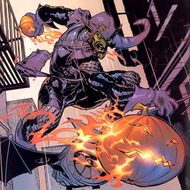
origins of the Green
Goblin or Doctor
Octopus to their nemesis Spider-Man).
An enemy or group of enemies that he or she repeatedly
fights.
A desire for revenge against said enemies. The method of
revenge often goes beyond simply killing them to making them
suffer before death, such as using deathtraps.
A dark and threatening-looking headquarters or lair, the
location of which is usually kept secret from police,
superheroes and the general public (Magneto’s
headquarters Asteroid
M, The Legion of
Doom’s Hall of Doom). However, some supervillains who
feel secure from prosecution live and work in palatial
buildings (Doctor
Doom's castles in his country of Latveria
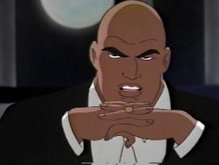
and Lex
Luthor's LexCorp
office buildings). Others are mobile and do not have one
particular base of operations.
A theme by which he or she plots his crimes. For
example, Two-Face
plots his crimes around the concept of duality and Mysterio
plots his around movie special
effects.
Although super villain “team-ups” occasionally occur and
some supervillain teams exist (such as the Brotherhood
of Mutants and Sinister
Six), most supervillains do not collaborate with one
another but employ a team of simple-minded and expendable henchmen to
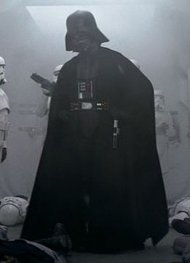
assist them. Some supervillains, such as Darth
Vader and Cobra
Commander, control entire armies.
A strong commitment to their criminal profession to the
point where they will quickly resume their activities in
their favorite area immediately after escaping prison or
recovering from serious injury.
A refusal to accept responsibility for personal mistakes
and setbacks in favor of blaming their enemies
A back
story or origin story that explains how the character
transformed from an ordinary person into a supervillain. The
story usually involves some great tragedy that
marked the change. In the case of many supervillains,
including Two-Face, Magneto, Doctor Doom, and some versions
of Lex Luthor, this story involves a one-time friendship
with their future foe.
Personality Types
One thing that supervillains do not share is motivation;
characters choose to become supervillains for many different
reasons:
Red Skull,
Lex
Luthor, Professor
Moriarty, and many others are portrayed as outright evil
and power-hungry. Few writers attempt to portray them with
any sense of humanity or redeeming qualities. This approach
was common in the Golden
Age of Comic Books, but subsequent writers prefer more
sympathetic villains. Marvel
Comics writer/editor Stan Lee
often says it is more important that fans sympathize with
villains than heroes.
Darth
Vader, Venom
and the Green
Goblin, have fallen under some corrupting influence. In
some cases, such as the famous ending of Star
Wars: Return of the Jedi, the character overcomes
their manipulator and is able to somewhat redeem himself.
A few characters deemed supervillains actually have
goals that could be considered noble but pursue them in
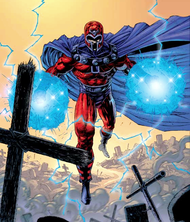
extreme ways. The best-known example of this is the X-Men’s enemy
Magneto,
a Holocaust
survivor who seeks to end the human's oppression of mutants,
but believes the only way for this to happen is for mutants
to rule over the humans, and is willing to use terrorism to
accomplish his goals. John
Sunlight, featured in Doc
Savagepulp
magazines, Batman's Ra's al
Ghul, and Ozymandias
of the comic book series Watchmen
have large-scale utopian goals
but are willing to resort to extremely destructive measures
to implement them.
Although not seen as much in the West, the concept of
the noble villain (similar to the description above),
the difference is that this kind of villains shows a sort of
respect for the hero despite hating them. This is seen a lot
in anime and tokusatsu.
While not exactly an anti hero,
they still do villainous deeds, but help the hero to pay
back the debt their nemesis has done for either them,
another comrade, even kin. However, when the debt is paid,
the villain continues with his crimes until the next time.
Usually, these types of villains are resolved by either
dueling with the hero and being defeated, becoming a
hero/anti hero, or dies rescuing the hero to repay their
debt to them. In the end, they usually make some kind of
final request to hero, in which the hero accomplish after
the individual perishes. This is the case where both hero
and villain can relate to each other as they both
experienced the same life, but chosen different paths. Storm
Shadow is probably the best known Western noble
villain.
A few supervillains, such as Galactus
personify forces of nature and cannot be judged by simple
standards of morality.
In the Modern
Age of Comic Books, heroes and villains have generally
become less morally
absolute. While many superheroes were portrayed as
psychologically complex and morally fallible anti-heroes,
villains also became more multifaceted. Psychological impulses
and personal tragedy were often explored as motivations behind
their behavior. During this time, many villains were
“redeemed” and, either permanently or provisionally, become
anti-heroes. Examples include Magneto, Elektra,
Venom, Sandman, Catwoman, Emma Frost,
Juggernaut
and Mystique
Many supervillains are portrayed as an inversion of their
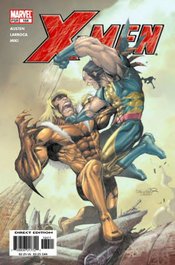
foe. For example, Wolverine
constantly tries to contain his animalistic urges, while Sabretooth
fully embraces his. Batman is a
humorless character with a foreboding appearance, but who is
dedicated to good. The
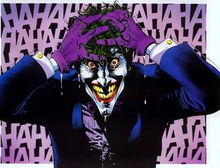
Joker, on the other hand, is a comical character with a
colorful appearance, who is actually evil. The
Incredible Hulk is the raging, reckless alter ego of a
brilliant scientist while The
Leader is the intelligent, conniving alter ego of a person
of average intellect and both were transformed by gamma
radiation. And, another example would be Spider-Man and
Venom. Peter Parker and Eddie Brock both worked for the Daily
Bugle, both transformed into superhuman beings (Parker by
spider bite and Brock by alien symbiote), and both have almost
equal abilities.
Occasionally, this contrast is more direct. Bizarro is an
alternate
reality version of Superman from
a “Bizaro World” in which everything is an inversion of its DC
Universe counterpart (In the current DC Comics continuity,
however, he is a flawed clone of
Superman.) Like Captain
Marvel, Black Adam
was once a protégé of the wizard Shazam, but
used his powers for evil and has returned to challenge Marvel,
wearing a costume that parodies his.
These contrasts help build-up the |mythic
grandeur of superhero and villain relationships and allow the
villain to serve as a foil
for the hero.
In an age of frequent comic-book crossovers, heroes
occasionally appear as supervillains in one another's books.
Many of the classic superheroes have elaborate codes of honor
under which they swear off firearms, seldom/never kill, work
under government supervision, and generally behave in a
kid-friendly and wholesome manner. Newer, more transgressive
heroes such as Hulk and Punisher can easily fill the role of a
supervillain under such "ground rules."
Origins
By most definitions, the first supervillain was Professor
Moriarty, the arch enemy of Arthur
Conan Doyle’s detective Sherlock
Holmes, introduced in 1891. Dr. Fu Manchu,
the antagonist of several popular novels of Sax Rohmer,
is credited with popularizing many of the typical
characteristics of the modern supervillain, including his
sadistic personality, his desire for world
domination, and his use of sinister lairs and themed
crimes and henchmen. Rohmer's work had a strong influence on
Ian
Fleming, whose James
Bond novels and their film adaptations further
popularized the image of the supervillain in popular
culture.
The first supervillain who wore a bizarre costume was the
Lightning, from the 1938 filmFighting
Devil Dogs, which preceded the first superhero, Superman.
The first supervillain to regularly battle a Superhero was
Lex Luthor,
who first appeared in Action
Comics #23 (1940).
Skeletor,
other-dimensional conqueror and arch-enemy of He-Man.
Well-known parodies of supervillains
Because the supervillain is such a common but distinct
character type in modern fiction, several parodies have
been created. Some of the best-known include:
Mr.
Burns, crotchety power
plant owner on The
Simpsons, takes on the role of supervillain in
various episodes, as when he builds a device to block out
the sun which causes Waylon
Smithers to remark: "He's gone from regular villainy to
cartoonish super-villainy!" At least one episode featured a
shot of Mr. Burns with the Darth
Vader theme playing. Mr Burns also bears a likeness of
the Evil Emperor Palpatine,
the ultimate evil in the Star
Wars saga.
The Simpsons also featured, in the episode 'You
Only Move Twice', the character of Hank Scorpio
(voiced by Albert
Brooks), a parody of James
Bond supervillains, who briefly employed Homer
Simpson in his plot to conquer the east coast of the
U.S.A. Scorpio is portrayed not as a mere vainglorious
supervillain but as a considerate and friendly employer
whose generosity to his employees is remarkable and who,
through his kindness and understanding, allows Homer to
actually develop enthusiasm for and competency in his job.
As a reward for Homer's invaluable assistance in his plot,
he gives Homer the Denver
Broncos football team.
Stewie
Griffin, diabolically ingenious, talking baby of the TV
series Family
Guy. In earlier episodes attempted to control the
weather to rid the world of broccoli,
and his biggest aspiration is to complete his matricidal
efforts (namely by killing his mother, Lois). Latter
episodes have portrayed him as merely inconsiderate,
prematurely grumpy and possibly gay.
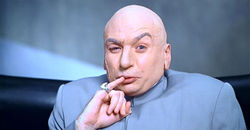
Dr. Evil,
bubbling criminal mastermind and adversary of Austin
Powers in a series of spy film spoofs.
The
Brain, from the cartoon series Animaniacs
and one of the titular stars of the spin-off show, Pinky
and the Brain, is a diminutive lab mouse bent on
global conquest.
Syndrome,
hyperactive mad
scientist and superhero-wannabe
from the computer animated film The
Incredibles, and now arch-enemy of the superhero
family of the same name. The Underminer and Bomb Voyage,
from the same film, parody the popular "themed"
supervillains. A fourth villain, Baron von Ruthless
is mentioned. In the DVD Bonus Features, it is revealed that
there was another villain to be the primary enemy of the
Incredible Family, a man named Xerek. Xerek, however,
was bested in popularity among the creators by Syndrome, who
took the role.
O'Malley,
the main villain and common adversary of both sides in the
second and third seasons of the machinima
series Red vs
Blue, is an over-the-top supervillain caricature.
He frequently uses clichés and
ridiculous dialogue such as "You foolish fools will never
defeat me! You're far too busy being foolish!", or "Prepare
for an oblivion, for which there is no preparation!",
usually accompianied by extreme close-ups of his helmet
visor, and followed by evil
laughter.
Professor
Chaos, the recurring alter ego
of Butters, a
fourth grader on the animated series South
Park, seeks to spread fear and chaos as revenge upon
the world that has forsaken him (made him socially
unpopular), but has a problem with scale. Exploits include
switching people's soup at a restaurant, attempting to
destroy the ozone layer by spraying regular aerosol cans and
flooding the planet by leaving the backyard hose on. Once
suffered an existential crisis prompted by the fact that all
of his plans had previously been done on The
Simpsons.
Dark Helmet, and the Spaceballs.
A parody of Darth
Vader with a new and creative twist (underneath his
massive helmet is a short man wearing a tie), Dark Helmet
would be a believable supervillain if it weren't for the
fact that he is so ridiculous and comical.
Casanova Frankenstein is the villain in the 1999 movie
Mystery
Men. He employed several gangs of themed henchmen
including the "Disco Boys." His goal was to destroy Champion
City with a doomsday
machine.