| JULIUS CAESAR POMPEY CRASSUS and the CONQUEST of GAUL |

|


 |
 |
|
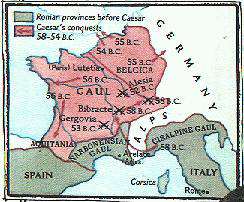
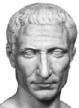
| Julius Caesar (100 B.C.- 44 B.C.) came from a Patrician family and traced back their descent to Aeneas of Troy. He supported the populares as his father had. He also was a supporter of Marius making him even more a populares. His wife Julia had married Marius, and Julius Caesar was married to a daughter of Cinna. When Sulla became dictator Julius Caesar became in danger of losing his life since Sulla had been an enemy of Marius. He was lucky to keep it since many powerful friends of Caesar protected him, and convinced Sulla not to kill him besides the fact that Sulla did not really dislike Julius. Julius Caesar then left Rome and went to Greece for a while to study and went and visited areas around there while Sulla was alive. After Sulla's death he went back to Rome. Pompey was a hater of the populares. Sulla came to like Pompey and would give him great jobs. Pompey also destroyed the pirates in the Mediterranean and also put down the slave revolt by the gladiator Spartacus (who had destroyed some legions). Pompey also was cruel and merciless and trained and disciplined his soldiers hard. Pompey later had ties to Caesar since he married Julia, Caesar's daughter. Crassus (107 B.C.- 53 B.C.) also came from a Patrician family. Crassus was also a supporter of Sulla and was a disliker of the populares. His father had been a consul thereby adding power to the family, and Crassus himself became the richest man of the Roman empire at that time. Crassus was a supporter of the optimates and by using his power he helped them. These three men joined forces or an unofficial pact called the first Triumvirate. Although they were really enemies and shared different view points, they did hate the power of the Senate and their conservative ways. Caesar went to Gaul to fight off the Rebels while Pompey and Crassus were elected consuls. Crassus died in 53 B.C. and the Triumvirate was finished. Pompey then assumed power. The Senate made him sole Counsel (meaning there would only be one counselor instead of two) and later made Caesar resign to his Legions. Caesar declined and crossed into Italy through the Rubicon River. According to Roman law a general and his army could not cross the Rubicon River because that was declaring war on Rome. Julius Caesar did cross it and after some battles Caesar defeated Pompey. In 45 B.C. he was welcomed to Rome and named dictator, and then in 44 B.C. he was named dictator perpetuos meaning emperor for life. That same year he was assassinated by Roman Senators. During the time in which Pompey and Crassus were consuls Julius Caesar was leading a Campaign in Gaul. The purpose of the Campaign was to conquer the whole of Gaul ( this was in the 50'sB.C.). Caesar had eight legions with him at the time and made good use of them. Caesar had to fight the fierce celts who greatly outnumbered his eight legions, but he still subdued them. He also had to fight the fierce Germanic tribes who had been slowly taking up lands in Gaul. Julius Caesar completed his campaign and then tried to invade England. He failed twice. A distraction to him was that of Pompey, and he had to go there instead of making plans of invading England. His most loyal legion was the XX who acted as Julius' bodyguard. |
 |
 |
 |
