Predators & Diseases
 Although deer live fairly tranquil lives, they must live cautiously and with a degree of alertness, for they must be aware of when danger approaches. In the wilderness, danger comes in the form of predators, meat eating animals who rely on deer and other forest creatures for sustenance. The main predators of the deer are mountain lions, wolves, and coyotes, although in some areas there are others such as bears, bobcats, dogs and alligators.
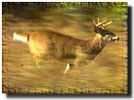
The deer's keen senses offer them a good perception of when danger is around. If they are faced with a predator, the deer's only defense is to run. Deer are one of the fastest animals in the forest, so this often proves successful. However, if caught by a predator, deer have no other method of defense, and must succumb. Bucks are sometimes able to use their antlers to ward off predators. Bucks have been known to kill a few wolves in pack before being devoured by the rest. Deer are also great swimmers; they'll often take to the water to evade predators who can't swim.

Humans are also a threat to deer. Although human intervention has not affected deer populations significantly, hunting has. But in most parts, hunting helps keep deer populations at a reasonable level. Also, many deer die each year from being hit by cars.
There is not one big disease which is an annual threat to deer; however disease is still a major threat to deer. If a deer is stricken with disease, it must bear it for the rest of it's life. Another big problem for deer is tapeworm. Tapeworms are usually contracted when deer eat questionable plants, plants which if they had a choice, they would not eat. Once a tapeworm enters a deer, the deer becomes greatly malnourished, until it dies.
Lyme disease is a disease which affects humans and not deer. It is contracted from the deer tick, which is a parasite which lives off deer. About 1 to 2 percent of deer tick are believed to have Lyme disease. The disease is named after Lyme, Connecticut, where in 1975 the disease was first discovered after there was an epidemic of Lyme disease.