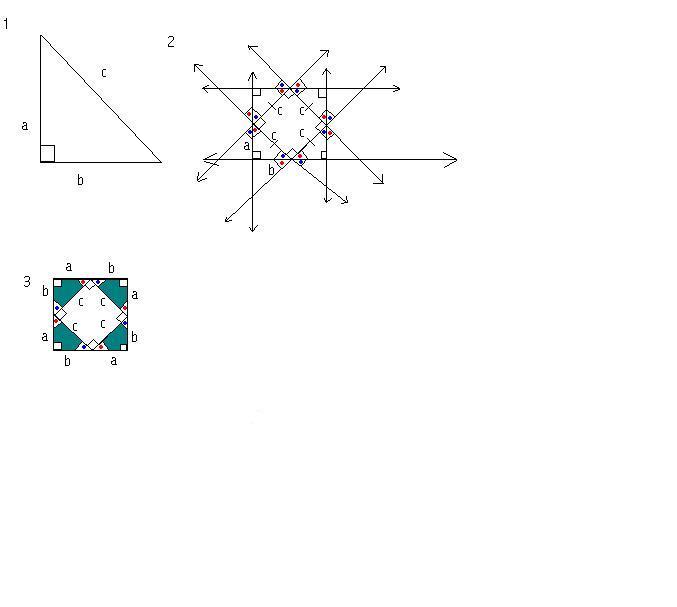
2. A square with side c is drawn. Then all the line segments are extended to infinity. Also a line parallel to line "b" is drawn so that it is tangent to the uppermost corner of square c. Another line that is parallel to "a" is drawn so that it is tangent to the square c's rightmost corner. After confirming all the angles, congruent angles are colored in uniform color.
3. This shows that square c is surrounded by 4 congruent right triangles with legs a and b.
4.Therefore c^2 will equal the area of the large square minus all the areas of the congruent right triangles.
5. c^2=(a+b)^2 - 4(ab)/2
c^2=a^2+b^2+2ab-2ab
c^2=a^2+b^2