As his conflicts with
the Mughals were intensifying, the Guru fortified the city well. In fact,
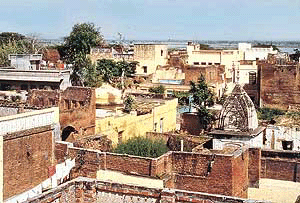
these fortifications were so solid that the original city walls and many
buildings within are still visible throughout Sri Hargobindpur. Tiny
Nanakshahi red bricks blend into more recent larger cut brick structures.
Similarly, the ancient history of the town blends into the present, as
residents of all religious faiths perceive themselves as heirs to the sixth
Guru’s mission to found a secure and secular home on the banks of the Best known for his
miri-piri approach to authority, Guru Hargobind was equally comfortable with
Muslim faqirs and Hindu sadhus. According to some Sikh histories, when asked
by the Mughal Emperor Jahangir about the difference between Islam and
Hinduism, the Guru responded with a hymn composed by his father, Guru Arjan
Dev, which concludes: "You are the Bestower of kindness and mercy. Grant
us devotion and worship of you, O Creator. Allah and Parbrahm are the
same." The Guru’s civic plan reflected this understanding of the concept
of God having multiple names but being one entity as the town included
gurdwaras, temples and a mosque. Even today, the people of Sri Hargobindpur
visit all these places frequently and freely, regardless of their religious
affiliations. One of the best
examples of this pluralism is that in the post-Partition period, in the
absence of Muslims to oversee a Sufi saint’s tomb, local Hindus, Sikhs and
Christians are continuing the tradition of the saints. They demonstrate their
concern for their shrines through weekly ceremonies, annual festivals,
voluntary cleaning and maintenance, and especially through narration of
stories about the pirs. |
|
|
Many of these stories
concern the association of a saint with the neighborhood or region, linking
the locality with famous saints, rulers, invaders, and miracles. Other
stories are more intimate, detailing events in the community and their own
houses, showing the depth of the connection between these saints and this
place. In fact, many residents say that one of the most significant thing
about Sri Hargobindpur are its five gates and the shrine at each gate
belonging to a Muslim pir. In fact, the gates and the pirs are credited with
safeguarding the community. Although all five pirs
at the five gates of Sri Hargobindpur can still be found, four of the five
gates are now in ruins and live on only in the memories of the residents. One
gate, however, still bears physical evidence of this source of Sri
Hargobindpur’s protection. The Lahori Gate is an imposing two-storeyed and triple bay structure
standing at the main entrance to the settlement. This little known monument
is of enormous historic importance as it is the only existing example of a
gate built by a Sikh Guru in all of
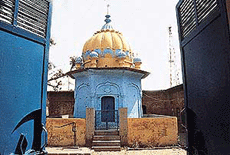
At the Shamana Gate is
the dargah of Baba Shamana. The gate itself disappeared long ago, but the
tomb remains perched picturesquely on a cliff overlooking the According to local
lore, the pir was here before the Guru came and when the walls were built,
the Guru asked him whether he wanted to be inside or outside the gates, which
would be closed every night at 10 and opened again at 4 in the morning. The
pir, not wishing to have his movements restricted, chose to remain outside
the walls. According to another account, Baba Shamana gave shelter to a gang
of Muslim cattle thieves who had been operating the city. When the town
people came to complain, the saint told them to take back the cattle if they
could recognise them—then he changed their shapes and colours. Afterwards,
the cattle thieves repented and became the pir’s sevadars . This interweaving of
religious traditions and local history is also evident at Damdama Sahib, a
gurdwara just outside the city on the road towards Although nothing remains of the original gurdwara, Damdama Sahib is
an important centre of Sri Hargobindpur’s religious life. The importance of
the site is increased by the presence of a pir’s shrine just across the large
sarovar near the imposing new gurdwara currently under construction. This
building is humbler, but ancient and beloved. It is dedicated to Jaane Shah,
a Muslim faqir who heard of the Guru and sought him out here. According to
the Gur Bilas, Jaane Shah came daily for darshan of the Guru. As a test of
the extent of his faith, the Guru refused to see him and even had a wall
built between them. This did not deter the persistent seeker, so the Guru
tested him further, instructing him to jump into the river if he wanted to
meet the Guru quickly. The faqir immediately went to obey the command, at
which point Guru Hargobind was convinced of his sincerity and brought him
back.
It is a further example
of the integration of religious traditions in this town that this pir’s
shrine does not house the saint’s tomb, but rather the Guru Granth Sahib. On
the walls are images of Guru Nanak and Guru Gobind Singh, Lakhadata Pir and
Namdev. Many people who come to Damdama Sahib from all over the region visit
both places. After establishing
Damdama Sahib at the site of his military victory, the Guru returned to his
civic planning. He said to his Sikhs, "Create a town of unmatched
beauty, with five gates, that puts the enemy to shame the moment it sets its
eyes on it. And let those who inhabit the town be free of sorrow." (Gur
Bilas) Then the Guru invoked the aid of God Visvakarma, who at the Guru’s
command "constructed mandirs and bazaars of different kinds and in their
midst a beautiful maseet which the Muslims would love. In this place—a
treasure of happiness— he placed his diwan and reflected." (Gur Bilas).
Setting to work, God Visvakarma took only six days to establish the
20-feet-high, 2.5-feet- thick walls and the grid-iron pattern of the
interior. The genius of this
centuries old urban planning is confirmed by the fact that it is still
impossible to get lost or remain isolated in Sri Hargobindpur. Small
alleyways join the two main roads, previously both bazaars. Today, along the
main road from Lahori Gate is a vibrant market. This plan connected all
neighbourhoods, integrating the settlement and allowing women in purdah to
pass easily between homes and markets. Also, on nearly every street is a
temple, gurdwara or pir’s dargah. From Baba Shahmana to the Gurdwara Sat Kartarian,
for example, is both a gurdwara and a mandir. This place is managed by a
Hindu family related to Baba Sangat Das, a descendent of Guru Nanak’s famous
follower Bhai Phero. The gurdwara is on the ground floor and on the two
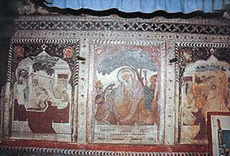
floors above is a small chamber containing the 300-year-old wooden seat, or
gaddi, of Baba Sangat Das. Exquisite paintings of the gurus and other saints
cover the walls of this room. Perhaps the fullest
expression of the secular spirit of Guru Hargobind and the citizens of Sri
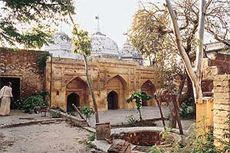
Hargobindpur is found in the ongoing work to preserve and maintain the mosque
the Guru built—the Guru ki Maseet. Of all the religious shrines in Sri
Hargobindpur, the Maseet enjoys one of the most stunning views of the The Maseet is small,
but lovely—built in the typical three- domed, three-bayed style of Shah Jahan
period mosques. As the work progresses, from beneath layers of limewash and
old concrete, calligraphy, decorative paintwork, and the small red Nanakshahi
bricks are emerging. The Guru ki Maseet is being repaired and restored by the
Cultural Resource Conservation Initiative (CRCI), as a part of the
UNESCO-UNDP Culture of Peace programme. The work is also supported by the This project has helped
restore the connection between the non-Muslim residents of the town and the
Guru’s mosque. Sangeeta Singh Bais, an architect and UN volunteer, says that
when she first came the site was overgrown and unvisited. But, "now
people can tell you all about it. Now they come to see the site and see how
the work is going, and say what good work we are doing." As CRCI’s director,
Gurmeet Rai, points out, "All too often the physical condition of a
building does not reflect the depth of the bond between a site and the
community surrounding it." Therefore, in conjunction with the work on
the mosque, the CRCI is working to re-establish these links between the site,
the event it represents, and the citizens of the town. Bais adds, "We
are here to raise awareness about why historical places are important and
culture is important. The people here should be able to take care of the sites
after we are gone, and they need to know how rich their culture is."
Working under the guidance of Dr Savyasaachi, a social scientist based at According to Meena
Manhas, the volunteer who implemented the school programme, "Previously,
students were surprised to see me at their schools, but when they saw that I
was telling them stories about their own city and the gurus, then they became
very interested and began to ask lots of questions and participated eagerly
in seva and in competitions." The work has also
encouraged local efforts to foster economic growth without destroying
historical places. For example, many residents are opposed to the initiative
to sell the shops within the Lahori Gate. They are afraid that the sale will
result in even further disintegration of the structure. As the main entrance
to the settlement it is a key point for local commerce, but as the only gate
built in the entire state by a Guru, it is also a unique historical treasure
in Currently the Punjab
Secretary of Culture and the Municipal Committee are considering ways to
allow the Gate’s continued use without further harming the structure, thereby
allowing the buildings of the past to give shelter and support to the present
needs of the community. After all, as one local
puts it, "Sri Hargobindpur is a place where everyone helps each
other." Furthermore, it is a place to which those who leave feel drawn
to return. Master Ohri, a local Hindu businessman and retired schoolteacher
,spent years away, working. But in these other places dil nahin lagiya
(his heart did not feel connected). So he came back and has become a great
supporter of the work on Guru ki Maseet, donating land to the project and
initiating a plan to start a foundation to preserve Sri Hargobindpur’s
heritage. His community spirit—a Hindu man helping in the preservation of a
Sikh Guru’s Muslim site— is echoed by many others who feel fortunate to live
in a place that is protected by the Guru’s walls, the five saints at the
gates, and perhaps most of all by the continuing efforts of the residents to
preserve this unique place and its rich heritage for their descendants. |