HOME DESTINATIONS
EPIRUS
HOME DESTINATIONS |
EPIRUS |
Local products: Spoon sweets (see "Culture" -> "Recipies" section), honey, apples, chestnuts, walnuts, various marmelades, various pies, milk, meat and homemade butter, yogurt and cheese. In Zitsa village they produce excellent wine and once every year there is a wine festival. Climbing:
Skiing:
How to get there:
Direct dialing codes: Central Zagori Vitsa 26530 Kipi 26530 Laista 26530 Monodendri 26530 Negades 26530 Tsepelovo 26530 East Zagori Greveniti 26560 Vovoussa 26560 Zitsa 26580 Kalpaki 26530 West Zagori Aristi 26530 Mikro Papigo 26530 Megalo Papigo 26530 | |
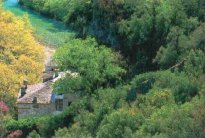
the stone villages 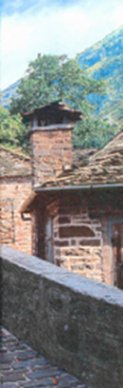 Zagorochoria are a group of 47 mountain villages in Epirus northeast of Ioannina in the area of Zagori. They are divided in 3 sections, the West Zagori, the Central Zagori and the East Zagori. The name Zagori is Slavic and it comes from Za = around and Gori = mountain. Natural borders are the mountains Mitsikeli and Tymphi (Gamila), the valley of Aoos (national park) and Metsovo. These picturesque villages are famous for their natural beauty as they are located in an area filled with forests, rivers and rare wild life, for their glorious past as centres of education and enlightenment and for their skilled artisans specialised in building beautiful stone houses and arched stone bridges. Zagorochoria are one of the most popular winder vacation resorts for the Greeks due to their vicinity to the National Park of Aoos-Vikos and numerous monasteries, their beauty and traditional atmosphere. An area with lots of opportunities for hiking in the forests or the ravine of Vikos or simply strolling in the narrow stone passages of the numerous villages. Some of the most known are Aristi, Vikos, Papigo (big and small), Dilofo (Sopotseli), Dikorfo, Leptokaria, Vitsa, Monodendri, Tsepelovo, Ligiades and Doliani. (Don't forget to ask the locals about the monasteries since there are plenty of those and usually there apart from their architecture and religious objects one can usually admire a breathtaking view to the Vikos Ravine as well.) Zagorochoria are a group of 47 mountain villages in Epirus northeast of Ioannina in the area of Zagori. They are divided in 3 sections, the West Zagori, the Central Zagori and the East Zagori. The name Zagori is Slavic and it comes from Za = around and Gori = mountain. Natural borders are the mountains Mitsikeli and Tymphi (Gamila), the valley of Aoos (national park) and Metsovo. These picturesque villages are famous for their natural beauty as they are located in an area filled with forests, rivers and rare wild life, for their glorious past as centres of education and enlightenment and for their skilled artisans specialised in building beautiful stone houses and arched stone bridges. Zagorochoria are one of the most popular winder vacation resorts for the Greeks due to their vicinity to the National Park of Aoos-Vikos and numerous monasteries, their beauty and traditional atmosphere. An area with lots of opportunities for hiking in the forests or the ravine of Vikos or simply strolling in the narrow stone passages of the numerous villages. Some of the most known are Aristi, Vikos, Papigo (big and small), Dilofo (Sopotseli), Dikorfo, Leptokaria, Vitsa, Monodendri, Tsepelovo, Ligiades and Doliani. (Don't forget to ask the locals about the monasteries since there are plenty of those and usually there apart from their architecture and religious objects one can usually admire a breathtaking view to the Vikos Ravine as well.) | |
| History | |
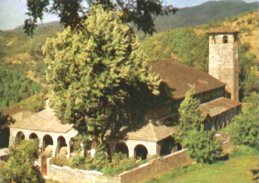 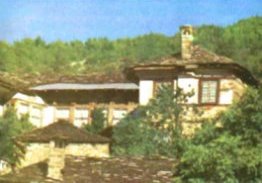 The most important phase of the past of Zagorochoria begins with their occupation by the Turks at the end of the 15th century. Due to their limited accessibility soon became a pole of attraction for the villagers of the valley who tried to protect their families from the conqueror. At the same time, the mountainous character of the area meant pour means of survival for those that chose to live there and soon enough the people of the area began to emigrate in Europe establishing a powerful channel of communication and cultural influence between northwest Greece and western and central Europe. It is not by accident that some of the first educational institutions of modern Greece 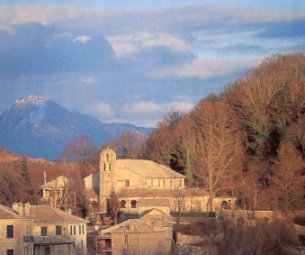 were built there. were built there.
Zagorochoria soon formed a federation that lasted for 2 centuries and achieved a series of privileges unheard in the rest of the occupied territories. No Turk was allowed to enter the zone of Zagorochoria, the Turkish law had no power there and the people of the villages had the right to practise their religious beliefs in freedom. The area soon flourished both economically and culturally and one can still see the old stone mansions and the old schools, remnants of that era. |
|
| East Zagori | |
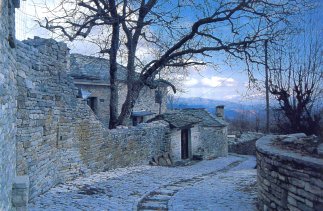 Ligiades is the village closer to Ioannina, the capital of Epirus. It is located on Mitsikeli mountain and it is visible from the city. As a matter of fact Ligiades has a very beautiful view to the city of Ioannina and that is why it is often called "the balcony of Ioannina". It is very common for the visitor of Ioannina to enjoy a dinner in one of the restaurants of the village with a night view to the city and the lake Pamvotis. Ligiades is the village closer to Ioannina, the capital of Epirus. It is located on Mitsikeli mountain and it is visible from the city. As a matter of fact Ligiades has a very beautiful view to the city of Ioannina and that is why it is often called "the balcony of Ioannina". It is very common for the visitor of Ioannina to enjoy a dinner in one of the restaurants of the village with a night view to the city and the lake Pamvotis.
Doliani is one of the most "intellectual" of the Zagorochoria as it used to be inhabited by highly educated people. One can admire the stone mansions and the belltower of the church of the Assumption. |
|
| Central Zagori | |
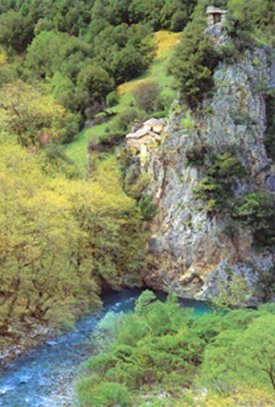 Dilofo (Sopotseli) is only a few kilometres away from Ioannina and even though its permanent population is small it attracts lots of vacationers during the weekends. That is why you will find the prices there significantly higher than the rest of Zagorochoria. Dilofo (Sopotseli) is only a few kilometres away from Ioannina and even though its permanent population is small it attracts lots of vacationers during the weekends. That is why you will find the prices there significantly higher than the rest of Zagorochoria.
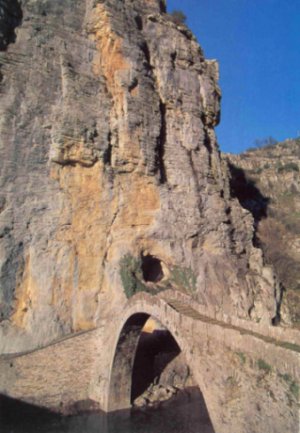
Tsepelovo has a very traditional atmosphere with well preserved mansions and a picturesque square with platans centuries old where the elders used to gather and socialise. Often enough the village is used as the basis for national and international conventions due to its beauty. Monodendri and Vitsa are very known to all that love nature or extreme sports because they are located very near the entrance of the Vikos ravine. From Monodendri there is a view of Vikos ravine and close by there is Voidomatis river which is very a very popular place for kayak. It is where the famous bridge of Kleidoniavista is located. |
|
| West Zagori | |
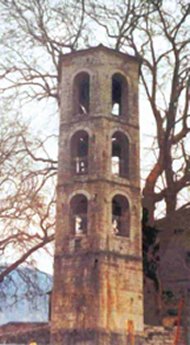 Papigo is by far the most popular of Zagorochoria. It is divided in big Papigo and small Papigo. During the '80s it was used as a station for climbers but soon enough its reputation as one of the most artistic and beautiful villages of the area reached greater audience. One can admire the stone houses with the exemplary architecture and the hexagonal belltower of St. Vlasios but the one feature that probably make this village unique is the peculiar natural formations of rocks and stones around the village that remind a human made city. It is that rare nature of the rock to produce symmetrical stones that lead originally the people of the area to use them as their building material and develop their technique that traditionally doesn't use any cohesion material. From small Papigo one can visit the Drakolimni (= lake of the dragon) Papigo is by far the most popular of Zagorochoria. It is divided in big Papigo and small Papigo. During the '80s it was used as a station for climbers but soon enough its reputation as one of the most artistic and beautiful villages of the area reached greater audience. One can admire the stone houses with the exemplary architecture and the hexagonal belltower of St. Vlasios but the one feature that probably make this village unique is the peculiar natural formations of rocks and stones around the village that remind a human made city. It is that rare nature of the rock to produce symmetrical stones that lead originally the people of the area to use them as their building material and develop their technique that traditionally doesn't use any cohesion material. From small Papigo one can visit the Drakolimni (= lake of the dragon)
Aristi and Vikos are two more traditional villages west of the Vikos ravine. From there one can visit the monastery of Spiliotissa and Voidomatis river which is one of the most beautiful places in the area. |
|
| The bridges | |
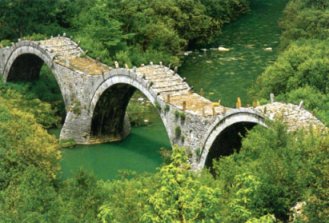 The stone artisans of Epirus used to be famous for their artistic and sturdy work not only in the Ottoman Empire but in central and eastern Europe as well. Their bridges, landmark and specimen of their art, stopped being constructed in the beginning of the 20th century when technology turned them useless but their skill was employed in Aegypt, Persia, Rodesia and Soudan. The knowledge of stone building that was based on exact balance and improvisation was so valuable that was preserved and protected with a special language that only the builders themselves knew and would pass on only to their successors. Today noone remembers how to build bridges like those and the old art of stone building is slowly dying. A fine example of that art can be seen at Kalogeriko bridge which the locals often call "caterpillar in motion"! The stone artisans of Epirus used to be famous for their artistic and sturdy work not only in the Ottoman Empire but in central and eastern Europe as well. Their bridges, landmark and specimen of their art, stopped being constructed in the beginning of the 20th century when technology turned them useless but their skill was employed in Aegypt, Persia, Rodesia and Soudan. The knowledge of stone building that was based on exact balance and improvisation was so valuable that was preserved and protected with a special language that only the builders themselves knew and would pass on only to their successors. Today noone remembers how to build bridges like those and the old art of stone building is slowly dying. A fine example of that art can be seen at Kalogeriko bridge which the locals often call "caterpillar in motion"!
|
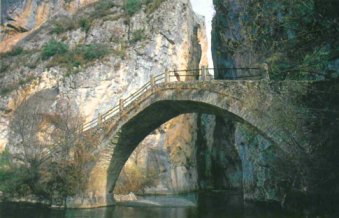 The erection of a bridge, especially one that had to cross a wild river or a deep ravine, was not always an easy or safe task. Very often the bridge would collapse causing numerous victims. The building of a bridge was always seen as a sacred task, sometimes even sacrilegious, as it was meant to rise over nature, to defy danger and bring human spirit against divine forces. The building of stone bridges was one of the areas where the deep Mediterranean spirituality of the Greeks would meet in a unique way with their ancient but not forgotten paganistic beliefs. Very often sacrifices of roosters or other animals would take place on the basis of the bridge with prayers and spells to ensure safety and sturdiness. A great number of folk songs and legends describe the anxiety of the builder and the dangers he would face to rise above the natural forces. One of the
  most famous legends is the one about the bridge of Arta that became a song. It is said that even though 45 skilled builders and 60 apprentices were employed to build it (a symbolic number indicating the difficulty of the task) it would collapse every night no matter their efforts, their prayers or their sacrifices. It was not until the most valuable offering was made, the head builder's wife herself, that the bridge finally was build. Since then the spirit of the woman hounds the bridge and it can be seen as a black dressed figure standing under the central arch of the bridge during noon throwing in the river anyone who dares to cross the bridge at that time.