
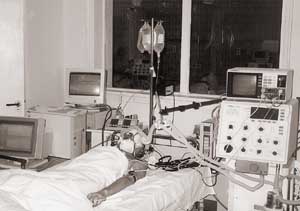

There are six subgroups of severe head injuries.
1. Coma
2. Vegetative State
3. Persistent Vegetative State
4. Minimally Responsive state
5. Akinetic mutism
6. Locked-in Syndrome
Coma is defined as a prolonged state of unconsciousness. A person who has experienced a severe brain injury will enter a coma as part of the natural recovery. While in a coma, a person doesn�t respond to external stimuli, even if it�s painful. They don�t produce any voluntary actions or meaningful responses. Sometimes a person will respond minimally and show levels of non-purposeful movements. They don�t speak, their eyes are closed, and they are unable to obey commands. While in a coma a person will continue to heal and progress. They are able to make significant improvements but are left with permanent physical, cognitive (ability to acquiring knowledge), or behavioral impairments. Doctors can�t predict when or what a person will be like, or if they will come out of the coma. A coma can last for days, weeks, months, years, or indefinitely. There is no way to predict or know how long a person will remain in a coma state or how much they have progressed throughout.
Vegetative State (VS) is when a person who suffered a severe brain injury is awake, but is unable to interact with the environment. They open their eyes in response to stimulation or spontaneously, digestive and respiratory functions return to normal. Responses to pain, increased heart rate, sweating, sleep- awake cycles, and increased respiration also occur.
Persistent Vegetative State (PVS) is a term used to describe anyone that has remained in a vegetative state for more than a month.
Minimally Responsive State (MR) A person in a MR state has experienced less severity with their head injury, compared to someone in a coma or vegetative state. Three things MR patients commonly demonstrate are an awareness of environmental stimulation, primitive reflexes, and an inconsistent ability to follow simple commands.
Akinetic Mutism results when the dopa minergic pathways in the brain are damaged. This damage enables the person to a minimal amount of body movement, eye opening and visual tracking, infrequent and incomplete (not consistent) ability to follow commands, and little or no speech, usually only answers questions asked, never initiates communication.
Locked- in Syndrome is a rare neurological condition in which a person is physically unable to move, like being paralyzed, throughout their entire body except the eyes. The person is conscious and able to think. To communicate with others and operate environmental controls vertical eye movements and eye blinking are used.
One last type of severe brain injury is brain death. The brain shows no sign of functioning, cause by a very severe injury. A specific formal brain dead examination can be performed by a doctor.