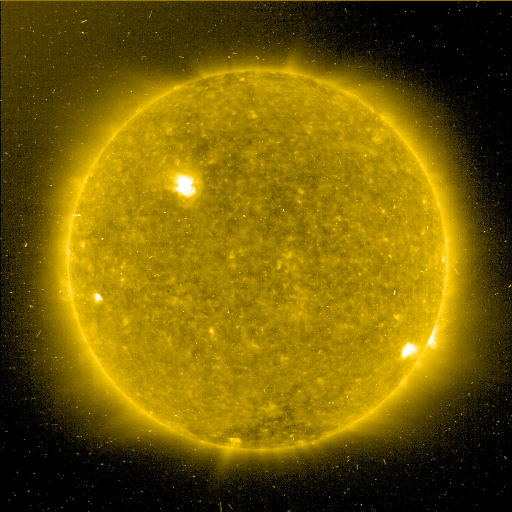
The National Oceanic and Atmospheric Administration (NOAA) uses WWV and WWVH to broadcast geophysical alert messages that provide information about solar terrestrial conditions. Geophysical alerts are broadcast from WWV at 18 minutes after the hour and from WWVH at 45 minutes after the hour. The messages are less than 45 seconds in length and are routinely updated every 3 hours (typically at 0000, 0300, 0600, 0900, 1200, 1500, 1800, and 2100 UTC). Updates are more frequent when activity warrants.
The geophysical alerts provide information about the current and predicted solar terrestrial conditions found useful for long distance HF radio communications and other applications. The alerts use a standardized format and terminology that requires some explanation. The terms used in the announcements are defined below:
Solar flux is a measurement of the intensity of solar radio emissions with a wavelength of 10.7 cm (a frequency of about 2800 MHz. The daily solar flux measurement is recorded at 2000 UTC by the Dominion Radio Astrophysical Observatory of the Canadian National Research Council located at Penticton, B.C., Canada. The value broadcast is in solar flux units that range from a theoretical minimum of about 50 to numbers larger than 300. During the early part of the 11-year sunspot cycle, the flux numbers are low; but they rise and fall as the cycle proceeds. The numbers will remain high for extended periods around sunspot maximum.
The A and K indices are a measurement of the behavior of the magnetic field in and around the Earth. The K index uses a scale from 0 to 9 to measure the change in the horizontal component of the geomagnetic field. A new K index is determined and added to the broadcast every 3 hours based on magnetometer measurements made at the Table Mountain Observatory, north of Boulder, Colorado, or an alternate middle latitude observatory. The A index is a daily value on a scale from 0 to 400 to express the range of disturbance of the geomagnetic field. It is obtained by converting and averaging the eight, 3-hour K index values. An estimate of the A index is first announced at 2100 UTC, based on 7 measurements and 1 estimated value. At 0000 UTC, the announced A index consists entirely of known measurements, and the word �estimated� is dropped from the announcement.
Space Weather describes the conditions in space that affect earth and its technological systems. Space weather is a consequence of the behavior of the sun, the nature of Earth�s magnetic field and atmosphere, and our location in the solar system.
Space Weather storms observed and expected are characterized using the NOAA Space Weather scales. The NOAA Space Weather Scales are further described on the Space Environment Center web site.
| QSL Net Propagation Website |
| NOAA Space Weather Website |
| NOAA Space Weather Prediction Website |
| Solar Cycle Prediction Website |
| Propagation Prediction - Free Downloadable Software |