 |
|
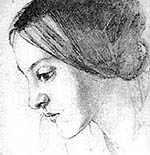
(sketch of Christina Rossetti
by her brother Dante Gabriel Rossetti)
Christina Rossetti was the youngest of four children of Gabriele Rossetti, an Italian exile and Dante scholar. Christina’s siblings chose to pursue artistic and literary careers. Her brother Dante Gabriel, painter and poet, founded the Pre-Raphaelite brotherhood, a group promoting beauty in art and a harkening back to medieval themes. The other two children, William Michael and Maria Francesca, were also published writers. Christina began publishing poems in D.G. Rossetti’s Pre-Raphaelite journal, The Germ (1848). Her first collection, Goblin Market and Other Poems (1862), has been considered the first literary success of the Pre-Raphaelites. She went on to publish both for children and adults throughout her life. She was a devout Christian, and religious themes are often central to her writing.
Christina Georgina Rossetti, one of the most important women poets writing in nineteenth-century England, was born in London December 5, 1830, to Gabriele and Frances (Polidori) Rossetti. Although her fundamentally religious temperament was closer to her mother's, this youngest member of a remarkable family of poets, artists, and critics inherited many of her artistic tendencies from her father.
Judging from somewhat idealized sketches made by her brother Dante, Christina as a teenager seems to have been quite attractive if not beautiful. In 1848 she became engaged to James Collinson, one of the minor Pre-Raphaelite brethren, but the engagement ended after he reverted to Roman Catholicism.
When Professor Rossetti's failing health and eyesight forced him into retirement in 1853, Christina and her mother attempted to support the family by starting a day school, but had to give it up after a year or so. Thereafter she led a very retiring life, interrupted by a recurring illness which was sometimes diagnosed as angina and sometimes tuberculosis. From the early '60s on she was in love with Charles Cayley, but according to her brother William, refused to marry him because "she enquired into his creed and found he was not a Christian." Milk-and-water Anglicanism was not to her taste. Lona Mosk Packer argues that her poems conceal a love for the painter William Bell Scott, but there is no other evidence for this theory, and the most respected scholar of the Pre-Raphaelite movement disputes the dates on which Packer thinks some of the more revealing poems were written.
All three Rossetti women, at first devout members of the evangelical branch of the Church of England, were drawn toward the Tractarians in the 1840s. They nevertheless retained their evangelical seriousness: Maria eventually became an Anglican nun, and Christina's religious scruples remind one of Dorothea Brooke in George Eliot's Middlemarch: as Eliot's heroine looked forward to giving up riding because she enjoyed it so much, so Christina gave up chess because she found she enjoyed winning; pasted paper strips over the antireligious parts of Swinburne's Atalanta in Calydon (which allowed her to enjoy the poem very much); objected to nudity in painting, especially if the artist was a woman; and refused even to go see Wagner's Parsifal, because it celebrated a pagan mythology.
After rejecting Cayley in 1866, according to one biographer, Christina (like many Victorian spinsters) lived vicariously in the lives of other people. Although pretty much a stay-at-home, her circle included her brothers' friends, like Whistler, Swinburne, F.M. Brown, and Charles Dodgson (Lewis Carroll). She continued to write and in the 1870s to work for the Society for Promoting Christian Knowledge. She was troubled physically by neuralgia and emotionally by Dante's breakdown in 1872. The last 12 years of her life, after his death in 1882, were quiet ones. She died of cancer December 29, 1894.
 |
The publication of Christina Rossetti's Goblin Market and Other Poems in 1862 marked the first literary success of the Pre-Raphaelites. This heralded a form of poetry which had no lack of readers. Rossetti often found herself caught between the claims of worldly passion and celestial faith.
In her early years she spent much time with her grandfather in the country which allowed her to be exposed to nature and the wilderness. These themes are recurrent in her poetry. Ironically, she spent most of her life in gloomy London houses. She was healthy as a child, but was often ill during adolescence. She was diagnosed with "a kind of religious mania" which was probably psychosomatic in nature.
Rossetti became engaged to James Collinson, a young painter and member of the Pre-Raphaelite Brotherhood, in the fall of 1848. The engagement was broken off because he converted to Roman Catholicism in 1850. Great things were expected from Collinson, but his contemporaries later referred to him as a ridiculous figure of mediocre talent, likely to go to sleep at the slightest provocation.
Dante Gabriel Rossetti was able to convince Alexander Macmillan to publish three of Chrisina's poems in Macmillian's Magazine. One of the poems "Uphill" was the first to receive wide attention and remains one of her finest works.
One of Christina Rossetti's more innovative poems, "The Iniquity of the Fathers Upon the Children," is a dramatic monologue in which the poet addresses the issue of illegitimate children by imagining that she is one herself. Her desire to address such a subject can be linked to her work for the House of Charity, an institution located in Highgate which was devoted to the rescue of prostitutes and unmarried mothers. She also broadened her poetry with "A Royal Princess" which dealt with starvation, inequality, and poverty. This appearred in an 1863 anthology published for the relief of victims of the Lancashire cotton famine.
Later in her career Rossetti abandoned such overtly political subjects and claimed that "It is not in me, and therefore it will never come out of me, to turn to politics or philanthropy with Mrs. Browning." In 1871 she wrote two poems about the war between France and Germany, and claimed they derived from sympathy, not political bias.
Partly because of her shyness and partly just because she was a woman, Christina Rossetti was never completely a part of the Pre- Raphaelite Brotherhood. Nevertheless, her Goblin Market and Other Poems (1862) was the first unalloyed literary success the Brotherhood enjoyed, and there is a loose parallel between her fondness for the rhythms of folk songs and the Pre-Raphaelite interest in things medieval.
Themes of frustrated love and an understated tension between desire and renunciation characterize her more serious work. Separated lovers often appear in her poems, and regret for life unfulfilled alternates with what one critic calls a death wish. But there is another strain in some of her poetry that can be called Gothic or even macabre - goblins, serpents, wombats, ratels, and lizards turn up in her verses. Growing up, the Rossetti siblings read Crabbe, Coleridge, Shelley, and Keats, to be sure; but they also read with delight Ann Radcliffe (Christina at one time undertook to write a biography of Mrs. Radcliffe ) and Monk Lewis.
Consider the following fragment:
I have a friend in ghostland, --
Early found, ah me how early lost! --
Blood-red seaweed drips along that coastland
By the strong sea wrenched and tost.
If I wake he hunts me like a nightmare:
I feel my hair stand up, my body creep:
Without light I see a blasting sight there,
See a secret I must keep.
Virginia Woolf's appreciation of her strikes the same notes:
Death, oblivion, and rest lap round your songs with their dark wave. And then, incongruously, a sound of scurrying and laughter is heard. There is a patter of animals' feet and the odd guttural notes of rooks and the snufflings of obtuse furry animals grunting and nosing. For you were not a pure saint by any means. You pulled legs; you tweaked noses. You were at war with all humbug and pretence.
Source 4
Jan Marsh's Christina Rossetti: A Writer's Life is a biographical account of the melancholy poet who waged "a life long struggle with feminist desires" by constantly attempting to reconcile her own often conflicting ideals towards religion, ambition, familial obligation and the Victorian model of womanhood. Marsh divides her work chronologically into four convenient periods of Christina Rossetti's life:
Part One: 1830-50,
Part Two: 1850-60,
Part Three:1861-70 and
Part 4: 1871-94.
Marsh depicts Christina's adolescent life as the continually developing scene of a precocious young poet who must establish her own identity from those of her three other siblings: Maria, the sometimes domineering yet always supportive older sister, William, a fellow conspirator, rhyming competitor and self-appointed scribe of the family and her equally precocious but far more gregarious brother Dante Gabriel. Marsh successfully illuminates the tremendous influence of the flamboyant painter-poet Dante Gabriel had on Christina. From his introduction of Christina to the artistically stimulating community of the Pre-Raphaelite Brotherhood to his involvement with her failed romance with James Collinson, Dante Gabriel embraced the integral role he played in his sister-poet's career from the moment he helped Christina publish her first poems in the Athenaeum.
Although Marsh is quick to point out how each family member played a pivotal role in Christina's development as poet and person, Marsh seems equally adamant in the role that religion played in Christina's life. While an apparent rejection of John Ruskin seemed to have little to do with religion and more to do with personal preference (in one poem she remarks, "Here's friendship for you if you like; but love -- /No, thank you, John), it was Collinson's reversion to Catholicism and Charles Cayley's lack of religion that led to the demise of potential love and matrimony. Marsh also comments, "just as with James, Charles' unworldliness and lack of sexual presence may have been his most appealing features; for whatever reason, Christina seems to have been frightened by aggressive masculinity." Such masculine figures existed on the other side of the religious spectrum -- Edward Bouverie Pusey and William Dodsworth, contemporary Tractarian preachers, who helped to inculcate Christina's devotion towards the Anglican church. Their religious zeal may have also established deep seeds of religious guilt that continually surface throughout Christina's poems and may have played a significant role in her adolescent breakdown, officially diagnosed as "religious mania."
Perhaps the most significant achievement of Marsh's full-length study was to psychoanalytically penetrate some probable causes to Christina's seemingly incessant state of malaise and the repetitive melancholy that surfaced throughout her poetic achievements. Conflating biographical information, letters and writings concerning an untellable secret with her own Freudian analysis of some of Christina's more nightmarish poems, Marsh posits the notion that the religious mania/breakdown and the subsequent transformation of Christina's once lively personality into a more saturnine disposition was a result of an experience of sexual molestation. She punctuates her conclusion with annotated references to the dark images of goblins and crocodiles in Christina's poetry in addition to Christina's self-mutilation as tell-tale signs of sexual transgression. Christina states, "I, too, had a very passionate temper. On one occasion, being rebuked by my dear Mother for some fault, I seized upon a pair of scissors, and ripped up my arm to vent my wrath." While Marsh concedes most of her analysis is conjecture, she opens up an entirely new possibility in the attempt to understand such masterpieces as Goblin Market. While Marsh does not deny the conventional references to Christina's deeply religious sentiment, her close knit relationship with her sister Maria and the social work with prostitutes Christina performed at the St. Mary Magdalene Penitentiary in Highgate as motivations for Goblin Market, she succeeds in establishing that there is much more going on than what Marsh's own exploration can provide and that there is more to be discussed than what has already been said.
Overall, I found Marsh's mixture of fact, fancy and poetry a successful interrogation of Christina's life and writing, although it does seem at times to have linked specific poems too neatly to actual events in the poet's life. For example, In an Artist's Studio is seemingly reduced to Christina's negative response to her brother Dante Gabriel's relationship with the model Lizzie Siddall. The following poem Song is also conveniently fitted to substantiate one of the many original claims made by Marsh:
When I am dead, my dearest,
Sing no sad songs for me;
Plant thou no roses at my head,
Nor shady cypress tree:
Be the green grass above me
With showers and dewdrops wet
And if thou wilt, remember,
And if thou wilt forget.
I shall not see the shadows,
I shall not feel the rain;
I shall not hear the nightingale
Sing on as if in pain:
And dreaming through the twilight
That doth not rise nor set,
Haply I may remember,
And haply may forget.
According to Marsh, this poem is poignantly directed to James Collinson, during the early stages of her hesitant love, and "the tender expressions of melancholy seem to reflect something of the current state of her heart." Other possibilities not explored by Marsh on this specific occasion include the possibility that this, like many other poems, surfaced as responses to the many works she was exposed to from the PRB, such as Dante Gabriel's "The Blessed Damozel." In any case, while many of her other poetic selections do seem to have strong correlations with specific biographical events, Marsh's matter-of-fact narrative almost precludes the consideration of other analytic possibilities and at times detracts from what is an essentially erudite example of scholarship.
Overall, Jan Marsh's scrupulous documentation and extensive quotations make for a completely thorough biography. Aside from a successful portrayal of Christina Rossetti as a Victorian Poet of significance, its personal style makes it extremely enjoyable reading and allows the reader to see the person of Christina emerge from the poems and life of Christina Rossetti. In its depth, scope, originality and accessibility, Marsh's biography should prove indispensable to anyone interested in the role of women and writing within Victorian culture.
ENCYCLOPÆDIA BRITANNICA
Rossetti, Christina b. Dec. 5, 1830, London, Eng. d. Dec. 29, 1894, London
in full CHRISTINA GEORGINA ROSSETTI, pseudonym ELLEN ALLEYNE, one of the most important of English women poets both in range and quality. She excelled in works of fantasy, in poems for children, and in religious poetry.
Christina was the youngest child of Gabriele Rossetti and was the sister of the painter-poet Dante Gabriel Rossetti. In 1847 her grandfather, Gaetano Polidori, printed on his private press a volume of her Verses, in which signs of poetic talent are already visible. In 1850, under the pseudonym Ellen Alleyne, she contributed seven poems to the Pre-Raphaelite journal The Germ. In 1853, when the Rossetti family was in financial difficulties, Christina helped her mother keep a school at Frome, Somerset, but it was not a success, and in 1854 the pair returned to London, where Christina's father died. In straitened circumstances, Christina entered on her life work of companionship to her mother, devotion to her religion, and the writing of her poetry. She was a firm High Church Anglican, and in 1850 she broke her engagement to the artist James Collinson, an original member of the Pre-Raphaelite Brotherhood, because he had become a Roman Catholic. For similar reasons she rejected Charles Bagot Cayley in 1864, though a warm friendship remained between them.
In 1862 Christina published Goblin Market and Other Poems and in 1866 The Prince's Progress and Other Poems, both with frontispiece and decorations by her brother Dante Gabriel. These two collections, which contain most of her finest work, established her among the poets of her day. The stories in her first prose work, Commonplace and Other Short Stories (1870), are of no great merit, but Sing-Song: a Nursery Rhyme Book (1872; enlarged 1893), with illustrations by Arthur Hughes, takes a high place among children's books of the 19th century.
In 1871 Christina was stricken by Graves' disease, a thyroid disorder that marred her appearance and left her life in danger. She accepted her affliction with courage and resignation, sustained by religious faith, and she continued to publish, issuing one collection of poems in 1875 and A Pageant and Other Poems in 1881. But after the onset of her illness she mostly concentrated on devotional prose writings. Time Flies (1885), a reading diary of mixed verse and prose, is the most personal of these works. Christina was considered a possible successor to Alfred, Lord Tennyson, as poet laureate, but she developed a fatal cancer in 1891. New Poems (1896), published by her brother, contained unprinted and previously uncollected poems.
Though she was haunted by an ideal of spiritual
purity that demanded self-denial, Christina resembled her brother Dante
Gabriel in certain ways, for beneath her humility, her devotion, and her
quiet, saintlike life lay a passionate and sensuous temperament, a keen
critical perception, and a lively sense of humour. Part of her success
as a poet arises from the fact that, while never straining the limits of
her sympathy and experience, she succeeded in uniting these two seemingly
contradictory sides of her nature. There is a vein of the sentimental and
didactic in her weaker verse, but at its best her poetry is strong, personal,
and unforced, with a metrical cadence that is unmistakably her own. The
transience of material things is a theme that recurs throughout her poetry,
and the resigned but passionate sadness of unhappy love is often a dominant
note.
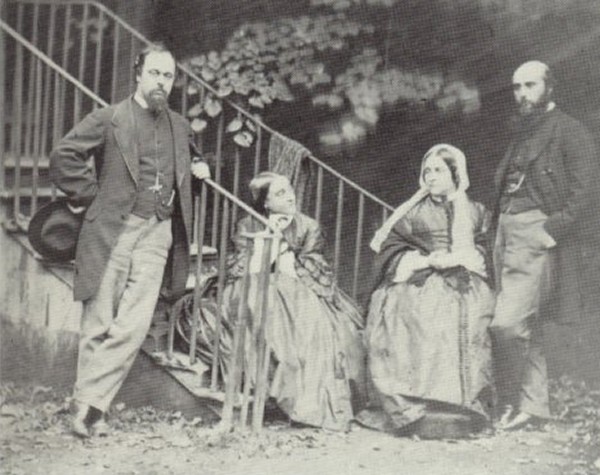 |
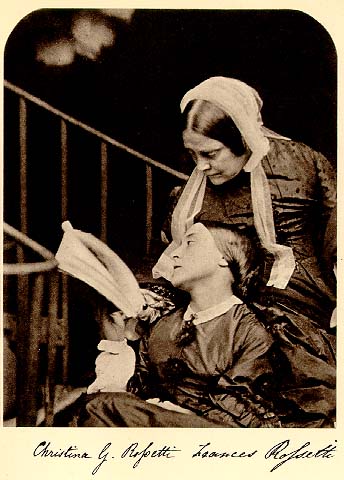
Taken at Tudor House, 16 Cheyne Walk, Chelsea, October 1863.
Dante Gabriel, Christina, their mother and brother William Rossetti
(photographed by Lewis Carroll)
 |