|
Wellcome To
Article Section
This
article is written for information purposes. Errors and omissions are
expected. If you want to send your article, mail at [email protected]
Electromagnetic Compatibility
Electromagnetic
Compatibility (EMC)
Electromagnetic
Compatibility is defined as: -
�The ability of
systems, equipment, and devices, that utilize the electromagnetic
spectrum, to operate in their intended operational environments without
suffering unacceptable degradation or causing unintentional degradation
because of electromagnetic radiation or response. It involves the
application of sound electromagnetic spectrum management; system,
equipment, and device design configuration that ensures
interference-free operation; and clear concepts and doctrines that
maximize operational effectiveness.�
EMC
Practices:-
The purpose of EMC practices is to ensure system or subsystem
compatibility. Control is achieved through the use of proven design
techniques having a sound theoretical and practical basis, the correct
use of which assures a system relatively free of EMI problems. Such
standard practices have been found to be effective through theoretical
analysis, laboratory measurements, and system performance checks.
The analysis of an EMI problem may begin with categorizing the path
between the source and the sensitive design as either a conductive or
radiated one, or a combination of the two. Further categorization can be
accomplished by observing the frequency spectrum commonality between the
emitter and the susceptor, as well as the time domain commonality
between them. Other factors are their location (distance and direction)
relative to one another.
One major question that arises when considering intersystem EMI is
whether the emitter or the receptors are operating within specifications
and regulations. If they do one seeks to determine the path between
them. If the possibility exists that the source, susceptor or the path
are not on at all times we may eliminate EMI via time-sharing or
synchronization. Finally if the spacing between the source and the
receptor can be increased EMI may be alleviated.
PHENOMENA AND
EFFECTS WHICH MAY BE REGARDED AS ELECTROMAGNETIC DISTURBANCE:-
Without prejudice to the generality of regulation 4(1), and in addition
to the phenomena regarded as electromagnetic disturbance pursuant to
regulation 4(2) (being phenomena expressly stated to be such in Article
1.2 of the EMC Directive), the following phenomena and effects may be
regarded as electromagnetic disturbance�
1. Conducted
low-frequency phenomena
�harmonics,
inter-harmonics;
�signalling voltages;
�voltage fluctuations;
�voltage dips and
interruptions;
�voltage unbalance;
�power�frequency
variations;
�induced
low�frequency voltages;
�DC in AC networks;
and
�DC ground circuits;
2. Radiated
low-frequency phenomena�
�magnetic fields; and
�electric fields;
3. Conducted
high-frequency phenomena�
�induced continuous
wave (CW) voltages or currents;
�unidirectional
transients; and
�oscillatory
transients;
4. Radiated
high frequency phenomena�
�magnetic fields;
�electric fields;
�electromagnetic
fields;
�continuous waves; and
�transients; and
5. Electrostatic
discharge phenomena (ESD)
THE CE MARK
In the EC mark, the
symbol "CE" shall be set out in the form shown below and the
figures of the year in which the mark was affixed.
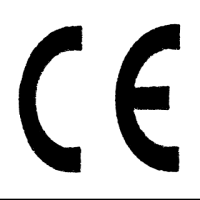
�This mark should,
where appropriate, be accompanied by the distinctive letters used by the
notified body issuing the EC-type examination certificate.
 The
EMC Directive 89/336/EEC
became mandatory on January 1, 1996, and it stands for Electromagnetic
Compatibility. EU (European Union) defined EMC as the ability of a
device, unit or equipment, or system to function satisfactorily in its
electromagnetic environment without introducing intolerable
electromagnetic disturbances to any devices in that environment. This
encompasses both immunity to outside noise (function satisfactorily),
and emission of noise (without introducing intolerable disturbances).
For this reason CENELEC (European Committee for Electrotechnical
Standardization) put out two different standards. The
EMC Directive 89/336/EEC
became mandatory on January 1, 1996, and it stands for Electromagnetic
Compatibility. EU (European Union) defined EMC as the ability of a
device, unit or equipment, or system to function satisfactorily in its
electromagnetic environment without introducing intolerable
electromagnetic disturbances to any devices in that environment. This
encompasses both immunity to outside noise (function satisfactorily),
and emission of noise (without introducing intolerable disturbances).
For this reason CENELEC (European Committee for Electrotechnical
Standardization) put out two different standards.
The
Generic Immunity Standard EN 50082-1,
and Generic Emission Standard EN 50081-1 from 1991 for
Residential, Commercial, and Light Industrial environment. This has been
harmonized in 1993 for Heavy Industrial environment becoming EN
50081-2 (Emission), and EN 50082-2 (Immunity). EN
50081-1:1991 Generic Emission Standard has two parts, Radiated Emission and Conducted Emission regulated
by EN 55022, comparable to FCC part 15 in US.
EN
50082-1:1991 Generic Immunity Standard consist of Electro Static Discharge (ESD), Radio Frequency
(RF) and Electric Fast-Transient Burst (EFT).
The
Radiated Emission deals
with the electromagnetic field emitted by any electronic circuit that
performs a switching sequence, and this increases if an antenna,
consisting of I/O cables, is present. The test is performed between 30
to 230 MHz with a limit of 30 dBuV/m from 10 meters distance, and
followed by 230 to 1,000 MHz with a limit of 37 dBuV/m from 10 meters
distance for Commercial environment.
For Heavy Industry
environments the distance changes to 30 meters.
Conducted Emission
refers to the noise that is generated into the power lines, and causes
interference at frequencies, between 0.15 to 30 MHz with limits of
60-dBuV quasi peak.
Electro
Static Discharge
deals with the static charges that can build up in normal operation to
several kilovolts and stresses the electronic components. The test is
performed with 4 kV for Direct Discharge and 8 kV for Air Discharge.
The RF Immunity refers
to the ability of the equipment to work undisturbed in a RF field
(electromagnetic field) between 27 to 1,000 MHz, with 80% AM (amplitude
modulation), and for Light industrial environments a 3 V/m Stress level
is used, or 10 V/m for Heavy industrial environment.
In every day life any
RF transmitter (2 way portable radio) that has a field higher than 1 or
10 V/m may disturb your device. If the power is known the field strength
can be easily determined.

E = Electric Field in V/m, Pt = Transmitter Power in
watts, and D = Distance from Transmitter to device in meters. Electric field in V/m
function of Power and Distance from source.
|