CONCENTRATION CAMPS AND ORGAN
HARVESTING IN CHINA
CONTENT
A Letter to the Media
Organ Harvesting in China
China has
become the global center for organ transplant.
Why do so many
foreigners go to China for organ transplant every year?
Organ supply is ample; waiting time is short.
Number of organ transplants
in China increased rapidly in recent years.
Who are the “donors” in China?
Organ
Harvested from Executed Prisoners
Organ Harvested from Persecuted
Falun Gong Practitioners
Concentration Camps in China
Exposed
Witnesses
Investigations by Civil Groups
1.
World Organization to Investigate
the Persecution of Falun Gong
2.
The Coalition to Investigate the Persecution of Falun Gong in
China
3.
Other Investigations
Responses from the Chinese Communist Party
Official
State Response
Websites
Taken Down Following the News of Sujiatun Concentration Camp
A Letter to the Media
Dear Editor,
The news of concentration camps and organ
harvesting in China
was first reported by the Epoch Times newspaper more than a month ago. Media
advisories were sent by Falun Dafa Association all around the world. However,
the majority of media outlets have not fully reported any story regarding this
subject. Most of you may excuse yourself from reporting such an atrocity by
saying that you need more evidence to protect your media’s reputation. I would
like to ask you to read the following material and act upon your conscience in
this matter for I cannot see what is more important than stopping the genocide
that’s happening right now in China.
Media Reputation and the Burden of Proof
The popular
interpretation of "burden of proof" is that whoever proposes any
position should present evidence to support his position. If one party accuses
another party of something, the accuser should provide evidence to validate his
accusation. In modern civilized societies, however, under certain
circumstances, the responsibility to present evidence is reversed. If the
accuser has circumstantial evidence and traces of evidence, he can propose the
indictment, while the accused must provide concrete evidence to prove his
innocence. If the accused fails to do so, there is reason to believe that he is
guilty.
Reversal of the
burden of proof is usually applied when the accused is in possession of, or
monopolizes, the evidence. One example is medical accidents: the patient may
lack medical knowledge and evidence, but if he was treated and harmed at a
hospital, he can press charges against that hospital, while the hospital bears
the burden of proof and has to show that it was not responsible for the harm
done to the patient. Reversal of the burden of proof does stand in this situation
on the basis of justice and moral principles. A civilized society prevents
those with power from harming and exploiting less powerful groups.
In the case of
the concentration camps and organ harvesting in China, reversal of the burden of
proof becomes absolutely necessary in order to uphold justice because the Chinese
Communist Party (CPP) is a violent, totalitarian regime that brutalizes its
people and blocks information,
If a media
which quickly and accurately reported the witnesses' words in its exposure of
the organ harvesting in China,
and this testimony constitutes powerful circumstantial evidence, the burden of
proof no longer lies with the media. If people ask for direct evidence such as
pictures or physical evidence, they should direct their requests at the CCP
regime, instead of the media. The CCP monopolizes all resources of information
and tries its best to cover up the truth and block information channels, and it
frequently persecutes people who provide information to overseas media by charging
them with "leaking state secrets." Due to the present situation, it
is immoral and irrational to demand the media to bear the burden of proof.
The witness who
exposed the Sujiatun Concentration Camp mentioned that many people are still
facing possible murder. If the media were to wait until it obtains physical
evidence to report this news, those people in danger might lose their lives in
the meantime. In consideration of this unique circumstance, a responsible media
should accurately and quickly report the witnesses' words and request the
international community to conduct an immediate investigation.
Someone asked,
"What if this news is not completely accurate? Wouldn't it affect the
reputation of the media?" I want to ask, "What if it is completely
accurate?" If a media misses the time and the opportunity to save lives
just to protect its "reputation," isn't it immoral for a media to
ignore other people's lives out of fear for its "reputation"? How can
a media without morality have a good "reputation"?
At this
critical moment of life and death, a responsible media should not wait for
irrefutable evidence and miss the time and opportunity to save lives. During
World War II, Western media and governments did not report and investigate the
atrocities inside Nazi concentration camps, and today's media and governments
are turning away from the same crimes.
Lessons from History
On March 27 Rudolph Vrba died in Vancouver, Canada.
Vrba and Alfred Wetzler were two of the first Jews who managed to escape from
the Auschwitz concentration camp in Poland. In April 1944, they had
presented to the allies the first detailed reports of the extent of the
holocaust in Europe, including details of the atrocities committed at the Auschwitz concentration camp. As first-hand witnesses,
Vrba and Alfred Wetzler had written a shocking and detailed report about the
crimes against humanity and the human slaughter that had been committed at Auschwitz. However, at that time in history, many people
did not believe that the report was accurate. As a result, the information in
the report was suppressed. Subsequent to the release of this report, during the
time between May 15 and July 7, 1944, an additional 437,000 innocent Jews were
sent to the Auschwitz death camp.
In mid-1943, when wartime
courier Jan Karski emerged from occupied Poland with detailed eyewitness
accounts of the Holocaust, he was met with skepticism. At a meeting with three
of the Roosevelt administration's most
influential Jews, Karski told the story that he had risked his life to tell. No
less than Supreme Court Justice Felix Frankfurter told him to his face: "I
am unable to believe you."
More than 50 years after
Lenin's establishment of the extensive system of Soviet labor camps known as
the Gulag, Alexander Solzhenitsyn wrote the definitive work on the subject,
"The Gulag Archipelago." His opus stemmed from eight years of his own
experience, as well as meticulous notes from the experiences of perhaps
hundreds of other inmates. Yet, in the West, his book also met with skepticism
and sometimes with outright resistance.
In early 1994, Canadian Lt.
Gen. Romeo Dallaire, an officer in charge of the U.N. peacekeeping mission in Rwanda,
repeatedly warned that an infrastructure for the systematic killings of Tutsis
was being put into place. He started his warnings a full four months before at
least half a million Tutsis were methodically slaughtered in a concentrated
campaign. Speaking of a massacre Dallaire personally witnessed, he told his
superiors in a coded cable that he "firmly believe[d] that the
perpetrators of these evil deeds were well-organized, well-informed,
well-motivated and prepared to conduct premeditated murder," according to
a Human Rights Watch report. Despite his being a witness to the atrocities,
Dallaire's U.N. superiors repeatedly turned down his calls for reinforcements
as well as his recommendations for intervention to stop the killings.
According to the Human Rights Watch report on the
Rwandan genocide, entitled "Leave None to Tell the Story," the powers
who could have committed themselves to stopping the killing failed to do so
because of their self-interest. "The Americans were interested in saving
money; the Belgians were interested in saving face; and the French were
interested in saving their ally, the genocidal government," said Alison
Des Forges, key contributor to the over 900-page report, in a press release.
"All of that took priority over saving lives."
Please ACT
NOW!
It’s been more
than 40 days since the first witness risked his life to expose China’s
concentration camps to the world on March 9. Many lives have lost during those
days. How many more lives have to lose for us to learn our lessons? Think about
the last time you went for shopping. How many products you saw were made in China?
How do you know that if the person who helped to make the product had not
killed in the concentration camp? Is this just a problem of one nation?
Please do not hesitate to act now and let as many people know as possible.
I thank you in advance for all the people who will be saved because you decide
to write about this story. I have organized some materials regarding the
concentration camps where organ harvesting takes place in China. Please see the following for
your reference.
Organ Harvesting in China
China has become the global center for organ transplant.
On March 5,
2006, a major northeastern Chinese newspaper group Changchun Daily published a
full page article entitled, "China
has Become the Global
Center for Organ
Transplant." This article quoted a director of a hospital in Beijing, “up to 1,000 Korean patients have had organ transplant
operations in China
annually.” Organ transplant patients from other countries are said to number over 1,000 per year.
According to a report on June 1,
2001 by Toronto Globe & Mail, a Vancouver
businessman Walter Klak said in an interview that he and his Shanghai
partner are using China
for transplants because "we found that to be the largest supply of organs
that are available." The Kidney Group, a Vancouver
company, sends Canadians and others to China for transplants. “Company
owner Vince Lam said Canadians with the money don't have to wait five to eight
years for a kidney transplant. He can arrange one in 15 days.” CBC News
reported on March 17, 2003.
When asked about how many Americans
go to China for organ
transplants each year, Dr. Thomas Diflo, director of renal transplantation, New
York University Medical Center, said “I think this is pretty widespread,"
and "You'll see it anywhere you have an Asian community.” New York Times
reported on November 11, 2001.
Why do so many foreigners go to China for organ
transplant every year?
Organ
supply is ample; waiting time is short.
Various medical reports indicates
that it takes years in average to wait for an organ transplant in developed
countries such as the United
States. While the rest of the world is in
short supply of organs, many hospitals in China are advertising that they
have sufficient organ donors. Here are some examples.
- When introducing their kidney transplant operations,
the Urological Department of Changhai Hospital in Shanghai emphasizes on their website:
·
“The
donor kidneys are high quality, and the kidney functions recover rather quickly
after the operation.”
·
“Sufficient
donor sources, waiting period very short."
Source: http://web.archive.org/web/20050302090111/http://www.chhospital.com.cn/dept/dept4/special/special4.htm
- The China International
Transplantation Network Assistance
Center at the China Medical
University in Shenyang City
advertised the
following on their website:
·
"If
you send your personal data to this center by e-mail or fax and accept the necessary
body examination in Shenyang,
China in order
to assure a suitable donor, it may take only one month to receive a liver
transplantation, the maximum waiting time being two months. As for the kidney
transplantation, it may take one
week to find a suitable donor, the maximum time being one month. Although the procedure to select a donor is very
strict,, the transplant operation
will be terminated if the doctor discovers that there is something wrong with
the donor's organ . If this
happens, the patient will have the option to be offered another organ donor and have the operation
again in one week. “
Source: http://en.zoukiishoku.com/list/volunteer.htm
·
"There
are more than 35,000 kidney transplant operations that have been done in public
hospitals in 29 cities, provinces and municipalities in China, and the
number of kidney transplant operations is at least 5,000 every year all over
the country. So many transplantation
operations are owing to the support of the Chinese government. The Supreme Demotic Court,
Supreme Demotic Law-officer, Police, Judiciary, Department of Health and Civil
Administration have enacted a law
together to make sure that organ donations are supported by the government.
This is unique in the world."
Source: http://en.zoukiishoku.com/list/facts.htm
·
This
website also claimed that it does not
use organs from those who are brain dead "because the state of the
organ may not be good."
Source: http://en.zoukiishoku.com/list/qa7.htm
- The Tianjin Oriental Organ
Transplantation Center, one of the largest transplantation
centers in northern China
shows its achievements (please refer to the graph below). It indicates
that the number of organ transplantation cases sharply increased in the
time period of 2001 to 2004. Medical professionals reason that there must
be a large live organ bank in the Shenyang area considering that some
organs have only 24 – 48 hours of survival time and that it takes only a
short time to find matching organs.
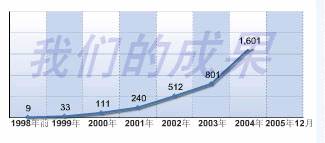
Number of organ transplants in China increased
rapidly in recent years.
According to official numbers from China, only 78 liver transplants
were performed nationally from 1991 to 1998. However, since 1999 (when the
persecution of Falun Gong started), the total number of liver transplants in China almost
doubled each year. An article entitled “The
History of Organ Transplant in Our Country” published on November 2, 2004 by Health Newspaper, a periodical
affiliated with the Ministry of Health, provides the following number:
|
Year
|
Number of Liver Transplant Surgeries
|
|
1991-1998
|
78
|
|
1999
|
118
|
|
2000
|
254
|
|
2001
|
486
|
|
2002
|
996
|
The Chinese Society of Transplantation says about
1,500 liver transplants were carried out in 2003. A report on October 25, 2005
from Deutsche Welle indicates that China had performed about 2,600
liver transplants and 6,000 kidney transplants in 2004, even this is thought to
be an underestimate by many medical experts.
The exact number of organ
transplants in China
is a state secret. However, according to preliminary statistics by the highly
authoritative Chinese Journal of Nephrology Dialysis & Transplantation,
about 15,000 to 20,000 organ transplants were done in China every year, only
second to the number done in the United States.
Who are the “donors” in China?
"People don't realize that only 1 per cent of all deaths meet the
criteria for organ
donation." "They have to meet brain-death criteria, which means they
have to die in a hospital and on a ventilator," said Bill Barrable, chief
executive officer of the British
Columbia Transplant Society.
-- June 1, 2001 by Toronto
Globe & Mail
While
it takes years to wait for a suitable organ donor in the United States, how does China achieve such a short waiting
time for organ transplants?
In
traditional Chinese culture, a corpse needs to be kept whole.
Thus, voluntary organ donors are very scarce in China. According to various
evidence and reports, there are two major sources for China’s organ
supply: executed prisoners and persecuted Falun Gong practitioners.
Organ Harvested from Executed Prisoners
The
illegal removal of the organs from executed prisoners in China has been widely reported by
international media and human rights organizations. The U.S. Congress held
hearings on this subject in 1994, 1998, and 2001. In June 2001,
Wang Guoqi, a Chinese former military physician, offered evidence to the US
Congress of how he had to harvest organs of more than 100 executed prisoners.
The number of executions in China is
considered a state secret. Amnesty International documented at least 3,400
executions in 2004 - 90% of the total of capital punishments recorded around
the world. Liu Renwen, a scholar at the Chinese Academy
of Social Sciences, recently stated that he believed the number of executions
each year to be around 8,000.
Source: http://www.laogai.org
Organ Harvested from Persecuted Falun
Gong Practitioners
Laogai Foundation issued several
reports indicating that labor camps in China have been harvesting human
organs for over twenty years. Since the CCP started its persecution on Falun
Gong in July, 1999, thousands of Falun Gong practitioners were detained in
jails and labor camps. According to the Falun Gong Human Rights Working Group,
there are many cases of Falun Gong practitioners being killed and their organs
taken away.
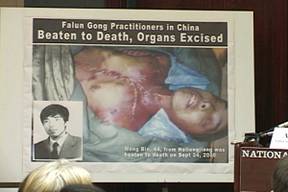 One of several confirmed cases is a
Falun Gong practitioner in Daqing City in northeast China. He was a software engineer
in the Petroleum Discovery and Development Research Institute in Daqing city.
On September 24, 2000, he was beaten to death by Feng Xi and other policemen in
the Daqing Labor Camp. His organs were removed, including the heart and the
brain.
One of several confirmed cases is a
Falun Gong practitioner in Daqing City in northeast China. He was a software engineer
in the Petroleum Discovery and Development Research Institute in Daqing city.
On September 24, 2000, he was beaten to death by Feng Xi and other policemen in
the Daqing Labor Camp. His organs were removed, including the heart and the
brain.
During the apparent peak of the
organ harvesting between 2001 and 2003, the major camps that detained Falun
Gong practitioners became overcrowded, with the number of detainees maintained
at a level of 5,000-20,000 in each. Many Falun Gong practitioners were
transferred to other facilities including mental institutions and hospitals. It
is estimated that 100,000 Falun Gong practitioners have disappeared or are
under arrest without notifying their family members.
It is said that the official policy
of China's
regime toward Falun Gong is to "destroy their reputation, suffocate them
financially, and exterminate them physically." This policy, combined with
the secret arrests of Falun Gong practitioners who have disappeared on a large
scale, has provided the necessary conditions for illegal organ traders.
Source:
http://www.faluninfo.net
Concentration Camps in
China
Exposed
Word of concentration camps for
Falun Gong practitioners has circulated for several years. A report on October
1, 2000 by Agence France Presse told of two concentration camps having been
recently built, both specifically for Falun Gong adherents. The camps were said
to have been built in north-west and north-east China, and were capable of each
holding up to 50,000 persons.
A 6 October
2000 report on Minghui.net stated that a concentration camp expressly for the
Falun Gong had been built in the remote north-western province of Xinjiang.
Chinese sources report seeing Falun Gong adherents shipped off on trains to the
Xinjiang camp. Little to no information on the secretive camp has emerged. No one to date is known to have come back
from the camp.
This past January Chinese officials
similarly announced a “new campaign” that would supposedly “sabotage activities
of cult organizations” as part of a “complex struggle against enemies,”
according to a Reuters report. Past campaigns to “strike hard” have resulted in
upwards of 10,000-plus executions in a single year, say human rights groups.
Last June CCP authorities reportedly
held a “crisis meeting” in which China’s deputy minister of Public Security,
Liu Jing, was assigned the job of “stamping out” Falun Gong “before the Olympic
Games in 2008”, according to the Paris-based Intelligence Online. Several
reports have stated that authorities wish to use the Olympics as a pretext to
deepen their assault on the Falun Gong.
 Witnesses
On March 8, 2006, a Chinese
journalist on the run from the Chinese communist regime disclosed the existence
of a death camp in the Sujiatun District of Shenyang City in Liaoning Province, China,
expressly for Falun Gong practitioners. The camp is said to once hold over
6,000 Falun Gong adherents and “nobody has yet to come out” from it alive.
According to the source, it contains a crematorium and an unusually large
number of doctors work there. He said, “Falun Gong practitioners are killed for
their organs, which are then sent to medical facilities. Currently, the organ
business is a very profitable one in China.”
 On March 17, a new witness reported
that the Sujiatun death camp was part of the Liaoning Thrombus Treatment Center
of Integrated Chinese and Western Medicine, where she and her family used to
work. It is said that “the hospital has a huge system of secret underground
chambers” to carry out operation of the death camp. The source also said that
at least two thirds of the detainees had been killed for their organs since she
left the hospital. Three days later, the witness revealed that her ex-husband
was once a surgeon operating coronal removal at the Sujiatun camp from 2001 to
2003.
On March 17, a new witness reported
that the Sujiatun death camp was part of the Liaoning Thrombus Treatment Center
of Integrated Chinese and Western Medicine, where she and her family used to
work. It is said that “the hospital has a huge system of secret underground
chambers” to carry out operation of the death camp. The source also said that
at least two thirds of the detainees had been killed for their organs since she
left the hospital. Three days later, the witness revealed that her ex-husband
was once a surgeon operating coronal removal at the Sujiatun camp from 2001 to
2003.
On March 18, 2006, a reader from
Mainland China called the
Epoch Times and exposed that a celebrity in China had a liver transplant. The
liver transplanted belonged to a Falun Gong practitioner. This reader also revealed
that the General Hospital
of the Army and Police Force in Beijing
still stores organs of Falun Gong practitioners for high-ranking officials and
celebrities.
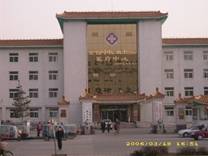 On March 30, a third witness identifies himself as a veteran medical
doctor who has served in the Shenyang
military zone. The source said,” The so-called underground Sujiatun
Concentration Camp does exist. Organ harvesting is routine there. It is also a
common practice to cremate dead or even living Falun Gong practitioners.”
However,”many detainees have been transferred to other concentration camps.” He
also revealed that a total of some 36 similar camps
exist throughout China.
It is said the three largest camps are in the northern China provinces of Heilongjiang,
Jilin, and Liaoning. The fifth-largest camp, located in
the Jiutai district of Jilin, holds as many as 14,000-plus Falun Gong
practitioners at a time. The largest
camp, codenamed “672-S,” is said to hold over 120,000 people, among who are
Falun Gong adherents and other prisoners of conscience.
On March 30, a third witness identifies himself as a veteran medical
doctor who has served in the Shenyang
military zone. The source said,” The so-called underground Sujiatun
Concentration Camp does exist. Organ harvesting is routine there. It is also a
common practice to cremate dead or even living Falun Gong practitioners.”
However,”many detainees have been transferred to other concentration camps.” He
also revealed that a total of some 36 similar camps
exist throughout China.
It is said the three largest camps are in the northern China provinces of Heilongjiang,
Jilin, and Liaoning. The fifth-largest camp, located in
the Jiutai district of Jilin, holds as many as 14,000-plus Falun Gong
practitioners at a time. The largest
camp, codenamed “672-S,” is said to hold over 120,000 people, among who are
Falun Gong adherents and other prisoners of conscience.
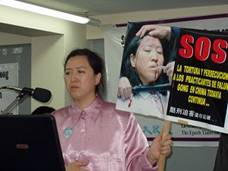 During a court session in April,
2006 in the lawsuit against Luo Gan (detailed information available under
Background) in Argentina,
persecution survivor Yuzhi Wang gave testimony relating to the organ harvesting
of Falun Gong practitioners. She said after she was tortured nearly to death at
Wanjia Labor Camp in Harbin, Heilongjiang Provice, she was taken by the local "610 Office" (detailed information
available under Background) to four very famous
hospitals in Harbin for physical exams, including blood tests and checkups on
the condition of her internal organs.After all the four hospitals
unanimously concluded that all her organs were "useless", the
"610 Office" suddenly lost interest in her and even stopped
monitoring her.
During a court session in April,
2006 in the lawsuit against Luo Gan (detailed information available under
Background) in Argentina,
persecution survivor Yuzhi Wang gave testimony relating to the organ harvesting
of Falun Gong practitioners. She said after she was tortured nearly to death at
Wanjia Labor Camp in Harbin, Heilongjiang Provice, she was taken by the local "610 Office" (detailed information
available under Background) to four very famous
hospitals in Harbin for physical exams, including blood tests and checkups on
the condition of her internal organs.After all the four hospitals
unanimously concluded that all her organs were "useless", the
"610 Office" suddenly lost interest in her and even stopped
monitoring her.
Source:
http://www.theepochtimes.com/211,111,,1.html
Investigations by Civil Groups
1.
World Organization to Investigate
the Persecution of Falun Gong
On March 14, the Organization published
an “Investigation Report on the Live Harvesting of Human Organs from Abducted
Falun Gong Practitioners at the Sujiatun Concentration Camp (Phase 1).” The
report confirms the first witness’ account on the existence of Sujiatun
Concentration Camp.
“The operation at Sujiatun Concentration Camp started
in 2001, and reached its peak in 2002. The Concentration Camp was located near
a particular hospital in Sujiatun. The whole facility was underground, and was modified from what was originally a
"civil air defense" (underground air defense fortification facility)
and other ancillary underground facilities. At least one entrance was located
at the rear entrance of said hospital. There was nothing appeared out of
ordinary above ground. This establishment was a high security area that is
totally closed off. It has its own supply system, including underground shops.”
On March 30, WOIPFG published second
report confirming the second witness’ accounts that the Sujiatun Concentration
Camp is part of a hospital, namely the Liaoning
Province Thrombosis Treatment Center of Integrated Chinese and Western
Medicine. The report says, “The hopstial had set up an unlawful crematorium to
burn the bodies and destroy evidence. The existence of a huge live human organ
bank in the Shenyang
City area has been
verified. The live harvesting of organs for transplants from unlawfully
detained Falun Gong practitioners was found in not only at the Sujiatun area
but also at many other places throughout Mainland China.”
The report also says that its
investigators had spoken with medical staff in eight of China’s provinces, each of whom
disclosed that organs being used in transplant surgeries had indeed come from
imprisoned Falun Gong adherents.
On April 4, an informant wrote a
letter to the Organization, revealing that “the First Center Hospital of
Tianjin suddenly received a large group of foreigners that had come to Tianjin for liver or
kidney transplants.” The informant also provided the hotel names where the
foreign patients stayed and waited for organs.
Source: http://www.zhuichaguoji.org/en
2.
The
Coalition to Investigate the Persecution of Falun Gong in China
On April
6, the Coalition issued an urgent announcement, stating that “Witnesses of underground
concentration camps, including Sujiatun camp, have been secretly relocated and
are subject to slaughtering anytime. Meanwhile some hospitals in China have
suddenly increased the number of transplant operations.” Hospital staff told an
undercover investigator that patients needed to hurry up if they wanted a
transplant. Staff said that as little as one or two days would be enough time
to find a matching organ. They also said it would be difficult to obtain an
organ after this batch of body parts is used up. The Coalition speculates that the CCP has intentionally set the
effective date of the newly issued transplant regulation on July 1, 2006 so it
has time to put the cover-up in place by destroying the evidence.
On April 11, the Coalition published a list of labor
camps, hospitals and prisons for evidence collection. On April 17, five members of the Coalition went to the Chinese Embassy in
the U.S.
to apply for visas to investigate the situation.
Source: http://clearwisdom.net/emh/articles/2006/4/19/72166.html
3.
Other Investigations
Early April reporters from Sound of
Hope Radio made phone calls to major hospitals in China with a human organ transplant
department. Most of the medical doctors that answered the phone gave the same
guarantee—there will be an unusually large number of organ donors before May 1.
After that date, the chance for a donor will become much smaller.
According to doctors interviewed,
all of the donors are in their 20's and 30's. They are very healthy. The
doctors guaranteed that livers and kidneys are from living human beings. One of
them even admitted that some organs are from living Falun Gong practitioners.
They can even provide a whole liver. For some blood type, they can find
matching donors right away.
The number of patients at the organ
transplant centers in China
suddenly surged. Major hospitals in China are now working overtime for
organ transplant operations.
"April. We should have a lot of organs before
the end of April. We are getting a larger and larger supply of organs, but you
have to grasp the opportunity. Do you know what I mean? After this period of
time, the supply will become very slim. After the end of April, there will be a
period we will have nothing. We just won't have any supply of organs. If you
don't have an organ transplant now while there is a supply, you are leading
yourself to a dead end when the supply disappears," said a doctor at Shanghai Changzheng
Hospital.
Source: http://www.theepochtimes.com/news/6-4-14/40373.html
Responses from the Chinese Communist
Party
Official State Response
1. On March 27, China’s
Ministry of Health issued temporary regulations to forbid the trade in human
organs and to require that donors give written permission for their organs to
be transplanted. The regulations are to be in effect from July 1, 2006. (http://news.xinhuanet.com/english/2006-03/27/content_4352460.htm)
Consider this:
·
Why did the CCP issue this
regulation at such a sensitive time; i.e. right after the news about Sujiatun
death camp came out?
·
Why after all this years of denial
did the CCP start to recognize the problem of organ harvesting?
·
Why is the effective date of the
regulation set three months later?
2. According to reports from Radio Free
Asia and Voice of America, the spokesperson of China’s
Foreign Ministry, Qin Gang, denied at a press briefing on March 28 the organ
harvesting from living Falun Gong practitioners at Sujiatun and organ
harvesting from executed prisoners in China. He also invited reporters to
visit Sujiatun. (http://www.epochtimes.com/gb/6/4/6/n1279107.htm)
Consider this:
·
Why
did CCP wait for more than 20 days to respond to such a serious allegation, not
to mentioning Qin Gang only spoke of this allegation because he was asked at a
press briefing?
·
Why
are there no records of Qin Gang’s statements of denial under the Foreign
Ministry’s website? (http://www.fmprc.gov.cn/eng/xwfw/s2510/t243018.htm)
·
Why
did Qin Gang deny organ harvesting of executed prisoners in China which is
a well-know fact among international communities? The Deputy Minister of
Health, Huang Jiefu acknowledged this issue in August of last year at an
international WHO meeting. How can we trust Qin Gang’s statement of denial on
Sujiatun incident when his other statement was clearly a lie?
·
According
to a Radio Free Asia April 8 report about Sun Xiaodi, a person who has been
appealing regarding a nuclear reactor leakage in China for several years, being
arrested in the Sujiatun area. The local police told Sun that the Sujiatun area
was considered a "highly sensitive area." The authorities were
alarmed when this dissident appeared in Sujiatun and arrested him again. It is
reported that the Sujiatun area is on an internal "security
surveillance" status. Any strangers who visit the area for more than 3
days will be followed and may be arrested.
3. On April 12, the State Council Information
Office in Beijing
arranged a press conference where officials of the Liaoning Thrombosis
Treatment Centre of Integrated Chinese and Western Medicine denied the
existence of a death camp located in their hospital. The hospital’s deputy
director, Zhang Yuqin stated that he would consider suing the Epoch Times. (http://www.chinadaily.com.cn/home/2006-04/13/content_566554.htm)
Consider this:
The Epoch Times held a press conference next day to respond Beijing’s denial on
Sujiatun incident. The newspaper stated, “We hope that the Chinese regime will allow an impartial
court to conduct a full investigation of the issue, including independent
investigation on labor camps in China.
The Chinese government doesn't like The Epoch Times . As of today, there
are at least 5 Epoch Times reporters and many Epoch Times
columnists in jail in China.”
Websites Taken Down Following the News of Sujiatun
Concentration Camp
Shortly after the news of
Sujiatun concentration camp came out on March 8, a number of China’s
official websites or articles suspected of containing important evidence
concerning the camp were taken down from the internet. Here are two examples:
- The China International
Transplantation Network Assistance Center at the China Medical University
in Shenyang, Liaoning Province took down the Chinese version from its
website www.zoukiishoku.com of 5 (now 4)
languages. Archived file can be found here:
http://web.archive.org/web/20050213101222/www.zoukiishoku.com/cn/CHINA/index.htm
- The Urological Department of
Changhai Hospital (an affiliation of the Second
Military Medical
University) in Shanghai removed its webpage which
promotes its achievements in organ transplant surgeries. Archived file can
be found here:
http://web.archive.org/web/20050302090111/www.chhospital.com.cn/dept/dept4/special/special4.htm