Care and Handling of Rabbits
(Our thanks to M and E Rabbitry for providing this useful information for Rabbit lovers everywhere! This information is freely provided for use by Rabbit owners, and may be copied for personal use, but may NOT not be published or sold in ANY form!)
Feed Water & Hay
This is one of the most important aspects in raising a rabbit properly. The correct feed and feeding methods will help your rabbit live a happier, healthier life.
Water is the most important nutrient you can give your rabbit. He or she should ALWAYS have access to cool, clean, fresh water - even if it means changing frozen crocks in the winter. Without water, a rabbit will not eat.
A good quality pellet rabbit food is essential for keeping your rabbit in good health. Pellets should make up the majority of your rabbits' diet. Young rabbits, under the age of 3 months, should have fresh pellets available at all times. As the rabbit begins to grow, you will need to limit the daily intake of pellets. The most common problem in feeding is over-feeding. If you over-feed your animal, it will become excessively fat. This can lead to a very unhealthy rabbit and will also result in breeding problems. So, please - even if your older rabbits may eat whatever you put in front of them, limit their pellet intake. A good rule of thumb is to feed 1 oz of pellets to every pound of bunny.
Hay is also essential for a healthy rabbit's diet. Hay provides fiber, which helps to keep bunnies stomachs in good working order. All rabbits should have access to fresh, clean hay at all times. It is important for wooled breeds to have hay to help prevent wool block. Kits in the next boxes will nibble hay as their first solid food. If you have a wooled breed, hay is important to keep the digestive system working and prevent wool-blocks. Also, animals with wool need a higher protein feed to keep their wool production going.
Remember to feed hay and not alfalfa or straw. Alfalfa is too high in protein to be tolerated well by rabbits (especially smaller breeds). Too much protein, over a long period of time can cause damage to liver, kidney and other vital internal organs. Stay away from straw too, as it has little nutritional value. If you don't know how to tell the difference between hay, alfalfa, and straw, ask your local feed dealer to show you the different bales.
Hay will be green with long blades that look similar to grass. Alfalfa will be dark green with large stems and leaves that look like clover plants. Straw will be bright yellow and be mostly large stems with no leaves at all.
Housing
Rabbits need to have a clean save environment to live in. The location of the cage can be indoors or out, but you need to keep the animal out of direct sunlight and out of drafts. Why? The sun will fade your animal's coat and a draft will cause 'snuffles' or even kill your rabbit.
Cages should be made entirely out of wire so the droppings fall through. Some cages have litter pans below them to catch the feces. These cages are wonderful if your animal is indoors. I would suggest buying a plastic pan over a metal pan however because the metal pans tend to be more flimsy and will rust. How big does your rabbit's cage need to be? Here are some suggestions for cage sizes depending on what size of rabbit you have.
* small breeds---------24x24x18
* medium breeds-----30x30x18
* larger breeds--------36x36x18 or 40x30x18
Cages should also be kept clean. I like to clean my cages, feeders and bowls out at least once a month with warm bleach water and a scrub brush. You may need to clean more often if you have a rabbit with scours, in a molt, or one that has been ill. Cleanliness is the best way to keep your rabbits healthy. If you're looking to purchase a cage visit the following sites:
Morton Jones
Bass Equipment
Wolf Cage & Supply
KW Cages
Grooming Your Rabbit
For the most part, rabbits are very clean animals and rarely need to be groomed. However, some wooled breeds, such as the angoras, fuzzy lops and jersey woolies do need a bit of maintenance work done on their wool.
Grooming Normal Haired Rabbits
Rabbits with normal hair require very little grooming at all. During a molt though, it's important that you do a bit more grooming to help remove the old, dead hair. To groom a normal haired rabbit, molting or not, moisten your hands with a spray bottle, rub your hands together to remove excess water, and rub your rabbit form neck to rump, occasionally stroking it from rump to neck to help loosen any dead fur. ONLY MOISTEN YOUR HANDS - YOU DO NOT WANT THE RABBIT TO BECOME WET. When a rabbit is in good coat condition, you'll only notice a few hairs end up on your hand. During a molt, your hands will be covered with hair. Simply rub your hands together and the hair will come off. Continue this process until very little hair comes out on to your hands.
Grooming Wooled Breeds
Wooled breeds are a bit more maintenance. Angoras (English, French, Giant & Satin) require more brushing than Fuzzy Lops and Jersey Woolies, because AFL & JW have a more coarser wool that doesn't mat as easily. However, you will need to brush the bunnies that do not have their adult coat at least every other day. What you'll need to keep on hand if you have a wooled breed:
Scissors or Mat Splitter (Plastic Envelope Opener w/ metal blade)
Slicker Brush
Flea Comb
Plastic Bag
Blower (Optional)
Grooming should be done outside. I'll sit with a rabbit in my lap and begin brushing the lower hindquarters and sides with the slicker brush and flea comb to remove any small mats. I'll then work my way up and forward covering every part of the rabbit. You need to pay special attention to the neck, lower hind quarters, and right around the tail as small mats will quickly form there and can become large problems if not taken care of.
Once the top is done, flip the rabbit over and work on the belly. I start at the tail and work my way up to the neck. Pay close attention to the armpit areas and up under the jaw line. Don't forget the feet! Rabbits with thick fur on their feet can get mats, which if not taken care of can cause foot problems. Use the mat splitters or scissors to remove any serious mats that you can't get through... if you've been brushing on a regular basis, there shouldn't be any serious mats.
Place any wool you've removed from the rabbit in a plastic bag or some sort of container. Depending on which breed you raise, you can keep the wool for spinning, or just store the hair incase a doe doesn't pull a nest.
Blowers are also a nice tool to have on hand. Professional blowers run around $100.00 and up. To groom your rabbit with a blower, place it outside on a groom table. Securely cover your rabbit's eyes to prevent any dust from getting into them. Start at the back side of the rabbit and work your way forward. Slowly blow the rabbit in small circular motions. You will notice the wool open up all the way to the skin. This is a good way to check for any mats, skin problems or mites. As you blow you will notice any webbing that has started to from in the wool eventually loosens and is blown to the ends of the wool. Blowing should be done slowly and in a controlled manner. Blowing not only will help to remove lose hair, it removes dust and dirt from the coat as well.
Stain Removal
Although rabbits are very clean animals, you will get the occasional stain now and then - especially if the cages aren't clean. Do not bathe your animal, only spot clean. To remove stains there are several animal safe products out there. One is ClassiCoat. It's a purple, waterless shampoo that can be found at rabbit shows or purchased from Vannec Bunny Farm
Summer & Winter Care
Heat is very hard on rabbits. Each summer many rabbits suffer from heat stroke. Signs of this include: wet mouths and rapid heavy breathing. Heat can also cause bucks go sterile and does to lose litters.
The best defense during the hot weather is to keep your rabbit in a cool, shaded area. Frozen 20 oz pop bottles are an excellent way to keep your rabbit's temperature down. I like to use frozen 2 liters for does that have litters. The bunnies love to play and lay on the bottles, helping to keep them cool. Also, osculating fans are very effective too. They get the air moving in the Rabbitry - but be sure not to aim the fan directly at your rabbits - this could cause them to become very sick.
Rabbits handle cold weather very well as long as they are protected from wind and rain. Most rabbits die in the winter because of a draft - not the cold temperatures. If you feel you need to bring bunny in from the cold remember not to put them somewhere really warm. Best to move them to the coolest part of the house for a few days until their systems adjust to the temperature change.
Breeding Basics
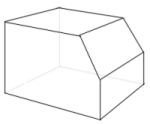
So you want to breed your doe, but how? What do you need? What should you know� well keep reading and find out! First you need to see if your doe is ready. Rabbits don't have a regular heat cycle. Other mammals usually go into heat just two or three times a year, but a mature female rabbit can go into heat almost every time she's with a male. Rabbits are what's known as "induced ovulators," which refers to the fact that a doe will ovulate after being mounted by a buck. This means that it's possible for a doe to become pregnant again within 24 hours of giving birth. To tell if your doe is ready you'll need to look at her vent area. If it is a dark pink to red color she's ready to breed. Always take the doe to the bucks' cage - never the other way around. The doe may become protective of her territory and attack the buck or the buck may be more interested in the new surroundings and not pay any attention to the doe. Either way - the job won't get done. Here are the steps of a successful mating.: Put the doe in the buck's cage The buck will mount the doe and begin to breed her. When doe is ready to accept the buck, she will raise her hind end and lift her tail. When the actual mating has occurred, the buck will give a little scream, or grunt and fall off of the doe. You should let this occur about 2-4 times. Repeat this process 6-12 hours later to ensure a good breed and to possibly increase the litter size. Sometimes a doe is in such a heat that she is very aggressive. She may chase the buck around the cage or even try to mount him. Let this go - it's just nature taking control. If she gets too aggressive, you may need to restrain her - but this isn't likely. 28 Days after the doe has been breed you will need to put in a kindling box... so MARK YOUR CALENDARS!!! Kindling This can be an exciting time for you and a stressful time for you doe. You need to make her as comfortable as possible - especially if it's her first time kindling. A rabbit's gestation is around 28 to 34 days - it just depends on the animal. Once you've got your doe bred, count 28 days from the date of the breeding. Find a big red marker or something and mark this date - it's important. You need to put the kindling box in on this day. If you don't have a kindling box, you've got 28 days to either build or find one. Your box should be wide enough and high enough for you doe to get in and out of but not too big. Also, make sure it fits through your cage door. Your kindling box should look something like this:
 Click here for nesting box dimensions:
Ok, so after all of that waiting, the 28th day rolls around. Take the box and add about an inch of shavings or a couple handfuls of straw. Try to stay away from cedar chips - they have too strong of an odor. Each animal has their own personality and will do different things, so don't get upset if she takes all of the bedding out of the box, or sits in it all day long. (just be careful that she isn't using it as a toilet).
When placing the box in the cage, make sure you look to see what corner she does her business in. Once you've found it, put the box in the opposite corner. Keep a very watchful eye on your rabbit for the next five days. If you notice her pulling hair from her body, or picking up loose pieces of straw or shavings in her cage, it's a good sign she's ready to deliver. But like I said - every animal is different. I have one doe that will build her nest the moment I put it in the cage, but will deliver three days later. Another doe of mine is just the opposite. She won't pull any hair until she's had the litter - strange isn't it?
All right, so you've got doe bred, the box is in place, the doe has built her nest, and you think she might have had the litter - but you aren't sure. Should you go in and have a peek in the box? Most certainly! Some people say that you should never bother the nest because the doe will kill the litter. Sometimes this is true if the doe is nervous, but there are things you can do to help safeguard yourself. Before you start to poke around in the nest, pet your doe. Get her scent all over your hands.
Now go ahead and look in the box. You may have to dig around in there but go ahead and pull the kits out. Yes, those bald mouse like things are the kits. They're kind of cute in an ugly way huh? Make sure there aren't any dead ones in the box, or there isn't any afterbirth lying around. (It's gross, but you have to keep the area clean.) If you do have a nervous doe, you can put a little Vicks or Vanilla on the end of her nose. This way that's all she can smell - and by the time that wears off, the kits will smell like her.
Frequently Asked Questions
I've decided to compile a collection of frequently asked questions that I receive in regards to rabbits to which I don't have an article written for. This list will probably change over time as I receive more questions and get the time to write more articles. If you have a question that was not answered here or in my articles section, please feel free to contact me at M and E Rabbitry.
Which breed of rabbit is best / friendliest?
This is a question that can not be answered. Each animal has his or her personality and there can be a bad egg in every breed. Also, each breeder, fancier or pet owner will tell you that their breed is best because they've had experience with their animals and in their eyes - they are the best breed. That's why they choose to raise or own them.
A better question to ask yourself is what kind of a rabbit do I want? Long hair or short? Erect ears, or a lop? A small, medium, large or giant? Do I want a solid color or spotted?
The best way to see most of the breeds it to visit a rabbit show. You can find show dates and information on the ARBA's web site: ARBA
Which is better, a doe or a buck?
Again this is another question that can't really be answered because both have their pro's and con's. A doe may become grumpy or even mean when she wants to be bred. This is usually 13 out of 16 days... but rabbit's don't have a heat cycle so it varies from animal to animal and season to season. Bucks on the other hand, once sexually mature, may decide to mark their territory by urinating on items or even you. If you're purchasing a rabbit for a pet - I'd advise getting the animal fixed to reduce these problems.
Notice in the above statements I said they "may become grumpy" and they "may decide to mark their territory". Again, every animal is different. I've seen does that are just as content when they're ready to breed, as when they aren't. I've also had bucks who rarely ever sprayed - just some chin rubbing here and there and they're happy. So again, it depends on the individual.
Can I give my rabbit a bath?
No! Do not bathe your rabbit. Rabbits are very clean animals - cleaner than cats or dogs - IF you keep their surroundings clean. If the animal is housed in an environment where it can lay in it's urine or fecal matter, or where it is dirty, wet or muddy - the rabbit will obviously not stay clean for long. Cages with solid flooring, carpeting, blankets or constantly have straw or hay in them are some of the main culprits for having dirty, stinky rabbits.
A bath can easily stress a rabbit or make it sick. It also can dry the skin and/or fur out, giving your rabbit skin rashes or irritations.
If your rabbit does get dirty or stained - SPOT CLEAN ONLY. Stains from dirt or urine can be removed with a waterless cat or rabbit shampoo. You can also use vinegar and cornstarch. Dampen the area with the vinegar then apply the cornstarch until a paste forms. Allow the paste to dry, then brush it out. Repeat until the stain is removed. (Do not use this method on colored rabbits) Also, don't put the rabbit back into the cage until you have cleaned the cage and rabbit and they have both dried completely.
Can I get a "friend" for my rabbit?
Honestly, your rabbit doesn't need a friend or a buddy in it's cage. But if you feel it is necessary to have one or more animals in a cage together - they should be fixed. Once sexually mature, the rabbits will begin to fight or attempt to mate one another. Animals can easily be injured - I've seen it happen. The injuries can be as minor as a broken nail, or as severe and a torn ear, scratched eye, broken teeth or even broken bones.
I've also been asked if rabbits and guinea pigs could be housed together. No - you should not house these two animals together. First of all - they require different needs in their diet as well as different quantities. It would be hard to monitor the feed intake for both if they were kept in the same pen together. Also, rabbits are best housed on a wire floor. Guinea pigs need a solid floor covered in shavings to prevent them from breaking their toes, feet or legs on the wires.
TopHat Rabbitry would like to thank M and E Rabbitry for making the preceeding information available. For more helpful information about care and handling of rabbits, visit the M and E Rabbitry homesite:
M and E Rabbitry The foregoing is copyrighted material, and may not be reproduced commercially for any purpose. It is only acceptable for use by the individual to facilitate proper care of their pets. All rights reserved.
Copyright: M and E Rabbitry
Email: [email protected]
This Basic Information Sheet may be printed, copied and freely distributed for personal use (but is not to be sold or published). All other rights are reserved and copying or use of all or any part of this Basic Information Sheet other than that stated shall be a breach of copyright.