
CONFERENCE
My Take on things: (notes by) Deanna
HALIBURTON (DAY 1) NOVEMBER 27th 2004
SPEAKER: Sharon and Gary Rosenfeldt: Son was murdered. Victim Service work 9/11. Office for Victims of Crime (Chair held by Sharon)
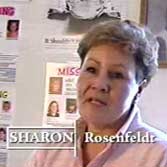
"We felt that we had to see Daryn's body. The people at the funeral home were the one's that told us the condition he was in- he was unrecognizable as a human being. They eventually had to get specific and asked us to please not see him. They were quite surprised that the police had not told us that we would never recognize him," Sharon recalls. They told them he was behind a curtain in a 2 foot glass jar.
The Olson fiasco gained national attention when it became public that a "cash-for-bodies" deal had been made between Olson and the RCMP. Ten thousand dollars was paid to Olson's wife in exchange for Olson revealing the location of each body of the children not yet found. An additional thirty thousand was paid for information about four bodies that had already been recovered. For the Rosenfeldts' and the other families, this was incomprehensible. "Frustration? Now you are talking about a killer who got a windfall of money," says Gary obviously still seething over the deal. (At the time, the payoff to Olson was never discussed or explained why this money was paid to any of the victims' families.)
Because the Rosenfeldts were lied to continuously during the process, the Attorney General and his entourage attended a meeting with all the parents of the victims of Clifford Olson. At this meeting, the prosecutor seemed so cold hearted. One of the most horrific memories the Rosenfeldts' have, and an example of the treatment they received, was when the prosecutor in the case, John Hall, came to this meeting. He sat down, looked around the room full of grieving parents and siblings, and said , "I don't know what you people are so upset about. Eleven children could just have easily been killed in a school bus accident. I mean come on, if they're dead, they're dead." That comment still hurts the Rosenfeldts' today. One parent actually lunged at him; another parent grabbed his chest, close to a heart attack. The Attorney General and his entourage took that as a queue to run for the door. He never looked back, nor did he attempt to reschedule. The Attorney General later resigned.
Eventually the Rosenfeldts' moved back to Edmonton, and it was there that in 1984, they along with other parents of murdered children founded Victims of Violence Canadian Centre for Missing Children. The organization moved from their dining room table to office space in the Edmonton Provincial Courthouse, which was provided by the Attorney General Neil Crawford, one of the first people to reach out to them. However, many did not support their presence in the courthouse, like the Criminal Trial Lawyer's Association. They maintained that victims had no place in the courthouse and likened Victims of Violence to the Ku Klux Klan. Sharon says, "We had every right to be there, The Elizabeth Fry Society was there, the Salvation Army was there, the John Howard Society was there, all to help the offender, but what about the victim?" In March of 1984 due to the national outcry from the victim�s families, a wing was donated at the courthouse in Edmonton for Victim Services. This was the first of its kind in Canada. 6 months later Victim Services opened in Ontario. The men and women in Victims Services would attempt to keep the victims up to date and provide practical assistance. Currently before the house, there is a request for a Federal Ombudsman for victims of crime. (Complaints) The main point that both Gary and Sharon wanted to reiterate was to keep the victim informed. Assure them to call for help anytime. This way they feel that they are contributing to the solution and not to the problem.
The Rosenfeldt's along with the ten other families are now preparing for the year 2006, when Olson comes up for his twenty-five year parole review. "We will be there every step of the way for Daryn, to ensure Canadians don't forget what he has done and to see to it that he is never freed or allowed to hurt any children ever again. For our family, we will not feel peace until the day Olson dies and we know for sure that he will never hurt anyone again."
Gary Rosenfeldt
(Picture not available)
While visiting family in India an uncle raped Ms. Rateja. She was 9 years old. When she was 14, she was again sexually assaulted by an acquaintance. Within 6 months of the acquaintance rape, she found herself in a psychiatric ward. Preeja had attempted to take her own life by taking pills and hairspray. The distress line that she called traced the line she was calling from and sent help. Preeja spoke of why the South Asian communities continue not to acknowledge the issue of sexual violence and child sexual abuse? She found the following factors to be crucial:
1. General, South Asian women and girls are devalued so sexual violence and abuse is one form of devaluation against them. This devaluation perpetuates the myth that their abuse experiences do not need to be addressed because sexual violence and abuse are not problems.
2. Religion, self-respect i.e. chastity, and family honor are imperative to many South Asian people, so they believe and think that sexual violence and abuse is not a problem in this community.
3. Many South Asian people also believe and think that sexual violence and abuse occur only in other cultures, i.e. �it occurs in the Canadian culture because sexuality is openly expressed in it�.
4. The lack of cultural acceptance and openness in discussing sexuality in the South Asian community makes it difficult to even begin discussing what constitutes sexual violence and abuse.
5. The South Asian community, like all other ethnic communities, is a target of racism and discrimination and is afraid of being labeled i.e. �sexual violence and abuse is a part of their culture�.
Lastly, it was important to discuss what the South Asian community and the community at large can do to bring the issue of sexual violence and child sexual abuse to the forefront.
1. Survivors need to feel supported, should they decide to break the silence.
2. South Asian women need to take ownership of this issue, so that they can label and define what is being done to them and their female children�s bodies, souls, hearts and minds.
3. They need to find their own voices to address this issue.
4. Create safe spaces to talk about the issue.
5. Culturally relevant education and outreach tools are necessary to successfully raise awareness both in the South Asian community and the community at large.
6. Involvement of community leaders, agencies, organizations and media that support women and children of the community.
(Picture not available)
Dave Franklin has lectured and trained people for many years in the area of effective intervention and problem solving techniques dealing with issues of violence in relationships, sexual assaults, child abuse, community policing and the roles communities can play. He has worked within the R.C.M.P. for over 30 years with a very diversified range of duties. Dave retired from the R.C.M.P. in 2003. Dave has previously been the Section Commander of the Newmarket Customs and Excise Office. Section Commander for the Federal Enforcement Section Newmarket. National Coordinator of the Anti-Violence/Victim Services Unit out of R.C.M.P. H.Q. in Ottawa. Seconded to Department of External Affairs Protocol Office as the protective security officer for all Diplomats in Canada. Task force Coordinator with the special projects section of the Staffing and Personnel office, for their Namibia Africa UN Contingent. This was the first time in the history of the R.C.M.P. that they took part in a United Nations Operation. Federal Security Coordinator with International Major Events Branch of the Protective Security Division. He also served as one of the Federal Media Relations Officers for a year upon arriving in Ottawa. Dave was an instructor and in charge of Human Relations Unit at the National Training Academy in Regina Saskatchewan for 4 years
Mr. Franklin also received formal education in Psychology, with minors in Sociology and Cultural Anthropology. Dave has been accredited by the Canadian Police College as : A fully qualified instructor, a Multi-Cultural Instructor, a Human Relations Instructor, a Conflict and Crisis Intervention Instructor and Hostage Negotiator. Recently Dave has qualified as an instructor in Interest Based Negotiation Skills and received a Certificate of Graduation as a fully qualified Advanced Mediator as well as an instructor in mediation skills. Dave Franklin was the first member of the R.C.M.P. selected to attend the University of Southern California�s Law Enforcement Scholarship Program, where he received a Graduation Certificate in the area of studies for Delinquency Control and Etiology of Violence. He has lectured at numerous National and International Conferences, Seminars and Workshop. He has lectured to police forces throughout North America and was sent by the Federal Government to present at a United Nations International Conference on Violence in Amsterdam, Holland. Internationally he continues to receive requests fir presentations and went to St. Lucia to assist the Royal St. Lucian Police and other various community agencies to improve their responses to calls for help in violent relationships. Dave has served on a number of advisory committees and working groups with the Federal Government, advising the Solicitor General and Ministers of Health and Justice on policy and guidelines, relevant to violence in its various forms within our society. I could go on and on with more accomplishments for David Franklin, I�m sure you understand how qualified he is by the list already provided.
David Franklin spoke about identifying and understanding prejudices. These are not always bad, as some people believe. The power of perception influences our lives. Seek first to understand, then to be understood and finally to respond.
Domestic Violence = Relationship Terrorism.
Anyone who uses ability to control someone else, denying the person to live their own life.
Imagine going to work at your job at the bank only to be held hostage for days on end by a prison escapee. Now imagine refusing to testify in court because you have developed, out of survival, a strong bond with the person who held you captive. Not you, you say? Well, it�s happened before and it�s known as the Stockholm syndrome. And, according to this retired RCMP hostage negotiator, it can be compared to Battered Woman Syndrome. The comparison has helped David Franklin for years now explain to frustrated cops and domestic violence workers why many people stay in or return to abusive relationships � something he calls Relationship Terrorism.
It�s no wonder that the Aurora resident is on the road so much�especially since he retired from police work in July of 2003�giving seminars to people who are all too familiar with this frustration. Many also come to him wanting to know what they can do to help children and adults who protect their abusers.
This person slowly permeates your life and enters your thought processes,� Franklin told the captive audience.� There is an overwhelming tidal wave of affection.� And that can happen in child abuse situations, coach and player scenarios as well as in adult relationships�anytime �someone uses a position of domination,� he explained, whether it�s physically, sexually or mentally.
Franklin certainly knows how frustrating it can be watching people go back to very unhealthy relationships. �He keeps beating her up. What the hell�s going on,� he said. �I really started the whole process because I felt frustrated.� Once he had the idea, he researched the subject and delivered it to police departments. �This helps police officers reduce their stress and be more effective,� Franklin explained. But the veteran officer doesn�t come offering a magic potion. �I strive to obviously challenge people�s perceptions and offer greater insight into the complexity of these relationships,�
Stockholm Syndrome - 4 factors must be present.
Fear: Person who threatens to kill is perceived as having the ability to do so.
Threatened person cannot escape, becomes dependent on the offender.
Threatened person is isolated, sees world through the eyes of their captor.
Captor is perceived as being kind and caring.
Often hostages will have empathy towards captor. They identify with the captor (Patty Hurst) they have a positive bonding experience with their captor, or what they perceive as positive. They resort to Traumatic Psychological Infantilism and suffer from Pathological Transference.
** Frozen Flight � too scared to leave even if the opportunity arises.
Society reinforces fear by reporting on captors and captives of relationship terrorism. (The victim may have been told time and time again that if they flee, the suspect will hunt them down and kill them, then the media reports where that has actually happened. The suspect then tells the victim for example �See what happens?�
Even hostage negotiators have to protect themselves from Stockholm syndrome because they are intensively working to find a resolution with someone who thrives on dominating others. �You�re partnering up with them basically,� said Franklin. That�s why there�s always a secondary hostage negotiator listening in, a roll that Franklin has assumed before. �You identify with the guy on a personal level�to a degree.�
Personality of the Captor: Antisocial personality behaviour. Self-serving egotistical behaviour.
�Only utter dehumanization permits the ruthless use of human beings as bargaining chips or objects for indiscrimination aggression� (from Crusaders, Criminals and Crazies by Frederick J. Hacker)
Hostage situation: At first the startled, panic stage sets in. It is associated with imminent death. Behaviour is driven by the impulse to survive, which is quickly overcome with feelings of defencelessness then changes to disbelief and hope and denial. They believe that someone will come, that quickly leads to disappointment and disillusionment that turns into depression. Conditioning of the hostage is occurring by this point. They are seen as sub-human. The hostage begins to disassociate unexpected talents of observation that help orient them to the immediate environment. �Own Space� becomes very important and almost a compulsion. The captor breaks down resistance by isolating the victim. The captor mixes violence with caring. Captors feed on misinformation. The hostage will appear lethargic thinking it will never end. They resign themselves and find acceptance and dependency. Hostages live one day at a time. They sometimes think about the past but not the future. Take away someone�s hope, and you own him or her. They begin to live a mechanical life. Hostages will wait for direction at this point; they do not feel like an individual any longer.
Hostages or Victims of Domestic violence feel:
1. Frozen Flight � too scared to run
2. Indecisiveness
3. Dulled compensation and intelligence due to fear.
4. Strong dependency of the suspect.
5. Self Blame
6. Decreased self esteem
7. Lacks motivation and energy
8. Feels isolated.