
Yunan Province :
The most colourful state in China
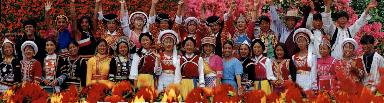
Yunan province, located in the South West part of China is one of the most colorful and unexplorded provinces in China. Apart from the Han people (majority of Chinese belong to Han tribe), there are 22 different tribes living there including Thai, Bai, Yi and miao. It is close to most of the South East Asian countries including Burma, Vietnam, Laos and Cambodia. In Yunan, the terrain varies from tropical rainforest to icy Tibetan highlands, and you can visit either Shangri'la palaces or traditional Chinese temples.
The capital of Yunan province is Kunming, a large city with 2--3 million populaion even though only 1.5 million people live in the urban area.Yunan holds the highest number of psecies of flora and fauna in the nation -- including 2500 vairieties of wild flowers and plants and is named as "kingdom of plants". As a result Kunming held 1999's world horiculure.
History of Yunan Province:
Yunan province was ruled by non-chinese before the 13th century. By the 7th century Bai people established a powerful kingdom called "Nan Zhao", initially allying with the Chinese government against the Tibetans. However, the kingdom was strong enough to claim independence during the 8th century dominating the trade routes from China to India and Burma. The NanZhao kingdom fell in the 10th century and was replaced by a "Dali Guo". Mongols invaded Dali in the 13th century and it was then Dali became known to the Westners.Marco Polo described the city as noble and great with fertile and rich land. People lived in the region used porcelain shells from the sea as their currency and ate raw fishes, buffalo and sheep. What is more interesting is that the locals did not consider it as an insult when their wives had connecions
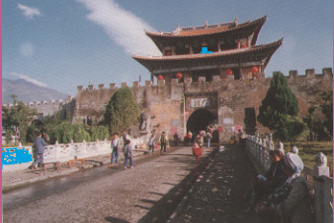
Dali city gate
with other people provided that the act was voluntary. This type of culture can still be seen in some part of Yunan province. In the 14th century, Ming dynasty of China took over Yunan and built a town with city wall at the site of today's Kunming.
Kunming became influenced by the West when France took control over South Asia. It opened its trade to the foreign countries in 1900 and a Indochina railway road was built linking it to other big cities in the region. This railway line is still in operation today. Kunming expanded in the second world war when a large number of Chinese fleed to the county because of Japnanese influence. Since then it expanded and eventually became a city with 3 million population.
Dian Chi, Kunming, Yunan
Climate of Kunming:
Kumning is surround by mountains on its north, east and west sides, therefore it has a very mild temperature. With the average temperature being 18 degrees celsius, it is named the "spring city" of China and is thus suitable for visitors to go there at any time of the year.
Language:
Most of the people in Yunan province speak Mandrain which is the official langauge of the People's Repuiblic of China, however just like most of the other part of China, there is a more commonly used dialect called "yunan hua". This dialect is very different to Mandarin and is thus difficult to be understood by visitors from other parts of China or the world.
Interesting sites in Kunming
Stone Forest
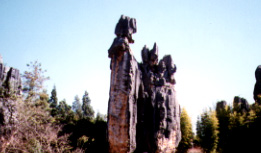
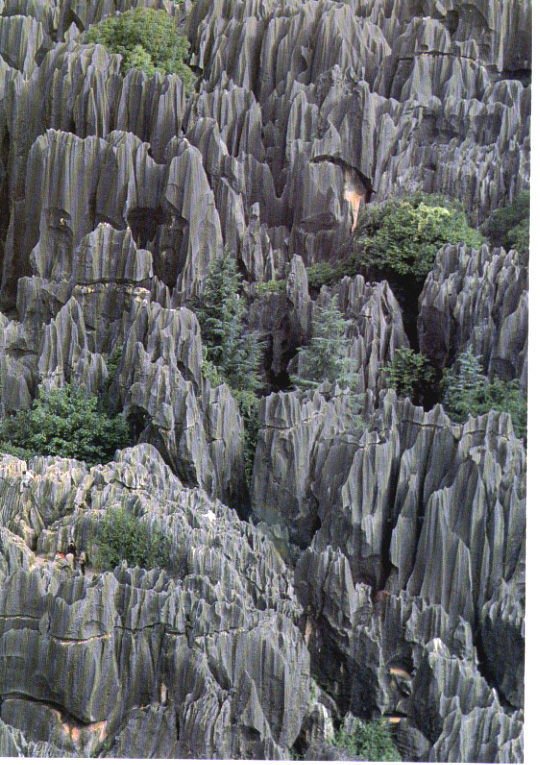
Ashma carrying a basket.
Stone forest is the symbol of Kunming. It is located 120 km away from Kunming city and is the holy ground of the Bai people. There is a very beautiful story associated with this place: a beautiful girl called Ashma fell in love with Ahai, but the brutal landlord captured her against her will. The brave and handsom Ahai set off with magic weapon to free her. However during the escape Ashma died of some misfortune and turned into a rock. Since then the rock became the holy ground of those Bai people who gathers in front of the rock every year in memory of the couple. The above pictures shos the the rock of Ashma carrying a basket looking forward for her boyfriend to return.
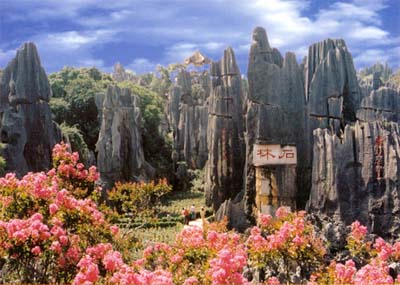
Stone forest, Kunming.
These karst formation started to form 200 million years ago and can only be seen in two places in the world. The stone trees here range from five meters to thirty meters and coveres 26000 hectares.
There are special buses running between Kunming staion and the stone forest which costs 30 yuen return trip. The entry cost is 55 yuen per person and there is student discount during school holidays. But don't forget to bring a tourist guide into the forest because it is very easy for you to lose your way. If you go with a travel group, 100 yuen will cover lunch, return trip, entry tickets and tour guide but the tour guide normally does not speak English.

Expo 99
The theme of the expo 99 is man and nature: marching into the 21st century. It has five halls, four subject exhibiion areas, one domestic exibition area showing differnt styles of Chinese arcitecture and one international exhibiton area showing architectures from Europe, America, Asia and Africa. The whole exhibition took three years to complete and covers more than 200 hectare.
The Expo is held during 1999, however, it is still open to the public at the moment. The entry costs 100 yuen for adult, 50 yuen for students (you can use interantional student card) and it is free for soldiers and teachers in China. Bus route number 56 takes you there.
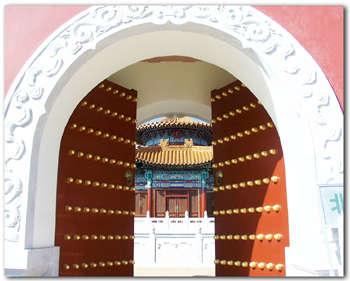
Beijing style building
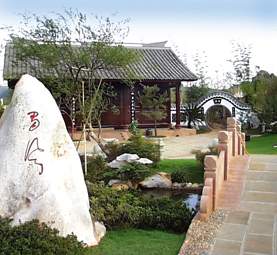
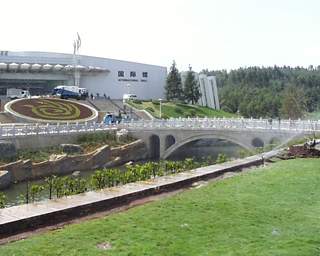
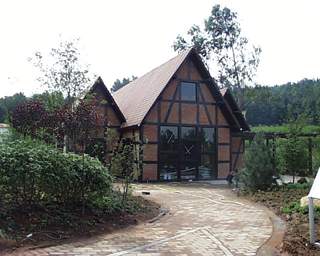
Inernational hall
German style building
Sichuan style building
Dian Chi and Western Hills
The Western Hills is also called "sleeping beauty mountain" because of the countour of the range. The path up the mountain passes several famous temples including Huating Temple, Taihua Temple and Saiqing Temple (Taoist temple).
Dian Chi (Lake Dian) is an elongated lake with its length being 40 km. Its Western side lies the Western Hills while its Eastern side is flat. Plying the water is Fan-chuan, a cute little Chinese style boat.
Others
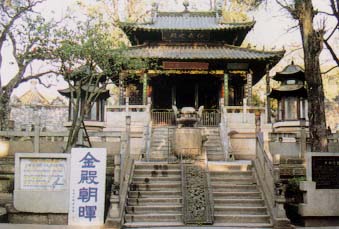
Other interesting sites in Kunming include : Bamboo temple, Daguan Park, Anning Hot spring, Black Dragon pool and golden temple.
Interesting Sites In Yunan Province
Dali
Dali lies on the Western edge of Erhai river at an altitude of 1900 km with the Cang Shan (cang mountain) behind it. Cang Shan has an average altitude of 4000 km.
The main inhabitants of this region is Bai people, and the population of Bai in China reaches 1.5 million in 1990. The Bai people has long established roots in this region. They built Dali and Nanzhao kingdom during the 8th century and exterted considerable influence throughout SouthWest China and also South West Asia as it controlled Burma in the 9th century.
The remaining Dali city can be back dated to 1500 A.D.At the present, it still has presereverd cobbled streets and traditional Bai stone architecture within its old walls.
Dali city Wall
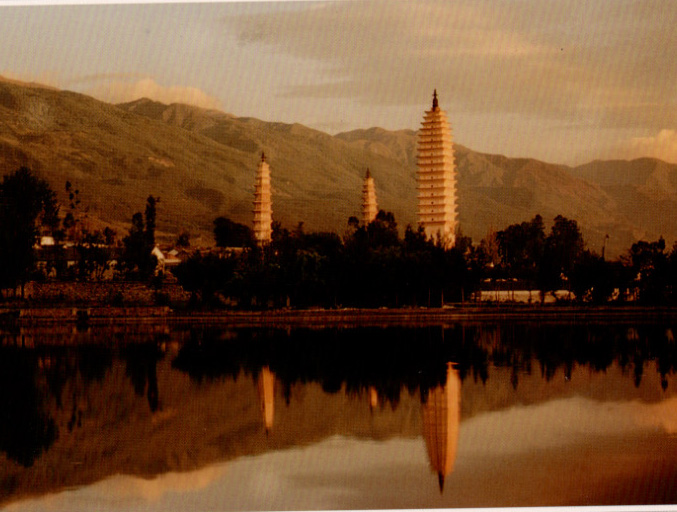
Three Pagoda: These are the oldest standing structure in the South-Western China. The tallest of the three reaches 70 metres while the two smaller ones are 42 metres. It is more impressive if viewed from a distance especially when reflected from the lake nearby.
Butterfly Spring is a pleasant spot 30 km away from Dali. The story is that two lovers ran away from a king and commited suicide at this site. After jumping into the pond, they turned into two beautiful butterflies which gather here in May every year. The best time to vist Butterfly spring is May of course and you can see numerous butterfly flying around the spring.
Three Pagoda
Lijiang
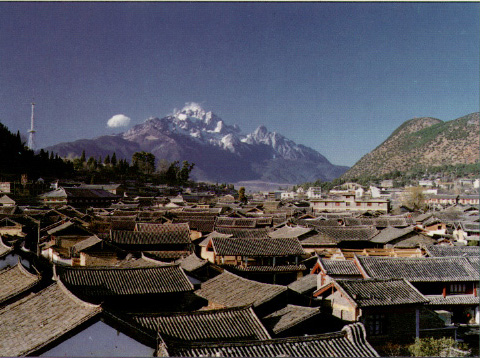
Lijiang Old town overview
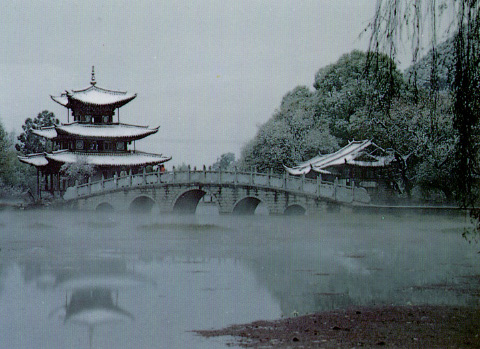
Black Dragon pond Park of Lijiang
Lijiang is located at the north of Dali, boardering Tibet. It is devided into Old and new town and the former has been listed as one of the world heritage site. The main inhabitant of this region is Naxi people and this is where Shangri'la culture originate from.
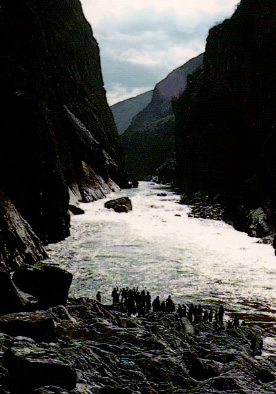
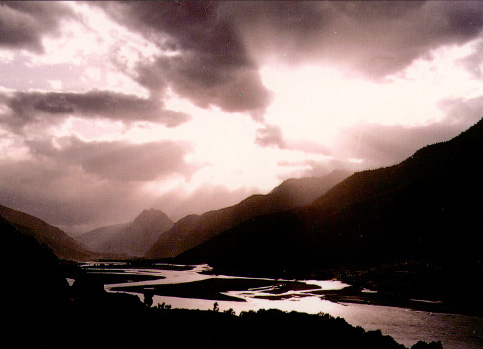
Tiger leaping gorge
Tiger leaping Gorge: This is one of the deepest gorges in the world. The entire gorge meausre 16 km, and from the waters of the Yangzi to the top of the mountain is 3900 km.
tiger leaping gorge
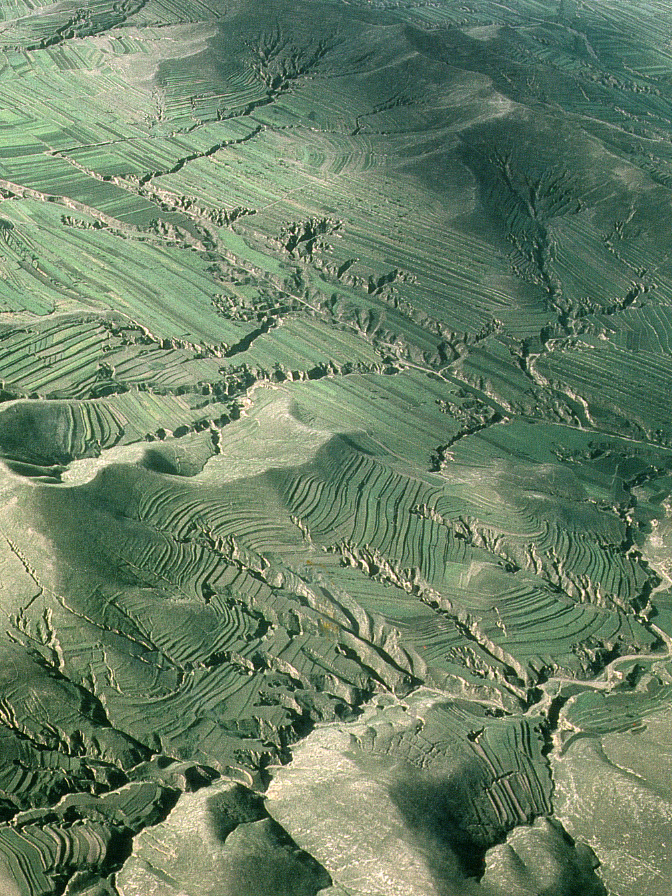
Even though Yunan is rich in its wild plants and animals, its land is not suitable for agricutlrue as there are numerous mountains in the region. So Chinese people has invented Terrace farm where little "platforms" were made in the mountain and used to plant crops. When you drive from Lijiang city to the Yangzi river, you can see the endless terrace farm on the road side and it is beautiful!
Terrace farm
Jade Dragon snow Mountain is located 35 km north of Lijiang. The peak of the mountain has never been climbed and its highest peak has an elevation of 5500m. When the weather is clear, the view is grand with the cloud beneath the cliff and thick layers of snow deposited on the mountain.
The Chairlift costs 120 yuen (15 American dollars), but if the weather is good, it is definitely worth the price.
Other places worth visiting in Yunan include Lugu river and Zhongdian in the north region. Zhongdian is a Tibetan town with heavy Han influence, it is sometimes used as the slip into Tibet by the Westners. Xishuangbainai is the mini Thailand in china and is located in the South of Thailand.