Beijing , Capital of China
Introduction of Beijing:
Beijing is the capital city of People's republic of China and controls every single aspect of China and billions of lifes living under the communist reign. It has an amazing history and is famous for its architecture and culture background. The city started to be inhabited by humans 500,000 years ago and has been the centre of China for many decades.
History of Beijing
Beijing started its history during the 1200s when the grandson of Genghis Khan -- Khanbali -- made himself the Emperor of most Asia in 1279 and Beijing his Capital. This is the period when tea was exported from China to the Western world by the silkroad.
Zhu Yuanzhang revolted against the Mongols and proclaimed the Ming dynasty in 1368. However it was only when his grandson became the ruler of China did he re-establish the capital in Beijing. Many of the structures like the Forbidden City and Tian Tan (temple of Heaven) were built during that period.
Manchus invaded China in 1600 and took over the country within months. with the help of a Ming general. The new dynasty is called Qin dynasty. Since then it has been a tradition for chinese men to have pigtails and women to wear Qipao. It is also under their reign that new architectures such as Summer palace, pagodas and numerous temples were built, forbidden city was re-expanded and renovated during then as well.
Beijing during the period of 1800s and early 1900 were subjected to political struggle and changes. It regained stability during 1949 when the Chines Liberal army marched into the city and Chairman Mao Zedong proclaimed "People's republic of China" in Tiananmen square.

Forbidden city --Beijing China
Language/weather:
Unlike the rest of China, the dialect in Beijing is the official language of China -- mandarin -- even though some of people speak with a different accent which make it difficult to understand.
The seasonal variation in Beijing is great, it ranges from -10 degree in winter to +35 degree in Summer. For daily report, please check: China weather online.
Winter lasts approximately five months per year and the average temprature of January is around --5 degree.
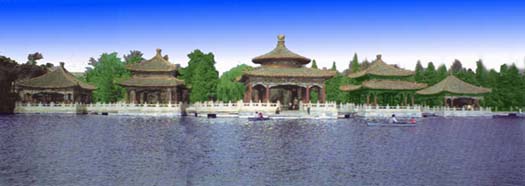
Forbidden city
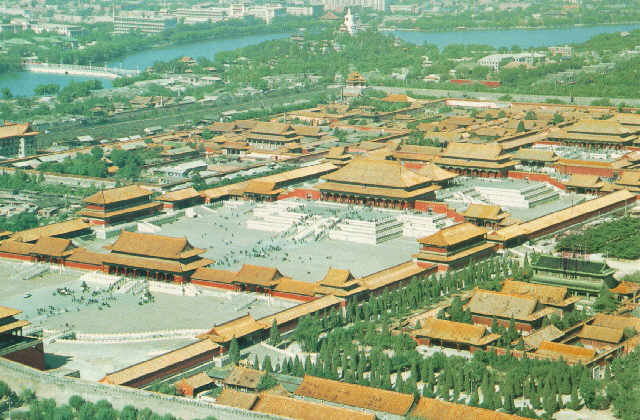
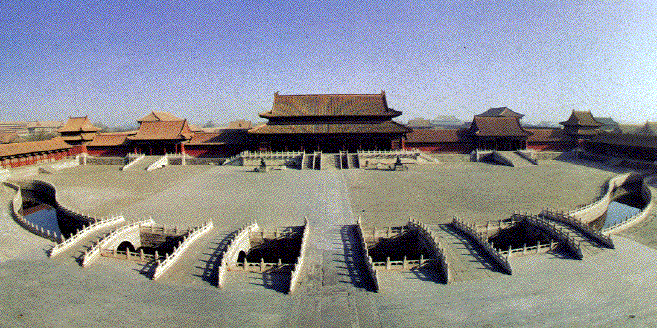
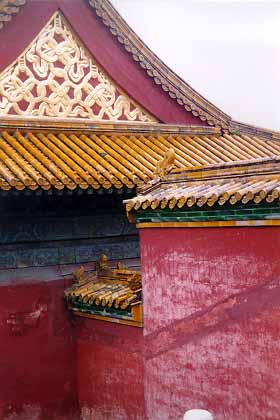
The Forbidden city, so called because it limited off Commoners from it in the past 500 years has been the residency of the Emperors of two dynasties (over five hundred years). As mentioned before, the basic layout of the palace was built in 1420s by the Ming emperor Yong Le. However, it was constantly going up on the flames, therefore most of the architectures we see these days are the re-stored buildings of the 1800s.
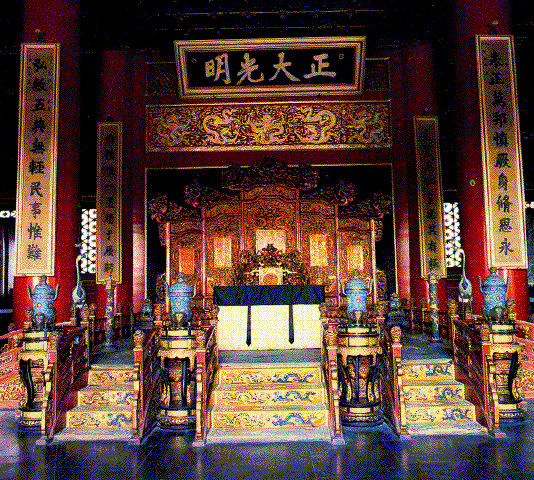
The walls of the Forbidden City measure 10 metres with the width of it being 760m and the length being 960m. The palace covers a total area over 720,000 square metres. The traditional myth is that the whole palace has 9999.5 rooms , just 0.5 rooms less than what the palace in the heaven has.The Chinese government did a count in the 1950s, and there were 8662 rooms then.
Forbidden City is divided into two parts. The outer part or "Wai Chao" is where the Emperors hold daily meetings with his royal court and where political decisions were made. There are three halls here each having different functions. The inner part or "Nei Ting" is where the Emperess and the Emepror's concubimes lived and where the royal gardens are. It is absolutely forbidden for any Commoners to step into Nei Ting, even the mother of the Emperess needs a permission.
Forbidden city is open to public these days. Its official name is the Palace Museum as it has a large collection of art crafts from various parts of China. The museum opens from 8:30am til 5pm and the cost is around 100 yen. Audio tapes in different languages are for rental.