
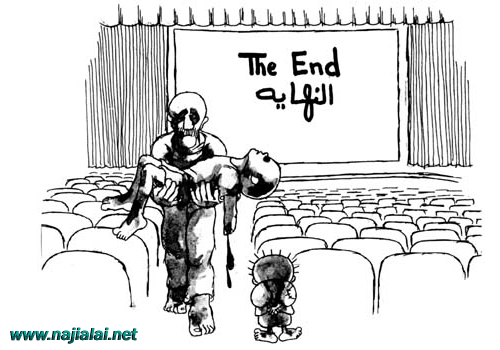
He was the last scream that we never dared utter for fearto be quenched with it.
The Palestinian cartoonist par excellence, Najial Ali is an artist who transcended fictional frontiers using lines thatdraw free borders, the boundaries of freedom without pavements, the freedomof the artist, the people, and the homeland. Every morning, for more than13 years (1975 - 1987)
Palestinians everywhere followed the cartoonist Naji alAli in whichever newspaper he published. His cartoons were re-printed inmore than one form, and discussed in every forum. He made everyone readthe newspaper starting from the back page.
Everyone who worked with him said that hewas wild, that the burning fire within him devoured everything, becausehis heart was in his quill and his quill was easily agitated and inflamed.He felt that Palestine was his own, and it will not return piece-meal,but all at once, all at once from the river to the sea, or else, no onewill forgive. The bitterness within him was constantly expanding, and heeventually thrashed at everyone with his ruthless quill.
His character was "Handala", a young boy with curly hairwhose back is always turned to the reader. His name means "bitterness"in Arabic, and he represents the distress the artist felt. In describinghis work, Naji al Ali wrote:
"The child Handala is my signature, everyoneasks me about him wherever I go. I gave birth to this child in the Gulfand I presented him to the people. His name is Handala and he has promisedthe people that he will remain true to himself. I drew him as a child whois not beautiful, his hair is like the hair of a hedgehog who uses histhorns as a weapon.
Handala is not a fat, happy, relaxed, or pamperedchild, he is bare-footed like the refugee camp children, and he is an "icon"that protects me from making mistakes. Even though he is rough, he smellsof Amber. His hands are clasped behind his back as a sign of rejectionat a time when solutions are presented to us the American way.
Handala was born ten years old, and he will always beten years old. At that age I left my homeland, and when he returns, Handalawill still be ten, and then he will start growing up. The laws of naturedo not apply to him. He is unique. Things will become normal again whenthe homeland returns. I presented him to the poor and named him Handalaas a symbol of bitterness. At first he was a Palestinian child, but hisconsciousness developed to have a national and then a Global and humanhorizon. He is a simple yet tough child, and this is why people adoptedhim and felt that he represents their consciousness."
"What is the role of political caricature? Its role isto bare life� caricature always hangs life to dry in the open air and inthe public streets� it grabs life wherever it finds it to place it on therooftops of the world where there is no place to fill the gaps or coverits holes." "When will people see Handala's face? When Arab dignity isno longer threatened, and when the Arab individual regains his freedomand humanity. Still, the most tiring part is to continue the road withall its contradictions.
The weariness of the homeland will alwaysremain deep inside." "Handala is the witness of the century who will neverdie� the witness who entered life all of a sudden and will never leaveit. He is the legend - witness. This character was born to survive�I willcontinue within him even after I die."
Naji al Ali was born in Ash Shajara village in 1936,one of 480 villages destroyed after 1948. His family was displaced to Einal Hilweh refugee camp in Lebanon. Between 1957 and 1983 he worked fora variety of newspapers in Lebanon and the Gulf. In 1983 he returned toKuwait to work for "Al Qabas" newspaper until 1985 when he was forced toleave to London to work with the same newspaper in its London office. Duringthis period he published more than 40,000 cartoons. The New York Timesonce wrote: "If you want to know what the Arabs think of the US look atNaji al Ali's cartoons." The Time magazine also described him saying: "This man draws with human bones." The 'Asahi' Japanese newspaper wrote:"Naji al Ali draws using phosphoric acid."
On Wednesday July 22, 1987 at 17:10 Greenwich meantime,Naji al Ali parked his car in central London, and walked a few meters towardsthe offices of Al Qabas newspaper where he worked. A dark complexioned,curly haired, young man surprised him with a bullet in his head and ranaway as Naji al Ali fell on the pavement. On August 29th, Naji al Ali finallydied in hospital and was buried on September 3rd in Brookwood cemeteryin Woking. His death marked the end of an era, and ironically, the beginningof the Intifada in the West Bank and the Gaza Strip. Until this day, hiscartoons are used over and over again, and "Handala" is still as relevanttoday as he was twenty years ago.

