Royal Saraphian Heritage Foundation
History | Culture |
Dictionary
Adress:
Royal Saraphian Heritage Foundation
1220, Crescent Avenue
PO BOX 08389979361 Dhamar
Saraphian Emirate
Telephone: 07 (1) 911 000 - 12
Fax: 07 (1) 911 000 - 45
email: [email protected]
History
1503 | 1504 | 1505 | 1506 | 1507
The history of our nation is ancient. Since the beginning of times nomadic tribes have wandered through the mighty Komi-Desert, travelling from oasis to oasis. Since our forefathers were nomads, very little is known for sure about them. Unlike other great civilizations, they did not leave behind great buildings, bridges, or other structures. They kept no written accounts of their lives, their wars, and their beliefs.
In fact, the first written accounts come from abroad: Fixation texts from around 3910 OE tell off 'barbaric' tribes from the Komi-Desert, who overrun their civilization during this period of time. The nomadic tribes, having wandered through their mighty, but harsh Komi-Desert, came to appreciate the rich culture and fertile lands that is present-day Fixatia. They had so much appreciation for Fixatian life, that they decided to stay in the lands. They remained in control until 1670 OE, when the Emirate of Fix became the dominant power in the Isania-region.
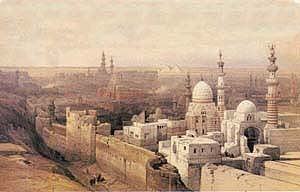 However, the wandering days of our forefathers were definetely over, they brought with them to the Komi-Desert a new way of life and soon settled in oases, alongside the central river, and in the coastal regions. A multitude of emirates were established around this period of time. The most dominant being the emirates of Dhamar and Shiraz, who merged eventually and conquered the remaining states. The family of the Emir of Dhamar and Shiraz has been in power ever since.
Several emirates set out to explore the world and they established trade posts and small settlements on the Dorania continent. The reminiscents of this sea-faring period in Saraphian history can still be witnessed in Luban on the island of Lucentia, where descendants still practise the Saraphian language, culture and Mounist religion. Furthermore, like Casatan, T�reo�ese contains a great number of words of Saraphan origin, a reminant of the sea-farers who established small settlements along the coast after the collapse of the Valanian empire. More info on the Rep�blica T�reo�a can be found here!
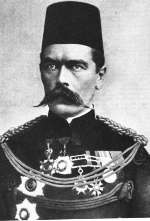 In 1503 the 'old' emir abdicates his thrown after pressure from religious leaders, the royal family and influential persons in our country. His policy of complete isolation to preserve the Saraphian culture had proven to be desastrous. The Saraphian Emirate had fallen dramaticaly behind on the rest of Scandia, having missed the Industrial revolution and the benefits of 'modern society'. It was decided this couldn�t continue and the result was that the Saraphian Emirate announced that it would open up to the outside world. In 1503 the 'old' emir abdicates his thrown after pressure from religious leaders, the royal family and influential persons in our country. His policy of complete isolation to preserve the Saraphian culture had proven to be desastrous. The Saraphian Emirate had fallen dramaticaly behind on the rest of Scandia, having missed the Industrial revolution and the benefits of 'modern society'. It was decided this couldn�t continue and the result was that the Saraphian Emirate announced that it would open up to the outside world.
The country has grown in record time to be Scandia�s 2nd biggest exporter of oil, but the government decided to embark on an 'economy diversification project' to ensure that the country would 'catch up' with the rest of the world. The oil revenues are almost completely used to finance this program. In 1504 the Saraphian Emirate, thanks to foreign technical expertise and souring oil revenues, saw the emergence of a domestic aircraft industry, called Emirat Aerospace. This high-tech industry was followed in the same year by the establishment of Emirat Defense, a weapon manufacturer. Both companies have contributed substantially to the Emirate�s prestige on Scandia and play a vital role in aquiring technology skills and knowledge to ensure the Emirate�s development. In this same year, the Saraphian Emirate participated by military means in the Republic of Luban to prevent an armed overthrow of the legitimate government by the Iudean minority against the Saraphian majority, unfortunately the Emirate�s efforts proved hopeless, due to the UFUR�s massive and overwhelming military involvement in aiding the Iudean minority. In the end, the Republic of Luban was broken up into two seperate states: Luban and Medinat Tzion.
The year 1505 was marked by more armed conflict on Scandia. The Mbalan minority in the republic of Especias rebelled against their legitimate casatan-dominated, government. The two parties in the conflict became known as the Libres (UFUR-aided Mbalans) and the Nacionals (Casatans & former Montedorians). The Saraphian Emirate aided the legitimate government, together with Andrea and Formotsinia, whereas the UFUR (once more) sought to replace that legitimate governemnt with a regime (Libres) more to their likening. The Saraphian Emirate eventually withdrew from the conflict because of a lack of funds. The conflict was solved at the Lycksele conference.
In Formotsinia the military regime was overthrown by a movement calling themselves Independence, afterwhich chaos broke out. In 1505 Unionists were fighting democratic forces in Formotsinia. International peacekeepers were succesful and a democratic regime was established in that country.
The Saraphian Emirate started construction of a railway to link her west and east coast to eachother and decrease dependency on the Formotsinian Straits.
 In 1506 Scandia saw Formotsinia going neutral. The Saraphian Emirate participated in a conference of the top-3 of oil producing nations on Scandia together with Fixatia and Especias. Despite an excellent economic year, many Saraphians fled from poverty, terrorism and oppression to Fixatia, Andrea and Sunami. The exodus brought to light the wide gap that exists between the elite and the poor masses. In 1506 Scandia saw Formotsinia going neutral. The Saraphian Emirate participated in a conference of the top-3 of oil producing nations on Scandia together with Fixatia and Especias. Despite an excellent economic year, many Saraphians fled from poverty, terrorism and oppression to Fixatia, Andrea and Sunami. The exodus brought to light the wide gap that exists between the elite and the poor masses.
The current year is 1507
Top | Home
Culture
Bull fighting:
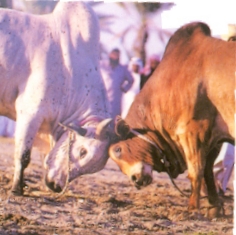 It is one of the cultural activities that Saraphian Emirate inhabitants like and consider a heritage, that is bequeathed from ancestors.
It attracts many tourists who visit especially for the spectacle. It is one of the popular games, that is arranged for weekly, in a specified place where all spectators gather after the morning prayers. It is attended too by bull owners, each exhibiting his trong, heavy weight, muscular and gigantic bull.
Bull butting is one of the sports in the Saraphian Emirate since long past times. It has rules and regulations known to those exercising it, as to how one bull confronts the other, and how it wins over the other bull. The price of a bull that takes part in butting sometimes reaches 50,000 Rial (Cc.10,000). Its owner looks well after it, feeds it with milk, honey and butter; its expenses reach 2,000 Rial (Cc. 400) per month. It is one of the sports that is loved
by the inhabitants of the town of Aya Taizz who are famous for it. Butting day is one of the most enjoyable time for the inhabitants, when they all, old and young, gather around the Butting Circle, shouting and clapping for the winning bull. The owner of the victorious bull, feels very proud and the price of his bull more than doubles, bringing big profits. The owner of the defeated bulls feels degraded and the price of his bull " falls below its real value.
The owner of the victorious bull gets no reward, but he feels pride and happiness as well as pleasure because of the rising price of his bull. Butting competitions are held during leaves and holidays of the week, for amusement and enjoyment of the heritage of the ancestors, as represented by this popular sports of the past.
Top | Home
Saraphian - Ingallish dictionary
General
Abd�abiid: Slave. Found in religious names like Abdesalam (Slave of Peace). Nonetheless the word, if spoken in anger, is an insult. (Jamal is mad at Bounejam. He spits out the word "Abid." Bounejam is mortally offended.
Abou: Father. See also Umm and Bou.
Alalla: A Taqah (ethnic minority) term for lady, roughly equivalent to Sheikh.
Ajam/Ajami: Noun and adjective meaning foreign, strange. One uses the term to distinguish Saraphians from foreigners.
Ait: A Taqah expression for village.
Quriya: The Saraphian equivalent for village.
Bedaouie: Nomad. Plural, bedaouine.
Bou: Father, a dialectal contraction of Abou. (or Abu)
Dar: A house.
Dhow: A (traditional) sailing ship.
Din: "Faith," or "Religion." In the Mounist religion, a common component of names, such as "Saifedine" � Saif ed-diin: "Sword of the Religion."
�Eid: A feast or festival.
Esori: An ethnic insult for any northerner, lit. meaning (censored).
Fellah / fellahin: Farmer / female farmer.
Girba: A waterskin; four are usually carried on each camel in a caravan.
Hammam: A public bath house, or a private bath found in wealthy homes.
Hashish: A concentrated form of hemp, used as a drug. (In Bandar it is known as Qif)
Hookah: A pipe for smoking, in which a long flexible tube draws the smoke through water in a bowl or vase and cools it, producing a smoother taste.
Howdah: A seat for riding on the back of a camel or an elephant.
Jariya: A (slave) concubine. Concubinage of free believing women (or more rarely men) is formally illegal, but a nasty tradition has sprung up, despite the disapproval of the progressive wing of the Mounist clergy.
Jebel/Jbel: Mountain (formal and dialectel forms).
Jebali: Mountaineer.
Khaadim / Khaadima: Servant or slave / female servant or slave
Mudiir: Director, chief.
Matrud: A thief kit for desert thieves and outcasts of the bedaouie, of the nomads.
Medrasa: School. Either university, college or secondary school.
Musoul: lit. "responsible," an officer in the corporate sense. For example, Musoul al-makhzen: roughly Treasurer..
Mawla: A "client" or subservient group or person.
Nahr: River.
Qasbah: A fortified town. Or more accurately a town/citadel.
Qat: A mild drug, which acts initially as a stimulant. Widely used and responsible for notoriously low production rates.
Kiif: (neologism) hashish.
Qursaan: Corsairs or pirates.
Qsar pl. Qsour: Castle, fortress or palace. Generally the later.
Raqeeqa: Roughly, "slavery."
Ribaat: A castle or citadel.
Sahra: Wilderness or Desert. (e.g. as in As-Sahra ul-komi, the greatest desert, which is an old name for the Komi Desert.)
Sahib: Owner. Also friend.
Sha'ir: Lit. poet; Also a practitioner of true magic, sihr. Spellcasters specializing in djinn-related magic. Sihr: True magic, as opposed to mere alchemy or amulet-carving. Sihr is commonly supposed to involve frequent trafficking with the djinn, and often does.
Sheikh (Sheikhs or sheiyukh): An old man, but in tribal society, a chief or leader. A Rais is generally a younger man in leadership position.
Souq: Market.
Si or Sidi: Local (Dhamar) abbreviation of Sayyid, meaning "Sir." Used to show respect, e.g. Si Rusen is like saying Sir Rusen. Normal address is by name only.
Tel: A hill.
Umm: Mother. Term of respect for women. (e.g. the famous Saraphian singer Umm al-Kalthoum)
Waasif: (pl wasfaan). Slave. A more formal term. When speaking the local (Dhamar) dialect, calling someone �abd or khaadim might be taken as an insult in Dhamar, especially if they are of a higher status like a mamlouk.
Wadi: A stream, or the empty bed of.
Clothing and ornamentation
Belghra: Moccasin like leather shoes. Most common kind of footwear after sandals.
Burnouse: A cloak like garment with a hood attached.
Caftan/Qaftan: A long gown with sleeves. Typical warm-weather wear.
Djellaba: A hooded, baggy robe for outdoor wear.
Haik: The combined headcloth and face mask worn in the desert.
Hanbal: A heavy wool cloak cum carpet.
Henna: A thorn-shrub and the reddish stain made from it. Applied to hair as a dye and used to create temporary tattoos for festivals, weddings, etc.
Kohl: Antimony powder used to darken the area around the eyes.
Tarboush: Felt cap in the shape of a flat-topped cone, more commonly called a Taizz after the city where the caps are made. Come in many colors.
Tiraz: A cloth armband decorated with writing (often religious); sometimes used as an amulet.
Qandarah/Gondorah: Similar to the Qaftan, the Qandarah is a almost sleeveless gown with varies between just over knee length to ankle length.
Rezza�: A long strip of cloth wound repeatedly around a small cap or the head.
Sabata: Leather boots.
Serwal: Loose, baggy pants worn underneath a Qaftan or similar clothes.
Selham: A kind of immense, hooded wool cloak, frequently patterned, worn against the nightly cold. Heavier than the burnouse, intended for desert nights.
Useful expressions
"Aleikum as-salaam": Proper response to the traditional greeting, "as-Salaam aleikum". It means roughly "And upon you the peace."
"al-Hamdulilum": Proper response to "Kaif al-Hal" ("How are you?"). "bi-khayr" ("well" or "fine") may be added before or after this phrase.
"Ulum Karima": An expression of gratitude at good fortune, meaning "God is all-beneficent."
"ashkuruk": "Thank you."
"Bisaha": "Wishing you health," another expression used in greetings and leave taking.
"Bismoun": "In the name of Moun"; used as a blessing or invocation to avert evil influences.
"Insha`moun": "If Moun is willing," used when announcing plans for the future.
"Kaif Halek": Saraphian equivalent of "How are you?" The proper response is "al-Hamdu lillah."
"La shukran �ala wajib": lit "There is no thanks for a duty." Equiv, of "You�re welcome"
"Min fedliq": "please." � can be used in exasperation just like in Ingallish.
"Salaam": "Peace," a common minor blessing, generally accompanied by a bow of respect (which is also called a salaam).
Shukran: alternate form of saying thanking, less formal.
"Smeh Li": roughly "Excuse me, I am smelling badly"
"as-Salaam aleikum": Traditional greeting, "Peace be upon you." The proper response is "Aleikum as-salaam."
"Tfuddul": "If you please," a generalized polite expression used when offering something to someone, when motioning someone to go ahead of you, or when inviting someone in.
"Yaulum": An expression of shock, dismay, or horror, roughly equivalent to "Oh, my God."
Religious
Baraka: Blessing, the condition of being blessed. Baraka combines charisma and perhaps luck with blessing to indicated an ability to pass on good fortune. Those with great Baraka are sometimes credited with an ability to heal others. Obviously a priest should have Baraka.
Dhimmi: "Protected". A person who enjoys royal protection, and therefore immune to civil / religious prosecution. Formally speaking in Saraphia, non-dhimmi can not avail themselves of legal protection. Those considered dhimmi are automatically extended most civil rights and protected by the royal family.
Faqih / faqiha: A learned person in religious matters, generally the ranking priest from one of the masjids. Faqihs of each of the various masjid and orders in the city help administer the religious laws of the city.
Hakima: lit. a wise woman. A Wise Woman has, with her divanatory powers, the ability to perceive truth and lies in the spoken word. Very rare.
Hazrat: Meaning "holy."
Imam: Chief priest of the masjid.
Jamaa:Great mosque or temple. For holy day prayers, meetings. Often hosts a school (College) and other institutions.
Kahin: A priest. A Kahin is a certain kind of priest who worships idols of unenlightened religion. Kahin is also used as a term of abuse by priests about others, implying they are false priests or heretics.
Kaafir: A harsh word for unbeliever.
Kufr: Unbelief
Mahdi(a): A messianic figure awaited by some sects.
Muallim / muallima: A learned person or teacher. Generally ranking below a faqiha. They are generally responsible for the masjid and its medrasa.
Mubarak: Adjective meaning "blessed." Occasionally used in names.
Muezzin: The individual who summons the faithful to prayer at the appointed times.
Mujahid(een): lit. "struggler" or "one who strives". A holy warrior in the Mounist religion tradition.
Masjid pl masaajid: Mosque or temple.
Mumin: pl. muminin, "Believer" used to refer to community of Believers as a whole.
Murid: A disciple or follower.
Murshid: A master or guide, used by leaders of Taqah.
Mutawahideen: Neologism. "The Oners." A sect of the Taqah which is popular among the western Aya Taizzi and Aya Taizzi nomads like the Sanhaja. It also is strong among the residents of the city, Aya Taizz, and is identified with the opposition to the Dhamari. They hold that Moun is All. They control the Aouina mosque in Eshemiya.
Nabi: A prophet.
er-Rejiim: The Evil One.
Tariqa: Order or Path. "Order(s)" (lit: path(s)) organized somewhat like chruistian monastic orders, except of course celibacy is not a rule - nor even encouraged. See also Zaouiya.
Zaouiya: A "monastary" of the Mounist religion. The Zaouiya are owned by various Tariqa or "Orders, see Tariqa entry.
Political and military
Emir/Emira: Lit. one who commands. Can mean "Prince", "General", "Commander" depending on the context. Emir(a) al-mumineen is a phrase which means "Commander of the Believers."
�Askar: Soldier. Most common warrior (historically), a native of a permanent residence, often serving in a militia.
Faris: Lit. a horseman, often a paladin. They are champions of good, fighters with just causes. Nowadays Saraphians are using it to mean any non-nomadic mounted (mechanized) warrior.
Hakim: >A wise man, a kind of neighborhood judge. An informal position often given to a priest or other learned person.
Mohtasib: Official responsible for the regular and consistent running of the markets, souqs etc. An important position with a city.
Malik: King. Sultan (lit Authority) is the equivalent of Emperor and Malik is used to refer to less powerful lords. Following that is Emir which can mean a number of things. See Emir and Sultan.
Mamlouk / Mamlouka: (historically) Military slave soldier, often of quite high social status despite being a slave under the law. Almost always enslaved prisoners of war from fairly distant lands. Nowadays, elite soldier like a marine or a commando.
Moulay: Roughly "Lord." The proper title to give to a powerful person. But not a merchant or Qadi.
Mujahid: lit. "struggler" or "one who strives". A holy warrior.
Qadi: Judge. A Qadi in the Dhamar Sheikhdom is something like a combined administrator and civil judge, whose ruling may be appealed to the Emir. A Qadi may also be a Faqih or have another profession in addition.
Qa�id: Administrator, an appointed official of the Sultan or Malik.
Rais: A military leader (non-naval): somewhat equivalent of captain. Also a civil rank, meaning simply leader. (e.g. Rais al-majlis would mean simply "Leader of the Council".
Sultan: lit. Authority. Sultan is equivalent to Emporer.
Wali: "Ruler" In Dhamar, a civilian title roughly equivalent to Rais. A civilian with commanding authority.
Wazir: Minister. (the Ingallish word Vizier comes from this Saraphian word)
Top | Home� Copyright 1503 by the Royal Saraphian Heritage Foundation. Revised December 1506.
|