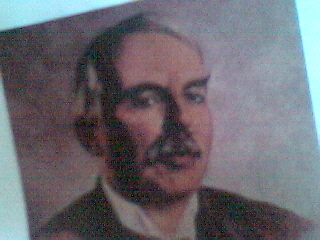
Ernest Rutherford also known as "The Friendly Scientist" performed an experiment in 1910 known as the gold foil experiment. Rutherford along with some coworkers shot alpha particles at a very thin sheet of gold foil studying the angles at which the particles bounced off at. Rutherford observed that almost all the particles went directly through the foil but a small percent of the particles bounced back about 1 in every 8000. Because some of the particles bounced back they determinded there was a core or nucleus in the center of the atom. Rutherford and his coworkers discovery lead to the downfall of Thomas's "plum pudding" model.
In 1911 Rutherford made the conclusion that:
*Most of the mass of an atom and the positive charges were found in the nucleus.
*Most of the volume of an atom was made up of empty space, with electrons orbiting around it.
|