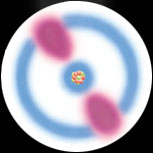
| An electron is a negatively charged subatomic particle. Electons in an atom are at various distances from the nucleus and are arranged in energy levels called shells. Electrons themselves take up almost all of an atom's volume but they only account for small portion of the atom's mass. Electons in the outer shell of an atom also determine the chemical behavior of the atom. Electrons are a fundamental unit of matter, which means that they are not made up of smaller units. An electon's diameter is 1/1000 of a proton and the mass of an electron is 0000000000000000000000000009 grams and electons are the lightest particles that have and electrical charge. The man credited with discovering the electron in 1897 was Sir Joseph J. Thompson who was a British physicist. In 1913 an American physicist named Robert A. Millikan was able to get and accurate measurement of the electon's charge. *Thompson, James E. The World Book Encyclopedia, vol. 6. p.203 1993 |
| The Electron |
 |