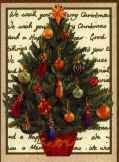
Today the Tree is a central feature of the Christmas
celebrations but its origins are ancient and pre-date
Christianity.
Pagans used trees as part of their religious ceremonies The Druids decorated
Oak trees with fruit and candles in honor of their Gods of the Harvest. During
the Roman festival of Saturnalia, trees were decorated with gifts and candles. The Vikings regarded
evergreen coniferous trees as symbols that the darkness of Winter would end and
that Spring would return.
So how did the Tree become part of
Christmas? One legend tells of St. Boniface who
encountered some German pagans about to sacrifice a child at the base of an Oak
tree. He cut down the Oak to preventsss the sacrifice and a Fir tree grew in its
place. St Boniface told the pagans that this was the Tree of Life and
represented Christ.
Another legend ascribes the
Christmas tree to Martin Luther, the founder of
Protestantism. The legend tells how Luther saw the stars shining through the
branches of a forest as he walked at night giving him an impression of twinkling
lights. The beauty of this so impressed him that he cut down a small evergreen
and brought it into his home to recreate the scene using lighted candles on the
tree's branches.
Germany seems to have started the use of a decorated
tree as part of Christmas. When trees were scarce a wooden pyramid was sometimes used
and this would be decorated with branches and candles.
In Britain the
Christmas tree tradition was popularized in 1841 by Prince Albert and Queen Victoria,
(both of German descent), who decorated a tree at Windsor Castle with candles,
fruits, gingerbread and sweets. The use of the Christmas tree spread to America with
German emigrants.
Nowadays the Christmas tree, (real or synthetic), is seen
worldwide in homes, Churches, workplaces and cities. A famous tree is the one
placed every year in Trafalgar Square, London, a gift from the people of Norway
in gratitude for the help that Britain gave during World War II.
|