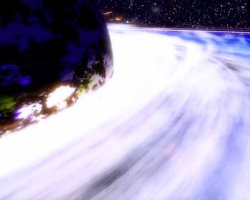
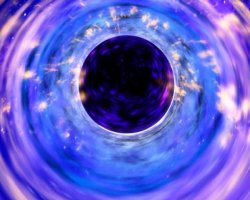
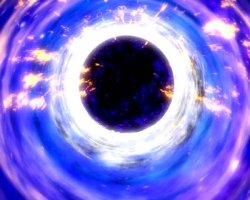
In Astronomy this semester, an important aspect of the curriculum was devoted to the study of supermassive black holes and the theory that they are the "central engines" powering galaxies. For this reason, developments that further our understanding of how supermassive black holes function and relate to the galaxies around them are exceedingly relevant. As the possibility of a supermassive black hole at the center of the Milky Way exists, understanding how the black hole relates to its surroundings is critical to our conception of our own galaxy.
Such developments will also eventually help us account for the formation of supermassive black holes, since apart from knowing that they do not require a supernova explosion to produve them, their origin is unresolved. This might also change our perception of the accretion disk surrounding a supermassive black hole, which we now imterpret as matter captured by the hole's gravity spiraling in toward it, but it now seems true that matter is also expelled out into it from the edge of the black hole.
Finally, this discovery has implications as evidence for supermassive black holes as the centers of quasars, which as of now is only circumstantial. If, as experts are speculating, this new model for supermassive black holes proves to be observational evidence for the Blandford-Znajek theory, then many hypotheses concerning the nature of these quasar systems would be validated. |