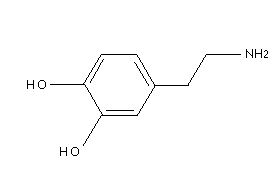
This past week and a half, we covered basal ganglia in several DES Neuroscience discussions outside of the classroom. One of the diseases discussed in detail was Parkinson’s disease – relating to the degeneration of the substantia nigra pars compacta, leading to a pathological state involved in the direct pathway communication from the putamen-caudate to the thalamus and the Brodmann’s #6 pre-motor cortex. Parkinsonism actually refers to a clinical syndrome which consists of: Tremor at rest (pill-rolling), Rigidity (“lead-pipe”), Akinesia/hypokinesia, Posturing (stooped posture) – hence the acronym TRAP. Other signs and symptoms include diminished facial expression, and a shortened accelerated steps gait. If the lesion is UNILATERAL, the patient only shows CONTRALATERAL Parkinsonism.
That’s
great, but what types of things actually cause this Parkinsonism?
1)
Striatonigral Degeneration -
In this form of Parkinsonism, the substantia nigra is only mildly affected,
while other areas of the brain show more severe damage than occurs in patients
with primary Parkinson's disease. Patients with this type of Parkinsonism
usually demonstrate a greater degree of rigidity. The signs and symptoms
also
appear sooner than
in classical Parkinson’s disease.
2)
Toxin-Induced Parkinsonism -
Toxins such as manganese dust, carbon disulfide, carbon monoxide, and a
chemical known as MPTP (1-methyl-4-phenyl-1,2,5,6-tetrahydropyridine) cause
Parkinsonisms. In the case of MPTP the Parkinsonism implicated
is permanent after one single ingestion, and closely resembles Parkinson’s
disease. Researchers discovered this reaction in the 1980s when heroin
addicts in California who had taken an illicit street drug contaminated
with MPTP began to develop severe Parkinsonism. Structurally MPTP is a
meperidine derivative. This discovery, which demonstrated that a
toxic substance could damage the brain and produce Parkinsonian symptoms,
caused a dramatic breakthrough in Parkinson's research. MPTP allows
scientists to simulate Parkinson's disease in animals and conduct studies
to increase understanding of the disease. A reversible form of Parkinsonism
sometimes results from use of certain drugs (chlorpromazine, haloperidol)
prescribed for patients with psychiatric disorders. Some GI meds
(metoclopramide) and high blood pressure meds (reserpine) may also produce
Parkinsonian symptoms. Stopping the medication or lowering the dosage
eliminates the unwanted presence of these symptoms.
3)
Postencephalitic Parkinsonism –
Shortly after WWI, the viral disease encephalitis lethargica struck almost
5 million people throughout the world. The disease then suddenly
disappeared in the 1920s. Known as sleeping sickness in the United
States, this disease killed one third of its victims and in many others
led to post-encephalitic Parkinsonism - a particularly severe form of movement
disorder in which some patients developed, often years after the acute
phase of the illness, disabling neurological disorders, including various
forms of catatonia. For those who have already had Dr. Pensick for
Microbiology, does the name "Von Economo's" disease ring a bell?
If it did not then, it should now - the Powerpoint slide with the guy looking
into the microscope, but no good description as to why he was doing that.
A neurologist named Oliver Sacks published Awakenings in 1973. This
was an account of his work in the late 1960's with surviving post-encephalitic
patients in a New York hospital. Using the then-experimental drug levodopa,
Dr. Sacks was able to temporarily "awaken" these patients from their statue-like
state. In rare cases, other viral infections, including western equine
encephalomyelitis, eastern equine encephalomyelitis, and Japanese B encephalitis,
can leave patients with Parkinsonian symptoms.
4)
Arteriosclerotic Parkinsonism –
Referred to as pseudoparkinsonism, arteriosclerotic Parkinsonism involves
damage to brain vessels due to multiple small strokes. Tremor is rare in
this type of Parkinsonism, while dementia is common. Antiparkinsonian
drugs have little efficacy on this form of Parkinsonism.
5)
The Bizarre Dementia In Guam -
This form of Parkinsonism occurs among the Chamorro populations of Guam
and the Mariana Islands and may be accompanied by a disease resembling
amyotrophic lateral sclerosis (Lou Gehrig's disease). The disease has a
rapid onset, with death typically occurring within five years. Some
researchers suspect an environmental cause, perhaps the use of flour from
the highly toxic seed of the cycad plant. This flour was a dietary staple
for many years when rice and other food supplies were unavailable in this
region, particularly during WWII (as Archie Bunker would say – “The Big
One”).
6)
The Others - (Always
my favorite section of any discussion -- the freak cases). Parkinsonian
symptoms may also appear in patients with other, clearly distinct neurological
disorders such as Shy-Drager syndrome (sometimes called multiple system
atrophy – Parkinsonism along with ANS failure – loss of sympathetic neurons
in the intermediolateral column of the spinal cord), progressive supranuclear
palsy (striatal syndrome in people >50yrs old, with widespread neuronal
loss and neurofibrillary tangles in many areas of the brain), Wilson's
disease (AR disorder of copper metabolism), Huntington's disease (AD disorder
with degeneration of the caudate nucleus), Hallervorden-Spatz syndrome
(very rare disorder with increasing dysarthria and progressive dementia,
and at autopsy brown discoloration of the globus pallidus and substantia
nigra), Alzheimer's disease (cerebral cortex degeneration), Creutzfeldt-Jakob
disease (prion spongiform encephalopathy), olivopontocerebellar atrophy
(AD disorder with shrinkage in basis pontis from loss of pontine nuclei
+ widespread loss of Purkinje cells), and post-traumatic encephalopathy.
(References: Robbins,
S. Pathological Basis of Disease; DeMyer, W. NMS Neuroanatomy; many web
sites.)

LINK TO THE LAST DISCUSSION ABOUT DENGUE