
Snow as bling? Yessir.
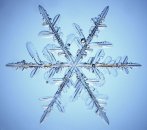
The word dendrite means "tree-like", which is an apt description for the multi-branched structured stellar dendrites. In a stellar dendrite there are six symmetrical main branches along with a copiuos amount of arbitrarily placed sidebranches. These snow crystals are generally about 5mm+ in diameter but only about .1mm thick.

Sectored plates are flat and very thin ice slivers that have a wide range of possible shapes. They are created by many ice ridges that force the "plate-like arms" to divide into sectors.

These columnar crystals can make up the majority of a snowfall. They are hollow, hexagonal columns--similar to a standard Ticonderoga #2!!!
These snow crystals occur when the columnar crystals build up to be so long that they take on the appearance of a needle. In some cases the needles have thin hollow regions, like the Hollow Columns, and in some cases the ends will split into even more needle-thin branches.

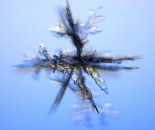
These unique snow crystals are formed when a few individual ice crystals are kind of thrown together. It's like an abstract snowflake. All of the different branches are placed differently from one another.
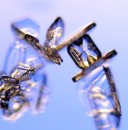
These equally as unique crystals began their crystal lives as columns but then, as a result of being blown into an area with different temperature, switched suddenly to the plate style.
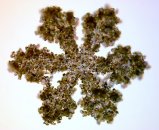
As the snowflakes collect water droplets in the clouds, some droplets may freeze onto a descending snow crystle. These droplets are called "rime"--sometimes a snowflake can be made up entirely of rime. When this occurs the snowflake is called "graupel" or, more commonly, soft hail.
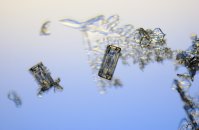
Because the journey to the ground is so perilous, some snowflakes often arrive on earth in pretty rough shape. Wind and warmth are both factors that create irregular crystals.


www.its.caltech.edu/~atomic/snowcrystals/class/class.htm