
HOW DO SNOW MACHINES WORK?
So I guess I'll tell you.
1. Temperature & Humidity: These two variables must be low enough in order for us to make snow. The relationship between temperature and humidity is for some reason called the Wet Bulb Temperature.
2. Water temperature: Obviously, the colder the water is, the better. Most ski mountains get their water from ponds or reservoirs where the water is typically 34 to 40 degrees Fahrenheit.
If you want to hear it the simple way, then all you need to know about snow making is that water from a hose is sprayed through a nozzle made up of very fine holes into the air and freezes. Thus, SNOW! Unfortunately, it's just not that easy. First of all, currently there are two types of snowmaking systems: Water/Compressed Air Systems, and Snow Cannon System. I think we all know which one sounds cooler.
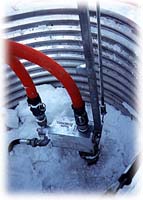
At most ski mountains you will notice two pipelines alongside a ski trial that uses snowmaking. One pipeline is used to carry water and the other is used to carry compressed air. The compressed air is used to atomize the water into tiny droplets and to assist in spraying the droplets out, where they cool and freeze to snow. However, snowmakers must carefully monitor and control the balance of compressed air and water that go into each snowgun. By doing this they are able to determine the consistency of the snow. For example, they can change the water and air percentages being used by the snowguns in order to make heavier or lighter snow. Essentially water and air are all that is used to create snow.
So...Why can't we just make snow whenevah we want to?
The answer to this question is humidity. When snowmakers consider temperature they must also consider humidity, and this is why we use the Wet Bulb temperature. The temperature might be below freezing, but the humidity could be high -- so instead of relying on temperature we use the Wet Bulb temperature. DUH !!!
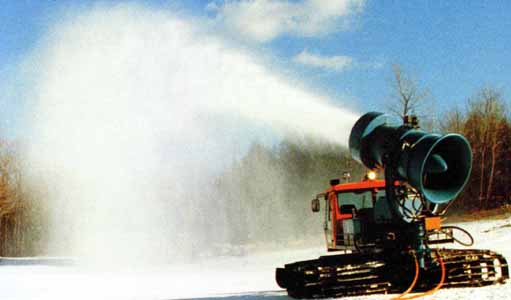
Another form of snowmaking is through "snow cannons" which do not use compressed air. In snow cannons, a large amount of water is atomized through the tiny nozzles around a massive fan blade. The fan shoots the droplets into the air where it freezes and forms to snow crystals. Snow cannons are capable of creating much more snow per hour than with the compressed air process and are also much quieter when running.
Well...the obvious answer is that we can't just snap our fingers at Mother Nature and ask for three feet of snow so we can enjoy a day at the ski mountain. Man-made snow allows us to ski virtually whenever we want to if the Wet Bulb temperature is right. Also, you might now that a natural snowflake has six dendrites, or tiny arms that branch out. However man-made snow has a very compacted six-sided structure which packs more densely and is more durable than natural snow.
Snowmaking is what allows us, whether we are skiers or boarders or whatever, to enjoy our sports, even if we do live in Vermont where snow during the winter is a given.


