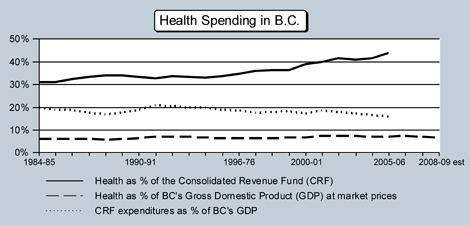
A popular public myth spread by the BC government and other private healthcare institutions is that an aging population will render our public health care system unsustainable. On September 25th 2006, BC Finance Minister Carole Taylor predicted that by 2017, 70% of the provincial budget would be spent on health care (Lee). Further reports by the Fraser Institute stated that “health care will consume the entire provincial budget by 2050” (qtd in Lee 9). There is no doubt that the number of baby boomers reaching retirement age is steadily increasing and their demand on our health care system will require a vast reformation of the existing system. However, these changes don’t necessarily mean that our system will be forced into bankruptcy nor do the changes imply that our entire system will have to undergo privatization. With the expansion and improvement of services to cater to seniors, I think that BC can easily sustain itself despite an aging population.
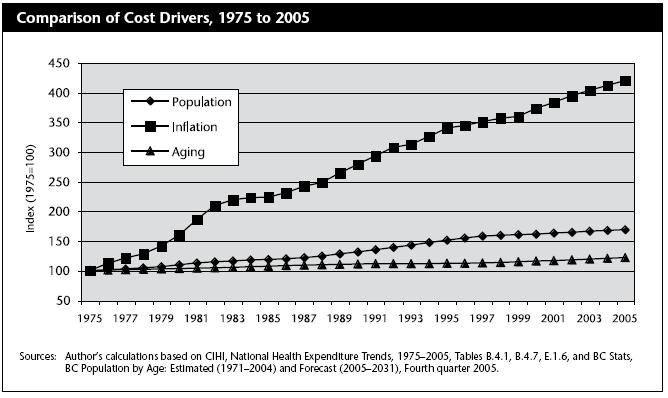
Opponents to this proposition will be the first to point out obvious statistics. Baby boomers born between 1946 and 1960 are today between 45 and 60 years old. In 2006, they will have just begun their retirements, leaving the workforce en masse and thus vastly decreasing our tax revenue. Pierre Fortin, a professor of economics at the Université du Québec á Montréal, points out that in 2006, 51% of Canada’s total population was working. With the majority of baby boomers aging into retirement by 2020, only 49% of the population will be working, thereby decreasing our taxpayers’ population by 4%. He also states that the number of senior citizens will increase from the 13% in 2006 to 18% in 2020. He stipulates that “senior citizen costs on average five times more in terms of health care costs and social services compared to a young adult” therefore increasing the overall provincial health care spending by 14%.
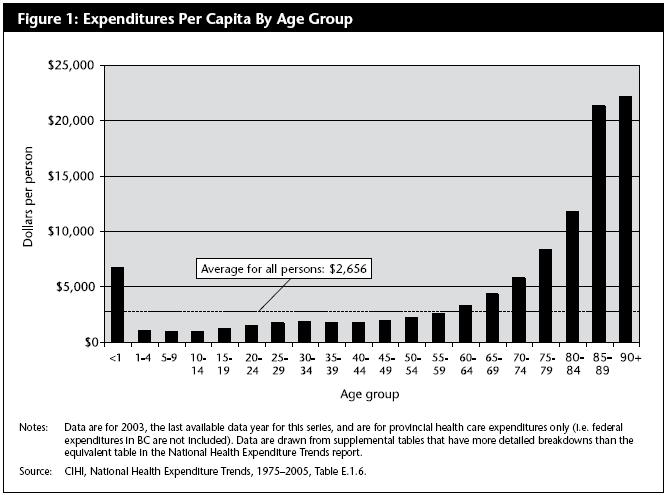
Many opponents also do not take into consideration that the overall lifestyles of the baby boomers have become healthier, therefore enabling them to live longer and healthier lives. It should be noted that the portrayals of these statistics have been rigged towards the bias of privatized healthcare. According to Marc Lee, a senior economist with the BC Office of the Canadian Center for Policy Alternatives, these statistics are measuring the wrong thing; the amount of money spent out of the provincial budget is not what is important, but instead, “the share of our total income we spend on healthcare”(9) is really what matters. Lee challenges the numbers presented by Minister Taylor, which “assume health care spending increases that are larger than those of recent history, and that revenue growth in the future will be much lower than recent history” (9).
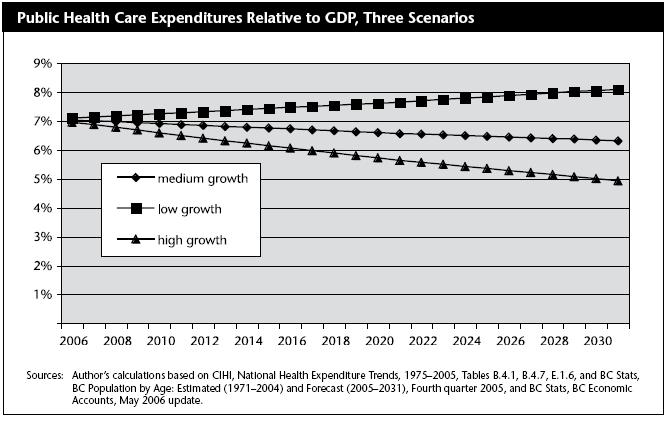
Government statistics also neglect to note that the aging of Canada’s population will allow savings in other areas. Average birth rates put out by Statistics Canada show that the school age population (aged 3 to 19 years old) will drop by 13% between 2006 and 2020. This will decrease the amount of money spent on children’s benefits, child care allowances and education funding (Fortin). In addition to the child care savings, Gabby Hyman, a World Wide Learn Columnist, counters the event of the rapid retirement of the baby boomers with the opportunity for young adults to build secure, profitable careers. She believes that as a result of the retirement of the baby boomers, there will be a sudden opening in the workforce as well as many new jobs created by the aging population. Hyman quotes an ancient Chinese proverb: “at the heart of every crisis, there lies a powerful opportunity”. She comes to the conclusion that according to the Bureau of Labour Statistics (BLS), “graduates from college and health care school programs will be in great demand over the next decade and beyond, along with program trained home health aides.” Statistics by Hyman show that program-trained home health aides are predicted to grow as much as 56% in the next 10 years. College or specialty school grads from medical assisting programs will encounter a 52% rise in employment opportunities. Physician assistants with dedicated schooling will experience a 50% increase, and college-trained physical therapists assistants will see their career prospects rise by 44% (Hyman). With these health professions in place and quickly being filled, the decrease in tax revenue caused by the retirement of baby boomers will be minimal.
In addition to the baby boomer’s retirement and aging not being the looming disaster they are made out to be by the media, there are other ways to decrease the demographic shock to the economy. A change that I believe will play a major factor in the sustaining of our healthcare system and economy is the expansion of services to cater to the aging population, which in turn will reduce prices and increase efficiency.
With any research, both sides of this argument will easily realize that "Boomers are the first generation that grew up exercising, and the first that expects, indeed demands, that they be able to exercise into their 70's" (qtd in Baby). This generation of baby boomers suffers from a phenomenon called “boomeritis” where many of the baby boomers visit the gym three to five times a week for their health. Due to excessive exercise, these baby boomers need knee and hip replacements, surgery for cartilage and ligament damage, and treatment for tendonitis, arthritis, bursitis and stress fractures.
Bostrom points out that baby boomers have grown up in an environment where they will not be like their parents or grandparents:
If [they] are tired or suffer from a little bit of pain, that’s not what [they’re] going to accept as a natural part of aging. [They’re] going to have a higher set of expectations. And the expectations are going to be driven by [their] aspirations and [their] money to be able to go after what [they] want (Bostrom).
Due to this “if it hurts fix it” attitude, the volume of orthopedic surgeries has increased above and beyond population growth and aging. In spite of the increase in surgeries, waiting lists are still an issue because technology has increased the demand of people who can avail themselves of such surgeries.
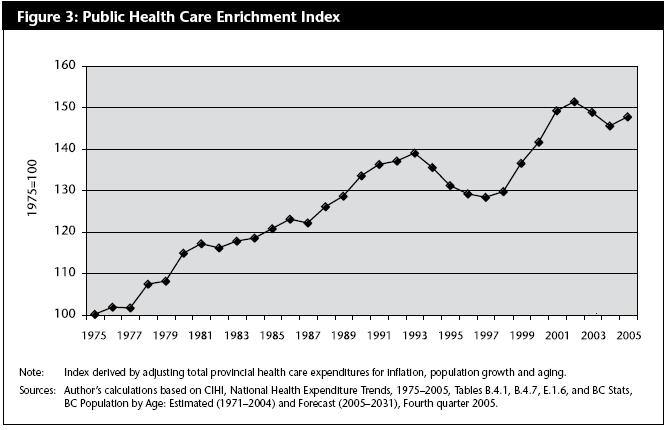
In response to the overflow of orthopedic surgeries, the opposition that supports the privatization of health care suggests that these surgeries should be turned over to private clinics which are “more efficient” (Lee). They believe that allowing private facilities to operate along side public ones will decrease waiting periods. The opposition enforces the idea that those who can afford to pay for private care should do so, thereby increasing the total funding available for health care. This privatization can also free up the queue for public services so that everyone can get faster treatment. They believe that “private health care will decrease costs and strengthen the public health care system” (Alleyne).
However, Alleyne states that research evidence on for-profit healthcare from England and New Zealand shows that both countries actually have larger waiting lists and longer waiting times than countries like Canada where most healthcare is provided through the public system. Why have these wait periods increased? These private systems take younger, healthier patients whose conditions are easier and cheaper to treat, leaving the more expensive cases to the public system. In addition, Alleyne believes that if doctors work in both public and private systems, but earn more in private systems, they will have the incentive to keep public waiting lists long to encourage patients to pay for private healthcare. Lastly, she states that having a private system running along side a public system would take the badly needed doctors and nurses out of public hospitals and into private clinics. This migration of medical staff towards private clinics removes the doctors and nurses from public sectors. The result is obvious: with no doctors present to perform surgeries, the wait lists for public hospitals will increase drastically.
Statistics provided by Alleyne demonstrates that for-profit care has been proven to be more expensive than non-profit care. In Sweden and Australia, for-profit care has substantially increased administrative overhead and overall costs. Observations of direct patient care show that when a privatized surgery is contracted out, it tends to cost more. This price difference occurs because for-profit facilities have to generate profits to satisfy shareholders, while not-for-profit facilities can spend that money on patient care (Alleyne).
With the advancement of technology and medicinal research, there is now a higher likelihood of curing medical conditions which were formally rendered incurable. Owners of the private sector companies believe that in order to effectively utilize these technologies and medicines which are too expensive to use in the public sector, they too should be privatized into specialized clinics. Those who have enough money to pay for the more advanced diagnostic machines can utilize the private clinics to catch ailments that could not be detected with the older machines in the public hospitals.
A caution provided by Lee is that “while such technological developments will almost surely be more costly, they may not provide more information than older technologies, and may be used more widely than specific cases that would actually benefit most from the technology”(19). As for drug therapies, they have become more prevalent and new developments can treat ailments that could not previously be treated. The rising cost of drugs overall is accounted for by both increased utilization of drugs and the increasing cost of drugs themselves. However, the increases in prescription drug prices and changes towards more expensive drugs are a large part in the growth of drug expenditures but have not necessarily been accompanied by improved health care outcomes. He also suggests that instead of combating common diseases with brand new expensive prescription drugs, the health industry can turn back to just as effective medicine such as Aspirin used to thin blood for stroke patients.
Baby boomers, as a whole, have fewer children. Because of this, as boomers age, they “will have to maintain their health for longer periods of their life in order to be able to function effectively” (Warner). They have fewer children to care for them, and more of their children are divorced and living great distances from them. Hence, when it comes to housing for seniors at a time when they can no longer look after themselves, it’s not surprising that children send their aging parents off to seniors’ institutions and nursing homes where they don’t have to worry about their care.
Hebert states that instead of placing senior citizens into institutions and nursing homes, they should be registered into community services and home care which are less costly to the system. Community services assist elderly citizens who wish to stay in their own homes with chores and repairs that they cannot do themselves, such as roofing or grocery shopping. With home care, a person (usually a nurse) lives with or visits daily to help care for the elderly citizen. Unbelievable as it sounds, these individual attention services are less costly than intermediary institutions which care for senior citizen in residences and nursing homes (Hebert).
In conclusion, the perceived predicament of the baby boomer population aging into retirement is not the large threat that the media, and other opposing groups portray it to be. The economic and social changes caused by the retirement and aging of our senior citizens can and will be countered with equivalent job opportunities for today’s youth, and other savings in tax funds. With these savings and job opportunities, executed along side with modest expansion and improvements of services for senior citizens, it is obvious that BC’s healthcare system can sustain itself, and will easily absorb the changes of our growing economy despite the aging population.