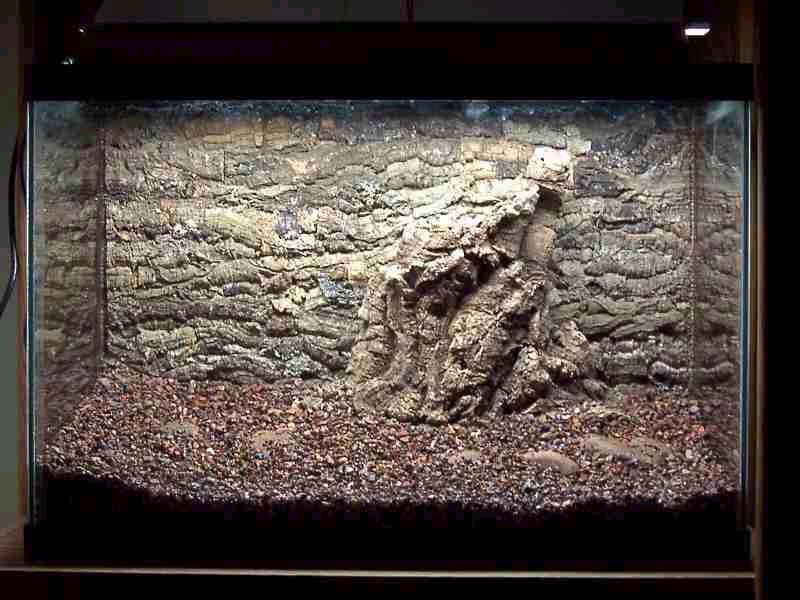
All the hardware has come in, it's time to start the installation! I got the tank scrubbed clean and the corkboard measured, cut, and siliconed to the back of the tank. After thinking about I decided to glue the "stump" to the cork rather than make a cut out and glue it to the glass itself. While the silicone was drying I cleaned out the substrate. One hour and a half inch of dust later I got everything cleaned out. I'm glad they don't sell Flourite by the pound!
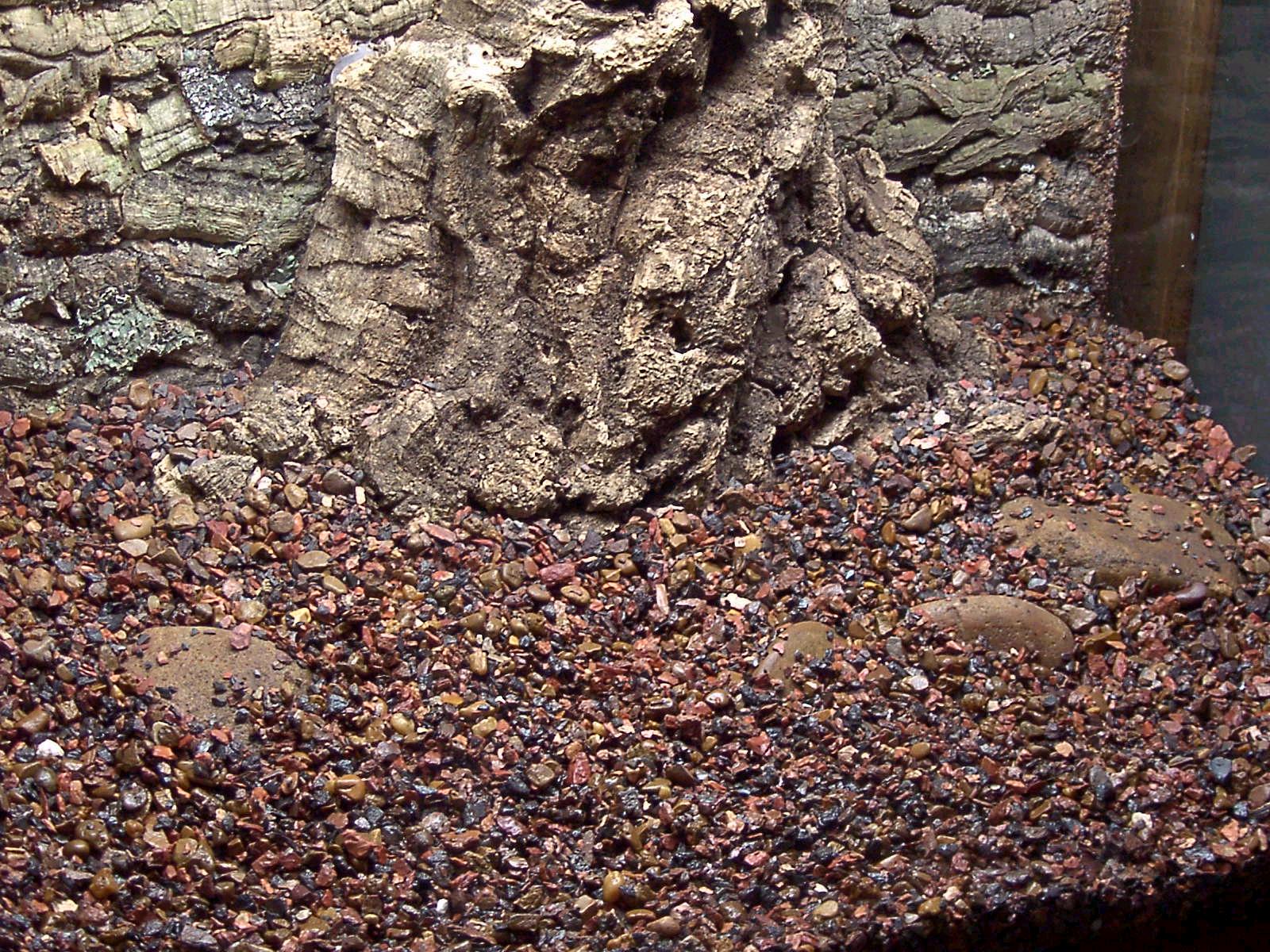
After letting the silicone set and dry I added the substrate. I first put in a 2-3 inch layer then added the slope foundation rocks. When that was done the rest of the substrate went in, making a very nice slope from 5 inches in the back to about 3 inches in the front.
Tuesday, May 28th, 2002:Tonight I hooked up the filter and heater and filled the tank. I had a little trouble attaching the powerhead to the spraybar as they're of different makes. Luckily I had purchased a CO2 diffuser and the adapter for that worked out perfectly. Unfortunately, I wasn't able to add the diffuser as well it didn't fit right and took up too much room. Hopefully, the powerhead and spraybar should provide enough diffusion for the gas.
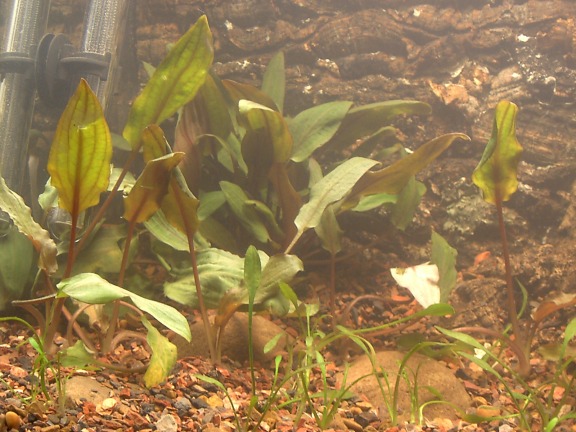
In a happy twist of fate the location of the aquarium in the wall unit provides enough cover so I can't see a lot of the harware from my bed! (Which we all know is the best place from which to enjoy any aquarium.) The only thing that should be visible once the plants are added is a small section of tubing connecting the filter to the spraybar. With any luck the C. walkeri should grow large enough to obscure the view of the heater.
Wednesday, May 29th, 2002:The cork is leeching a lot of tannin, it looks like some serious monitoring and/or changing is going to be in order. The heater is still running a little hot, which is helping the cork bleed, I guess. I'll lower the temp tomorrow night when I do a water change. I can't wait for the plants to come in!!! Everything is going to look so much better when there are some living things in there. I'm still debating putting some wood in there. I'll have to wait until all the plants are planted and everything's been sitting for a few days. I don't want the aquascape to get too busy.
Thursday, May 30th, 2002:My plants came in today! I got four beautiful plugs of C. walkeri, three of which I had to break down into constituant plants, but they all came out well. After planting I added the recommended doses of Flourish Iron, Excel, and Trace Element. We'll see if this and mixing some RO water with what was in there already has been enough to keep the crypts from melting.
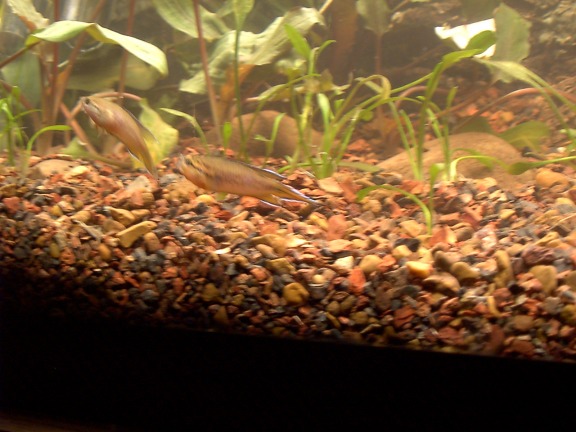
I also put my two P. dayi in the aquarium. With the strong lighting and the shortness of the plants the fish look very washed out when viewed from a distance. Hopefully the plants will grow upwards quickly and provide some shade. I'll probably be adding the B. titteya this weekend or early next week, depending on how patient I am. I want to give the crypts a chance to establish some root systems before adding too much Nitrogen to the system. It'd be nice to have it under a semblance of control from the beginning and not let the algae get out of hand.
I'm running into a hardware problem. The shunt on the adaptor I have for the filter to the spraybar is putting out a lot of current. This is putting a lot of pressure on some of the crypts below it. I'm waiting to see if there will be any negative side effects, or if the plants will be hardy enough to withstand the force. I'm going to hit the hardware store to see if I can find some sort of PVC plumbing adaptor that will work better.
 Saturday, June 1st, 2002:
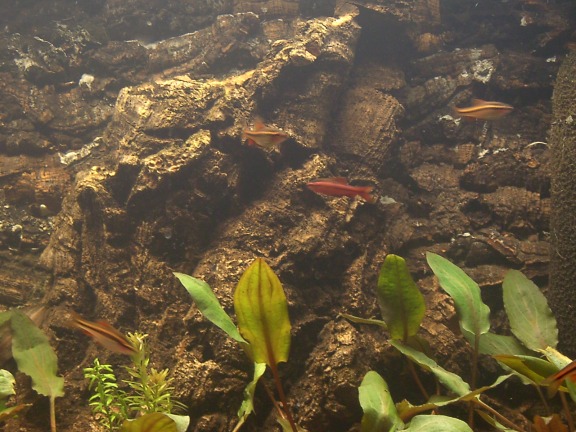
My patience ran out. I ended up going to the store and getting 8 Cherry barbs and 10 Ottocinclus. I'm still not too sure about having the otto's in there. Unfortunately, I'm not ever going to be able to find an algae eating species from this biotope, and otto's are the next best thing so I guess they'll stay. The male cherry barbs are strutting around right now in full regalia. They're absolutely gorgeous! I've had some beautiful males before, but these two definately take the cake. They're cherry red with dark markings and some stunning irridescence on their dorsal sides. The females have very good coloring too. I'm quite pleased with this batch.
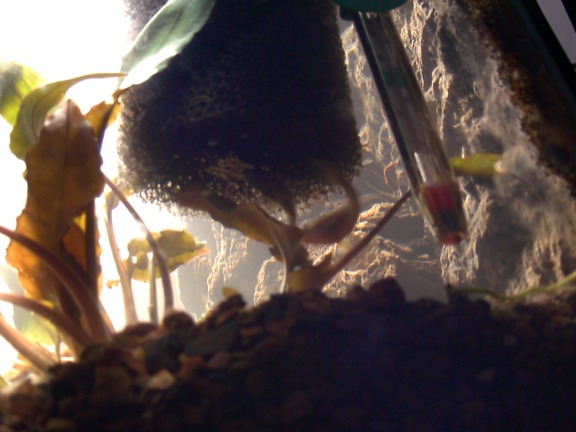
I almost got another pair of P. dayi too, but I couldn't tell if there were any females in the tank. Good thing I didn't! The P. dayi already in the aquarium ended up spawning tonight! I guess that answers the question as to if I had two males. I wasn't sure if the female was actually female, or just a poorly bred male. I may go back to the store on Monday on my way home to see if there is a pair left. I think I figured out the difference between the sexes. Unfortunately the fish haven't been able to figure out that the big black sponge is hooked up to a powerhead and thought that the bottom of it would be a perfect place for their bubble nest. It'll be interesting to see if anything comes of this spawning. If not, it's alright, I'm very happy to have been successful in getting them breeding in the first place.
It's a shame the news couldn't be all good. The crypts have started melting, slowly, and just a little here and there, but melting none the less. I really didn't expect to keep all the leaves, but it would have been nice to be able to keep them around a bit longer. I checked the water before turning the lights and CO2 on and the pH was about 6.5-6.7. Not too bad, just .1 or .2 off from yesterday afternoon. The hardness has gone way down though. If I can believe the test it's somewhere below 1 degree. I'll have to add more tap water to see if I can get it buffered a little better before turning out the lights.
Friday, June 14th, 2002It's been a while since I've updated my journal. Since my last entry I've added four stands of Cabomba and an unknown stem plant that looks an awful lot like Rotala indica. However, it's leaves are longer and the internodal length is longer than any Rotala i. I've seen or grown. It may be Didiplis diandre, which looks very similar to what I've got growing in my aquarium right now. The addition of these stemplants was to help use up excess nutrients and avoid an algae bloom. Ironically, I think it was these same plants, and some lax testing on my part, that contributed to a massive outbreak of green spot algae. At my last test my nutrient balances were way off. I've added a little Potassium Nirate to help rectify this deficiency. When I got home the plants had shot up at least half to three quarters of an inch while I was at work and the surface was covered in oxygen bubbles.
Monday, June 17th, 2002
After a good scraping and water change on Friday night I added one and a half 1/8th tsp scoops of KNO3 and the rest of my bi-weekly nutrient additives. So far I haven't seen any new growth of spot algae on the glass, but it's still on the plants. What looks to be the problem species now is "regular" green algae. It's growing all over in the substrate (most likely due to my adding fertilizer tabs in the beginning, big mistake) and lightly on the plants. I'm with the growth I've noticed it doesn't seem to be causing any problems with the plants, but it will kill any serious competition considerations.
I'm still working on finding a balance between nutrients and the plants. I'm also going to see if my LFS will go in on an order of C. japonica with me to lower the costs. Again, there goes my biotope! At least it will be algae free then. My goal is to eventually have the balance such that I won't need to have many algae eaters in there at all and that the plants will take care of it themselves with some help from me.
