Cell
Project
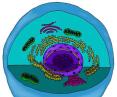
For my model of an animal cell I am
comparing it to
a train. That is my analogy. The eight organelles that I chose are the
nucleus, cell membrane, endoplasmic reticulum, mitochondria,
ribosomes, chromosomes, centrioles, and vacuoles.
For the nucleus I chose the head of the
train where
all the controls are. This is because the nucleus decides most of the
things that happen in a cell. If something happens in the cell, the
nucleus will know about it. In other words, many people refer to the
nucleus as the brain of the cell. The head of the train is where all
the controls are. That is where you can run the train, stop the train,
slow or speed it up and just control the whole train. In this way the
nucleus is the same as the head of a train.
The cell membrane would be the walls of
the train.
The cell membrane protects the things inside the cell and it controls
what goes in and out of the cell. If something is too big or the cell
doesn’t want the thing going in, it can stop the molecule.
The
walls of the train are like that because part of the wall has the door
on it so the walls protect the train and the people inside it and then
the doors control what
goes in and out of the train. If something is too big, it
can’t
get into the train because the door won’t get bigger.
The endoplasmic reticulum or the ER
transports
things to and from the cell. It’s also the packaging system
in
the cell. I am going to compare this to the food cart that goes around
the train. It goes around the train (the cell) and gives food to
people, plus the food is packaged up so it is like the packaging
system.
The chromosomes are the the organelles
that make the
cell what they are. They carry all the information that a cell needs to
live and grow and reproduce. I think that the best analogy for this is
the driver in the train. He knows how the train works and what he can
do to make it better, so he’s carrying all the
information.
The ribosomes make proteins and protein
chains. This
is like the train carts because the train carts are like one big
protein chain. The train carts are the protiens made by the ribosomes
and they are the ribosomes.
The mitochondria is said to be the
powerhouse of the
cell. It breaks down nutrients and combines the oxygen with the food to
create energy for the cell. The cell then uses this energy to do all
the activities it needs to do to keep themselves alive. The electricity
line that the train uses to run on is the best analogy for this cell.
The same way that a cell runs on energy broken down from the
mitochondria the electricity line is making energy for the train to use
to run.
Centrioles help the cell when the time
comes for it
to divide. This is the hooks that keep the train carts together. If the
train has to divide for some reason then the hook is lifted up and the
train splits, just like a cell. In this way the train hooks are similar
to the centrioles.
The last cell organelle is the vacuoles.
The
vacuoles are the storage bubbles in the cell. They store
food,
nutrients that the cell needs to survive. They also store the wastes
that are in the cell. This is like the garbage cans in a cell because a
garbage can stores waste and food ( nutrients) and other things as
well. They are usually by the bathrooms in the trains that go
a
longer distance. In this way the vacuoles are like the garbage cans in
the train.
I hope now you see how a train and a
cell are
similar if you look at the different functions and organelles of the
train they are both smiilar.