
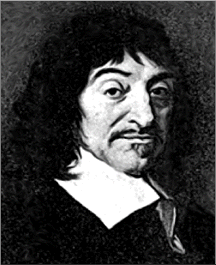
Behind Prison Walls: Independence and Isolation in the Writings of Rene Descartes and Jackson Browne
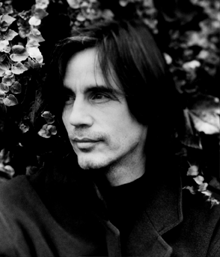
Jackson Browne, 1948-
Rene Descartes, 1596-1650
Here is an introduction to the paper. You may reach the full version by clicking on the link below. Thank you!

Two men, two art forms, four centuries and two continents apart, share the same problem. In Discourse on the Method of Conducting One's Reason Well and of Seeking the Truth in the Sciences, Rene Descartes defined Existentialism with his proof, Je pense danc je suis (I think therefore I am). For Descartes, the assertion of the independent will was essential in assesing truth, in knowing the difference between imagination and reality. Nearly four-hundred years later, American singer/songwriter Jackson Browne examines the same issues in songs like "I Thought I was a Child" and "The Road and the Sky."
Descartes' famous maxim is indeed a necessary precursor to all Cartesian metaphysics and, probably, the very grounding of modern Western thougt. Isolating the concept of "mind", that is, what the mind does and not what is in the mind, sets up Descartes' proof of God and the self, but does not seem to leave room for certainty of much anything else:
"Thus, because our senses sometimes decieve us, I wanted to suppose that there would not be anything that were such as they have us imagine it to be. And, because there are men who deceive themselves in reasoning, even concerning the simplest matters of geometry, and who there commit paralogisms, judging that I was as prone to err as any other, I rejected as false all the reasonings that I had previously taken for demonstrations. And, finally, considering that all the same thoughts that we have when we are awake can also come to us when we are asleep, without there being any of them, at that time, to be true, I resolved to feign that all the things that had ever entered my mind were no more true than the illusions of my dreams." -- Descartes, Discourse
And so Descartes hedged his bets and decided to treat every sensory impression he received as if it were a dream. After all, how is one to know whether or not our lives are other people's dreams? It is possible, is it not, that we are all brains in vats, electrical impulses being sent into out synapses by some mad scientist? These questions of perception vs. reality are still quite current to contemporary thinkers. Jackson Browne has explored fear and doubt about this issue in a number of songs:
"I thought that I was free, but I'm just one more prisoner of time, alone within the boundaries of my mind." -- I Thought I was a Child
"I spend my time at the bottom of a wishing well,
and I can hear my dreams ringing clear as a bell
I used to know where they ended and the world began
But now its getting hard to tell." --The Road and the Sky
Browne, in the first quotation especially, seems to have the same realization that Descartes so carefully stumbled upon. The mind does in fact seem isolated in its very nature.And it is a frightening prospect. Ultimately, it is not the idea of independence, but of total isolation that seems the most daunting.
Is it hopeless? Probably not.
"I wanna say right now
I'm gonna be around
When the walls and the towers
Come tumblin' down." --Jackson Browne, "The Fuse"
Click Below to read the full paper:
Jackson Browne Unofficial Home Page: Everything you'll ever need to know!

