GREATER
MIAMI HILLEL
THE STAFF AND
THEIR ROLES
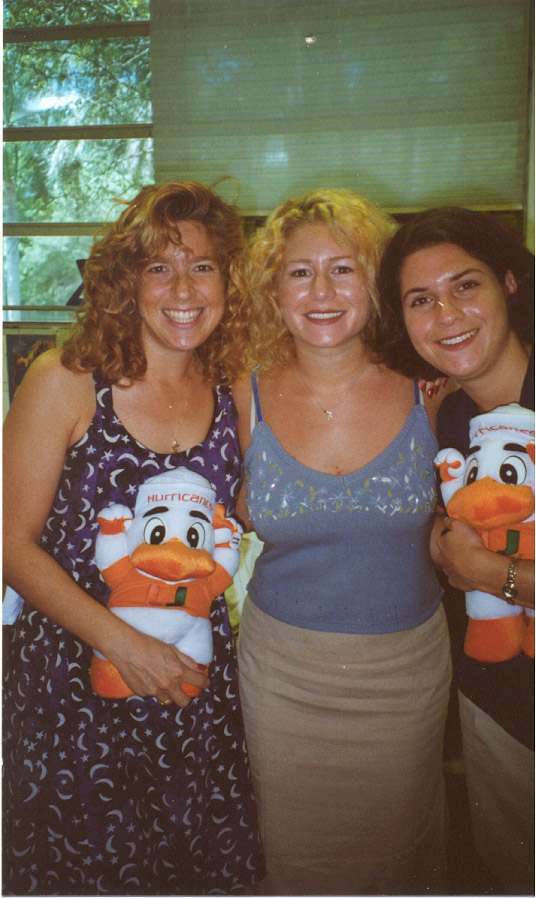
(Tamara,
Jamie and I)
Linda
Skolnik is our new Executive Director.
She came to us from the Jewish Community Center (JCC) in Dallas, where
she gained lots of experience working as a programmer and developer.
We’re so glad to have her join us!
She is responsible for our fundraising and development, as well as staff
supervision.
Jamie Kaminetsky is our Program Director.
She supervises the Jewish Student Organization and their programming.
They do all kinds of social, religious, educational and philanthropic
programs. Jamie attended UM
as an undergraduate student and she has worked as a Program Director for Greater
Miami Hillel for two years. She
knows a great deal of information about the University of Miami and what it is
like to be a student here.
Tamara Lustig is our Israel Program Director.
We are one of only two campuses in the country fortunate enough to have a
position like this! Since Tamara
started working for Greater Miami Hillel a year ago, she has arranged two
Birthright trips to Israel. She is
responsible for recruiting students for the trips, orientating them to Israel,
and following up with them once they return.
She also organizes cultural and educational programs on campus which
relate to Israel. She has brought
several speakers to campus and coordinated a huge Israel Independence Day Fair
for Yom Ha’Atzmaut.
Isabel Montoto is our Office
Manager. She’s been here for
three years now and she keeps this place in order.
She has two Administrative Assistants who work part-time to help her out:
Noelle who is a student at Florida International University (FIU) and
Linda Montoto (who is also Isabel’s daughter).
Angel, a Cuban Jew, comes in a few days each week and helps with the
maintenance of the building.
The
staff members here are incredibly warm, approachable and friendly.
They are very supportive and being able to work with them is one of the
best parts of the job!
THE STRUCTURE OF HILLEL
The purpose of Hillel: The
Foundation for Jewish Campus Life is to provide Jewish students the opportunity
to explore and celebrate their Jewish identity.
Hillel’s mission is to maximize the number of Jewish students doing
Jewish with other Jews. It
seeks to engage uninvolved Jewish students and to empower involved students to
become leaders in the community. The
organization is dedicated to a pluralistic vision of Judaism.
Hillel’s International Center,
located in Washington D.C., has established a network of over 500 regional
centers, campus Foundations and Hillel student organizations.
They have granted Foundation status to 120 Hillel Foundations in the
United States, Canada, Israel, Europe, the United Kingdom, Australia, South
Africa and the states of the former Soviet Union. The
International Center is a resource that helps with fiscal administration,
student programming, and communication. The
center provides leadership, administrative supervision, national accreditation,
national conferences, professional training and development support for Hillel
Foundations, Regional Centers and other Hillels throughout the world.
Hillel’s Center for Jewish
Engagement (CJE), located in Los Angeles, is a major resource for fellows.
The CJE facilitates communication between fellows through emails and
conference calls. They have also
set up an online program exchange which is a useful tool for finding clever and
creative new programming ideas.
Rhoda
Weisman is the Senior Director of Creative Development, Director of the CJE, and
Director of the Jewish Campus Service Corps (JCSC).
Melanie Sasson-Gruenwald is the Assistant Director of the CJE.
While Greater Miami Hillel is
located on the University of Miami campus, it also
serves the students of Florida International University (FIU) as well as
other smaller schools. As the
University of Miami Fellow, I worked specifically with the University of Miami
students. However, the other staff
members in the office divide up their time amongst the different campuses.
ENGAGEMENT VS.
EMPOWERMENT
The fellow’s primary goal and
responsibility is what we call refer to as “engagement.”
Engagement is what we do when we reach out to students who are not
already active in Jewish life on campus.
The fellow is expected to meet students “where they are at” (meaning
the residence halls, university center, Greek houses, etc.).
In order to meet and interact with the greatest number of students, the
fellow should to be out of the Hillel building and on campus as much as
possible. Rather than waiting for
Jewish students to come to Hillel, the job of the fellow is to go out on campus
and bring Jewish life to them. Fellows
can engage new students by tabling, programming, or simply by meeting someone
new and having a one-on-one conversation with them.
Once students are engaged in
Jewish life on campus, they may become “empowerment students.”
When we empower students, we take students who are involved in Jewish
life on campus and develop them into student leaders. Empowered students are those who take ownership of
programs; they take on the responsibility of planning events and following
through with them.
The JCSC works primarily with
engagement students; the Program Director generally works with the empowered
student leaders.
RESPONSIBILITIES
Tabling:
Tabling is just like it sounds; fellows stand in front of a table with
candy, activities, or other miscellaneous items that look enticing and relate to
Judaism in order to encourage new people to come and talk to them.
Programming:
The fellow works with students who have typically been uninvolved in
Jewish life on campus to create programs that appeal to them.
Programs may or may not relate to Judaism; they can just be social.
The fellow is expected to think out of the box and to take risks to
create programs that appeal to different students.
One-on-One Conversations: Fellows are expected to meet as many new people as possible
and to engage them in one-on-one conversations.
This helps us get to know students on a more personal level and establish
a close relationship with them. After
meeting someone new, it is my responsibility to follow up with that person,
either through a phone call or by meeting them for coffee or lunch.
Jewish Learning:
Each fellow is entitled to one hour of Jewish learning a week.
This allows for intellectual growth in whatever area of interest the
fellow has. For my Jewish learning,
I chose to audit two classes (one per semester) on Judaism taught at the
University of Miami.
Communication with the rest of
Greater Miami Hillel: The Greater
Miami Hillel staff works as a team. We
work with each other rather than against each other.
It is very important that we communicate with each other and keep each
other informed. We do this through
our bi-weekly staff meetings and emails.
Communication with the CJE: Fellows
are expected to submit monthly reports as a way of recording their progress,
successes and challenges. They are
expected to participate in monthly conference calls as well. These calls are facilitated by a member of the CJE.
Professionalism:
The
fellowship allows you to be back on a college campus but instead of being a
student you have the responsibility of a working professional.
It’s always important to keep in mind that the actions you do and
statements you make will be taken as a reflection of the organization you work
for.
DRESS
Hillel’s Center for Jewish
Engagement looks to hire recent college graduates to become fellows because they
are the people college students are most likely to relate to.
You are allowed to come to work wearing jeans, shorts, and casual
clothing because they want to allow you to be able to blend in with the
students.
SUPERVISION
Fellows are expected to meet
with their supervisors once a week to discuss successes, challenges, goals and
concerns. Supervisory sessions give
fellows the opportunity to ask questions, learn
and grow. These sessions are
most beneficial when you are open and honest about how you are doing.
Your supervisor will help you be the best you can be at your job and make
and impact on the maximum number of students possible.
My supervisor has been Linda
Skolnik, our Executive Director. Linda
is extremely warm and approachable; she
is a great listener. She
often keeps her door open, giving me the opportunity to consult with her about
issues as they arise.
RESOURCES AND PARTNERS
The Residential Colleges: There are five Residential Colleges (or dorms) at UM:
Pearson, Mahoney, Stanford, Hecht and Eaton.
All of them house both first year students and upperclassmen.
Fraternities and Sororities:
There are eleven fraternities in the Interfraternity Council and six
sororities in the Panhellenic Association.
Some of them have a greater concentration of Jews than others, however
they all have some Jewish students in them.
Hebrew Union College: A representative from HUC came to campus and helped us reach
out to students interested in the Reform movement.
Koach:
Our campus has a Koach fellow who helps us reach out to students
interested in the Conservative movement.
Chabad-Lubavitch:
The Chabad House of Coconut Grove has helped us with various activities
and holiday celebrations. They
organized a giant Menorah lighting on campus for Hanukkah and invited our
students to their Megillah reading and Purim celebration.
American Israel Public Affairs
Committee (AIPAC): AIPAC’s
Southeast Field Coordinator made a couple of visits to our campus, helping us
reach out to students interested in learning more about the conflict in the
Middle East and ways they can help support Israel.
The Consulate General of Israel:
The Consulate General helped us multiple times throughout the year,
informing students about the history of Israel and the peace process.
United Jewish Communities (UJC):
Hillel was able to hire two students to be UJC interns and help us plan
Bid for the Bachelor, our biggest fundraiser for the year.
We were able to raise $1800 to donate to the UJC.
The Holocaust Memorial on Miami
Beach: The staff at the Holocaust
Memorial gave us resources that we used for our Yom HaShoah commemoration.
ON CAMPUS
JEWISH ORGANIZATIONS
The Program Director oversees
several student organizations. It
can be very helpful to work with students in these organizations towards the
goal of engaging new students:
The Jewish Student Organization
(JSO): JSO organizes social,
religious, educational and philanthropic programs.
Their programs primarily target undergraduate students. Most of their programming money comes from Hillel, but they
get some additional funding from SAFAC (which is the University of Miami’s
Student Activity Fee Allocation Committee).
Jamie is their adviser.
Jewbilee:
This Jewish singing group was put together this past year.
They frequently perform during Shabbat services.
They often get together to practice at Hillel during the week.
The Jewish Volunteer Team (JVT):
JVT organizes volunteer opportunities both on and off campus.
They have made food donations and taken trips to the Humane Society. Jamie is their adviser.
MiamiPac:
MiamiPac is the University of Miami student group affiliated with AIPAC.
They educate the Miami student body about the conflict in the Middle East
and teach students ways they can help support Israel.
Tamara is their adviser.
Cardozo:
Cordozo legal society organizes social, educational, and philanthropic
programs for law students. They
have had several educational speakers come over the past year.
They have also organized several very successful Happy Hours.
Maimonides:
Maimonides is the medical school group. They were not very active this past year.
Since the medical school is on a different campus, they are harder to
reach out to. But it would be great
if we could develop a stronger relationship with the medical school students in
the future.